

In the early subscription economy - gym memberships, cable bundles, early SaaS - the cancellation process was an intentional wall, and an obstacle that was stopping users from leaving. The logic was simple: if leaving is harder than staying, people tend to stay - the company keeps protecting ARR. Nobody asks what went wrong.
For a long time, it worked. Primarily on monopolistic markets - cable, telephony, gyms - there were no real alternatives, and people badly needed at least some product. You couldn’t leave Comcast for a better provider if Comcast were the only wire running to your building.
And you couldn't cancel Amazon Prime without navigating what engineers internally called the Iliad Flow - a four-page, six-click, fifteen-option sequence designed not to let you cancel, but to stop you.
That, after lasting long, thankfully, has changed - the shift happened when switching costs dropped to zero. Once competition became very diverse and more alternatives appeared on the market, users started having somewhere else better to go. The energy required to cancel was less demanding than the energy required to stay frustrated. Companies that spent decades building walls instead of reading signals found themselves with a retention strategy, but no retention intelligence.
That’s the structural problem the Retention Wall always contained. It was optimised to prevent departures. It was never designed to understand them.
About this newsletter
I’m Daria Littlefield. I spent a decade running customer operations across 35+ dating and social apps - the kind people delete in a rage and reinstall a week later. That taught me more about why products lose users than any framework ever could.
Do Not Churn is where I put that to use. Every week I break down the retention mechanics behind the products we all use - what keeps people, what loses them, and why the difference is rarely what you’d expect.
If that’s useful to you, subscribe below. If you have a take on whether AI can actually replace a marketing team - drop it in the comments.

The Retention Wall - optimised for what I’d call defensive capture, and it worked, for a while.
Amazon Prime’s cancellation process was so architecturally complex that it had an internal code name: The Iliad Flow.
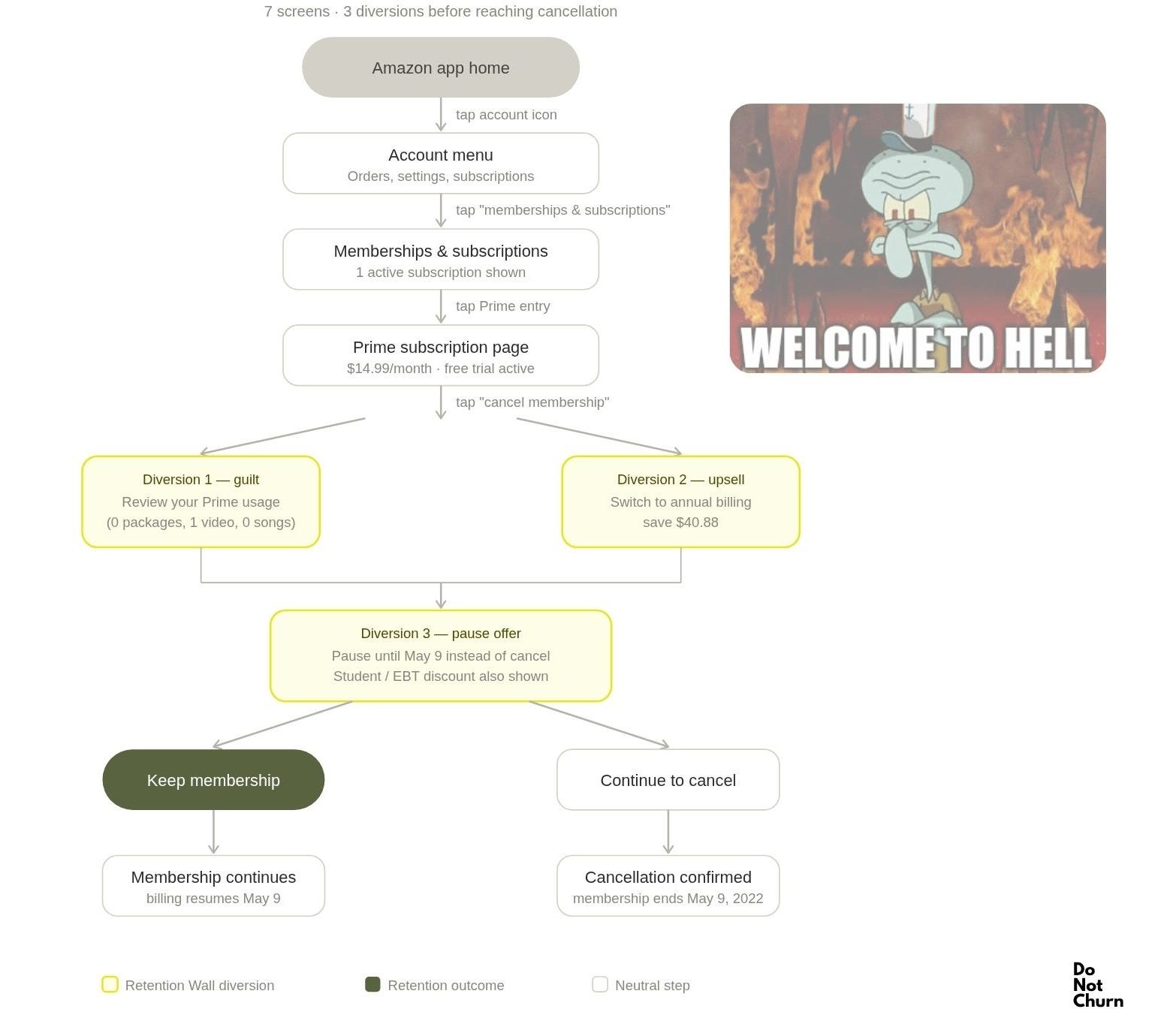
The reference to a 10-year siege was not ironic - it was descriptive. Users who located the cancellation page were redirected through multiple screens offering discounts, free months, and the option to “pause” instead - each one a diversion, not a path forward. The FTC described it as a four-page, six-click, fifteen-option sequence. Internal Amazon data showed that the flow reduced cancellations by 14%. That number was not a warning sign. It was the point.
The FTC sued in 2023. Three days into trial in September 2025, Amazon settled for $2.5 billion - including $1 billion in civil penalties and $1.5 billion in consumer refunds. Three senior executives were named personally. Internal emails presented at trial showed that engineers had flagged the cancellation features as confusing, and that those simplifications were rejected by leadership because they adversely affected Amazon’s bottom line.
Why it doesn’t work
1. The critical structural weakness of the Retention Wall is that the only metric it generated was “cancel/stay.”
Whether the user stayed because they saw value or because they gave up trying to leave was invisible. Companies accumulated almost no behavioral intelligence about why users were leaving or what they needed differently. Aggregate churn rate was the only visible signal. The wall looked like it was working right up until it wasn’t.
2. ‘The Wall’ begins to fail the moment an alternative exists.
Once a user has somewhere better to go and enough frustration to get there, friction becomes aggravation - and aggravation accelerates departure rather than delaying it. The Retention Wall’s churn risk isn’t at the door. It’s in the years of product signals the company never received, and the retention infrastructure it never built, because the Wall seemed to be working.
3. Any dark pattern kills trust that you’ll never gain back
This is the most valuable currency that is reflected across a several metrics, yet it’s hard to measure it purely. But, despite of the, it’s very clear that if you lose users trust - they would hardly ever recommend you to any of their friends; they would never come back, even if they need will reoccur.

The Signal Reader - optimised for what I’d call intent-aligned departure, and this is the new standard.
Lovable is an AI-powered app builder that hit $75M ARR in seven months and $400M ARR by March 2026 — one of the fastest-growing products of the vibe-coding era. Its growth was extraordinary. Its retention challenge was structural: the product creates something you build, not something you keep building every month. Users who finished their main project had no obvious reason to keep paying full price.
The cancellation data surfaced the same response over and over. Too expensive. Standard Retention Wall instinct would have offered a discount. Lovable’s Head of Growth, Elena Verna, asked a different question: expensive relative to what the user is doing right now?
The answer: users who had finished building didn’t need credits. They needed to keep their project alive - the custom domain, the private project, the paid features that kept their work from expiring. They weren’t leaving because Lovable had failed them. They were leaving because Lovable only had one pricing tier for a user whose job had changed.
The response was a $5/month Lite Plan - access to paid features, no additional build credits. Not shown on the main pricing page. Surfaced only inside the cancellation flow, for the specific cohort of users whose behavior matched the pattern.
Elena Verna broke down the full test - including why $5 beat $10 and $15 - in her newsletter: We stopped forcing the subscription model on our users. Here's what happened.
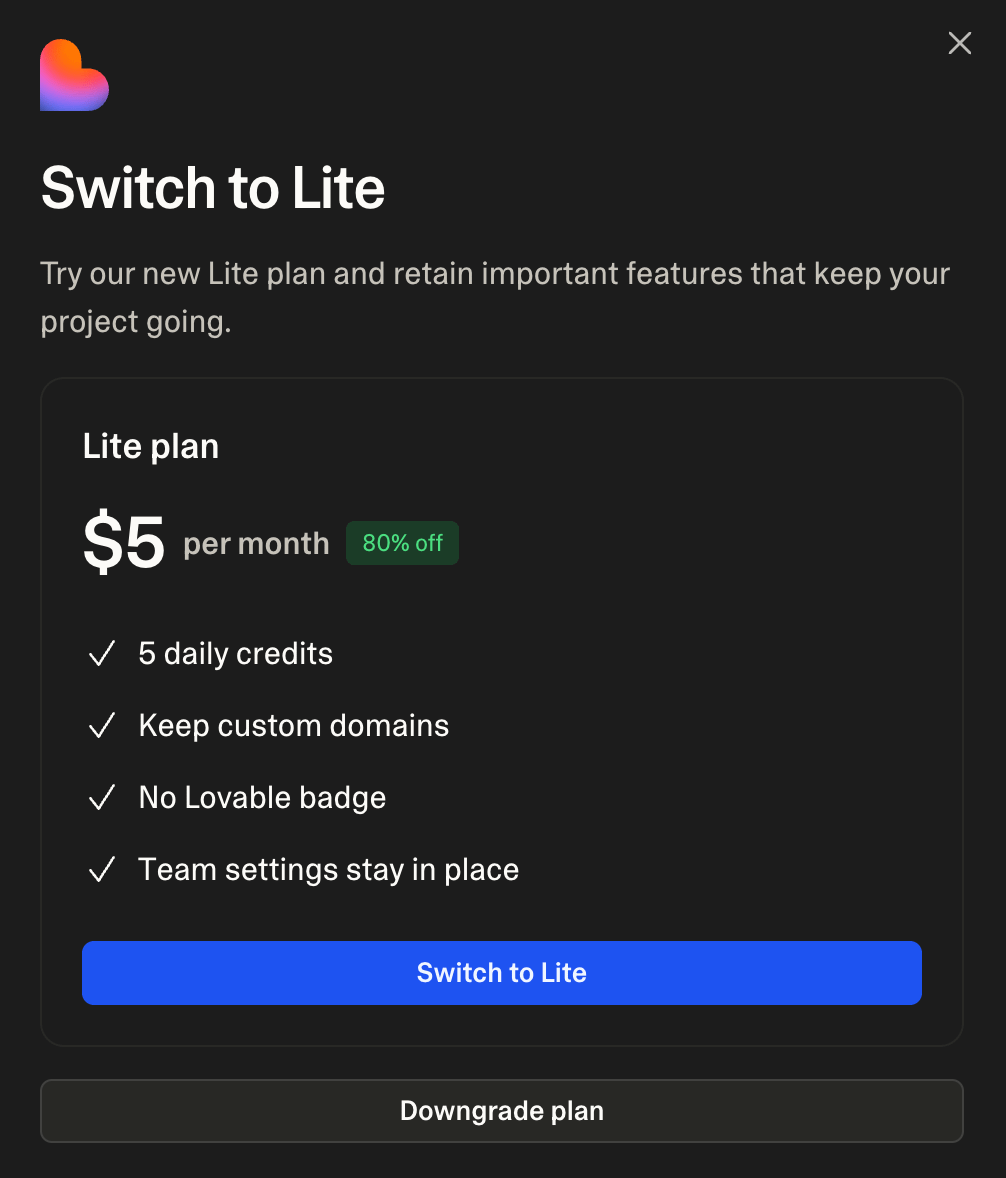
Lovable nailed that cancellation data is not a signal to suppress - it’s a product research instrument. The Lite Plan wasn’t a retention hack. It was a product decision made possible by reading what “too expensive” actually meant in behavioral context. That’s the structural difference: The Retention Wall treats “too expensive” as an objection to overcome. The Signal Reader treats it as a question to answer.
The additional mechanics Lovable built from this same philosophy: credit rollovers, daily free credits, in-product payment failure alerts (50% improvement in recovery rate over email-only), and ad hoc top-ups that produced a 7% lift in overall retention. Each one came from the same starting position — what is this user’s behavior telling us, and what does the product not yet have a response for?
Churn watch: Lovable’s residual churn risk is the user who builds one thing and doesn’t know what to build next. The Lite Plan addresses the user who has finished building. It doesn’t yet address the user who lost momentum - that’s closer to an activation and re-engagement challenge than a pricing one.

The Re-entry Designer - optimised for what I’d call relationship preservation, because it understood something Amazon didn’t.
Netflix studied its re-subscription cohort data and found something that looked, on the surface, like a churn problem but was actually something else entirely. Roughly 50% of users who cancelled eventually returned. They weren’t leaving because Netflix had failed them. They were leaving because they’d finished watching their current series, had nothing they wanted to watch right now, and were paying $15+ a month for a service they weren’t actively using.
That’s not a dissatisfied customer. That’s a seasonal one.
The insight reframed the entire retention problem. If the user is going to come back anyway - and the data said they would - then the job isn’t to prevent the cancellation. It’s to make the return as frictionless as possible, and to ensure that the relationship survives the gap intact.
Netflix’s response was structural. Pause functionality: billing suspended for up to three months, full access preserved, one-click resume.
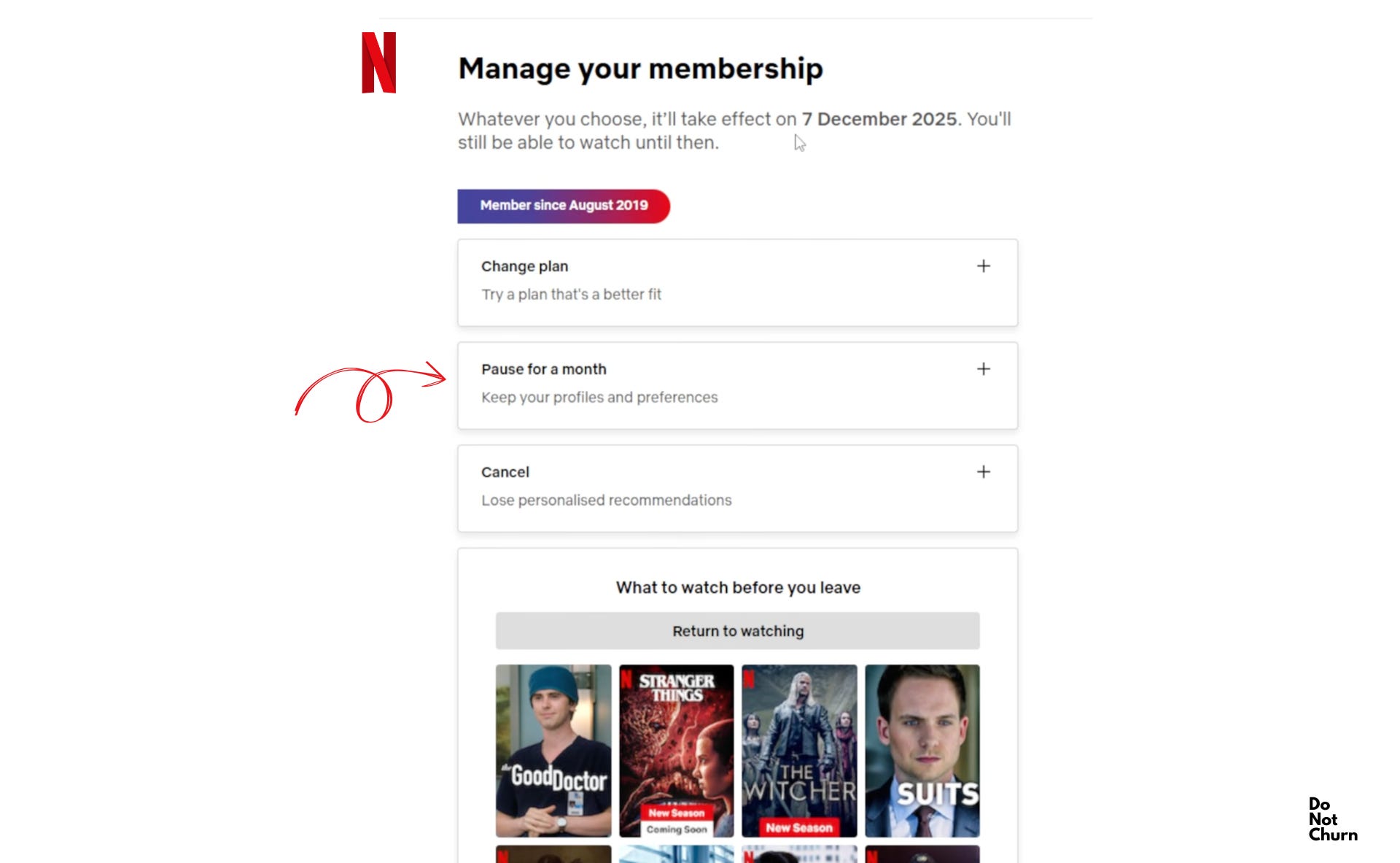
Account preservation after full cancellation: watchlist, viewing history, and preferences stored for ten months. When a user returns, they arrive back into their own account - not a blank slate that makes re-entry feel like starting over.
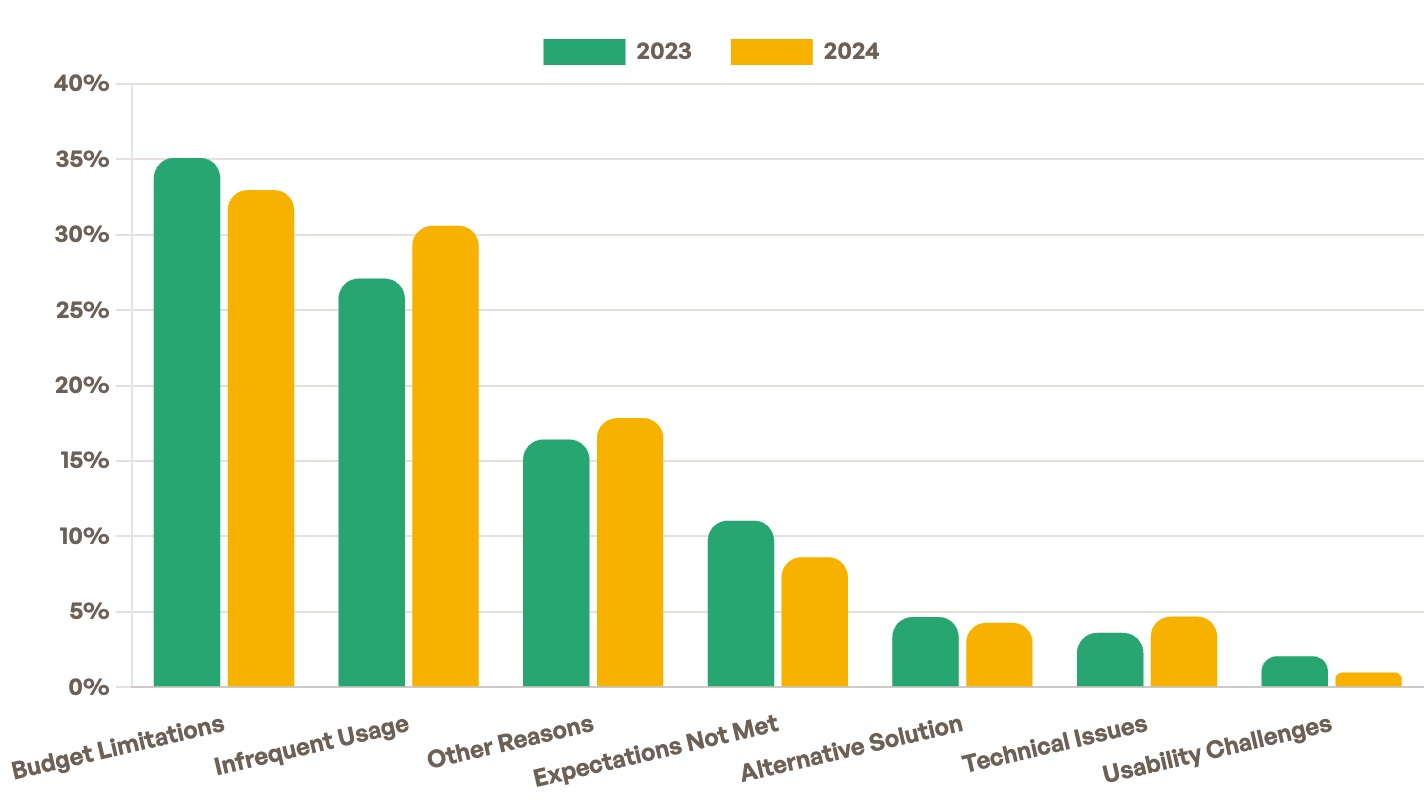
One of the churn problems consists of the fact that the customer doesn’t fit into any of the created categories with his usage patterns and with what he thinks is valuable for him.
According to Churnkey, the insufficient usage is second-highest cancellation reason
Subscription products didn’t converge on a single retention philosophy — they split along lines of belief.
Churn emerges when a product’s retention mechanics contradict its retention values - when a company says it cares about customers and then makes them navigate an Iliad Flow to leave.
In subscription retention, trust grows when departure is as easy as arrival — and the product learns something from every decision either way.
A subscription remains worth paying for only if the company knows what it’s worth to the specific person paying for it right now.
Key takeaways
Subscription products compete on whether they can learn from departure - not on how hard they make it.
The Retention Wall worked in low-competition, high-switching-cost markets. When alternatives appeared, it had nothing left.
Amazon’s $2.5B FTC settlement is the invoice the Retention Wall eventually sends.
Lovable’s Lite Plan is what happens when “too expensive” is treated as a behavioral question rather than a pricing objection.
Retention follows intent alignment. Churn begins when the product stops having a response for where the user is in their journey — and the Retention Wall, by design, never had one.
If you liked this article, read these next:
Search to Swipe: what three decades of dating apps reveal about customer experience and churn - How engagement-first design rewarded motion over outcomes, and accidentally trained users to disengage.
Why AI note-taking tools no longer compete on features - Instead, they compete on intent: preserving decisions, building understanding, or capturing ideas before they disappear.
From swipe fatigue to IRL: Inside the apps racing to get you off your screen - The products building genuine connection - and why their churn profile looks completely different.
Why buying a plane ticket feels harder than it did 30 years ago - How flight booking evolved from delegated trust to endless comparison, and what the best products do differently.
Is app-of-apps becoming the new interface for work and life? - The six retention mechanisms that make daily assistants impossible to leave.