

The math stopped working somewhere around 2022.
Users were swiping more - averaging 90 minutes per week on Hinge alone - but matching less. Conversations were starting (barely) but dying in under four messages. Apps kept adding features: video prompts, voice notes, AI-powered icebreakers. Engagement dashboards looked healthy. Revenue was up. But in focus groups, the same phrase kept appearing: “I’m exhausted.”
In my previous analysis of dating app evolution, I traced how we got here - how swipe-based mechanics accidentally trained users to treat dating as lightweight consumption rather than intentional connection. The core finding: when effort doesn’t visibly compound toward outcomes, users slowly disengage.
The disconnect driving this shift isn’t subtle. According to Forbes Health Survey, 76% of Gen Z dating app users reported feeling emotionally, mentally, or physically drained from the platforms designed to help them connect. Meanwhile, the WHO declared loneliness a public health crisis carrying the same mortality risk as smoking 15 cigarettes per day. The US Surgeon General called it an “epidemic.” In the UK, 67% of university students living in halls reported feeling isolated - despite being separated from peers by paper-thin walls.
As Zara Zaman writes in her essay on the loneliness epidemic, “It’s never been easier to get what you want and harder to figure out if you actually wanted it in the first place.”
Dating apps had delivered on their original promise: access. But somewhere between infinite choice and meaningful connection, the product broke.
Now, a new category is emerging - one that flips the core assumption. Instead of maximizing time-on-app, these platforms measure success by how quickly they get you off the app and into real space with real people.
Zaman calls it JoyTech: technology designed not to capture attention, but to catalyze presence.
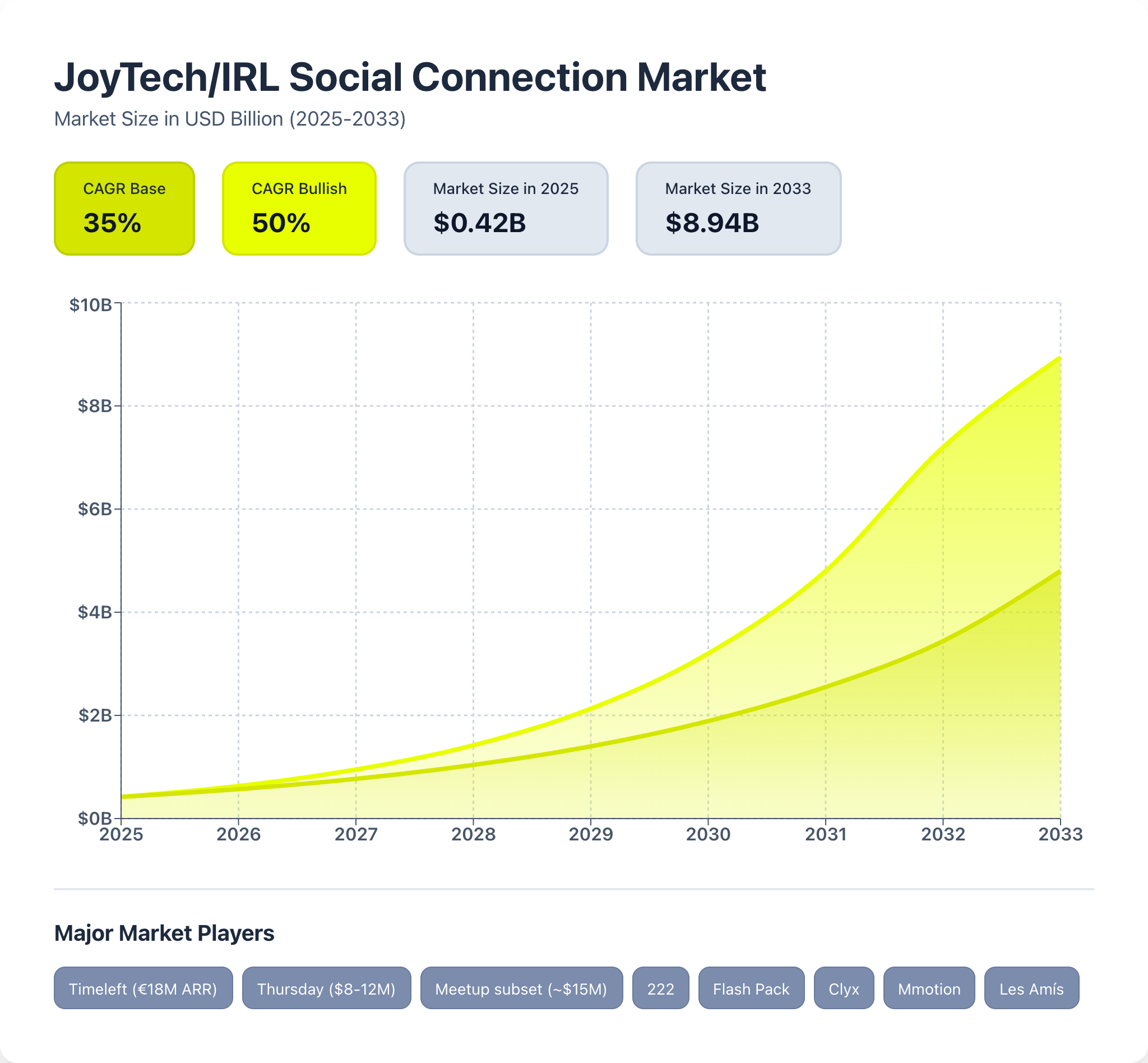
Market at a glance: The JoyTech/IRL Social Connection market is an emerging category without formal market research from established firms. The 2025 baseline ($420M) aggregates revenue from Timeleft (€18M ARR, founder-stated), Thursday ($8-12M estimated from event attendance), and 15+ emerging platforms.
Growth scenarios derive from: (1) Timeleft's demonstrated 20-month trajectory (0→€18M), (2) comparable category growth patterns (dating apps, food delivery, rideshare during early phases), and (3) TAM validation against 300M people globally with zero close friends (CU Independent study). Base case mirrors early dating app adoption; bullish scenario assumes multiple accelerants (corporate wellness, institutional funding, Asia-Pacific expansion).
If anything, it’s not nostalgia for pre-digital dating, but a recognition that the hard problem was never “how do I see more profiles?”, but “how do I spend my limited time with people who matter?”- a coordination problem at scale that digital matching alone cannot solve.
The three platforms profiled here represent different answers to that question - and early proof that the post-swipe era is already generating millions in revenue.

Hinge launched in 2012 as a Facebook-connected dating app where you could list which friends you had crushes on. Cool idea, but idn’t scale. By 2015, it looked like every other swipe app - and Nancy Jo Sales’ Vanity Fair piece “Tinder and the Dawn of the Dating Apocalypse” put a target on the entire category.
Founder Justin McLeod took Hinge off the app store entirely to rebuild. When it relaunched in 2016, the tagline was a dare: “The dating app designed to be deleted.”
It wasn't just a marketing pivot. The product architecture changed. Limited daily likes forced intentionality. Profile prompts ("Two truths and a lie," "A life goal of mine") gave conversation starters that went deeper than "Hey." The "We Met" feature explicitly tracked whether matches led to actual dates - then used that feedback to improve future recommendations.
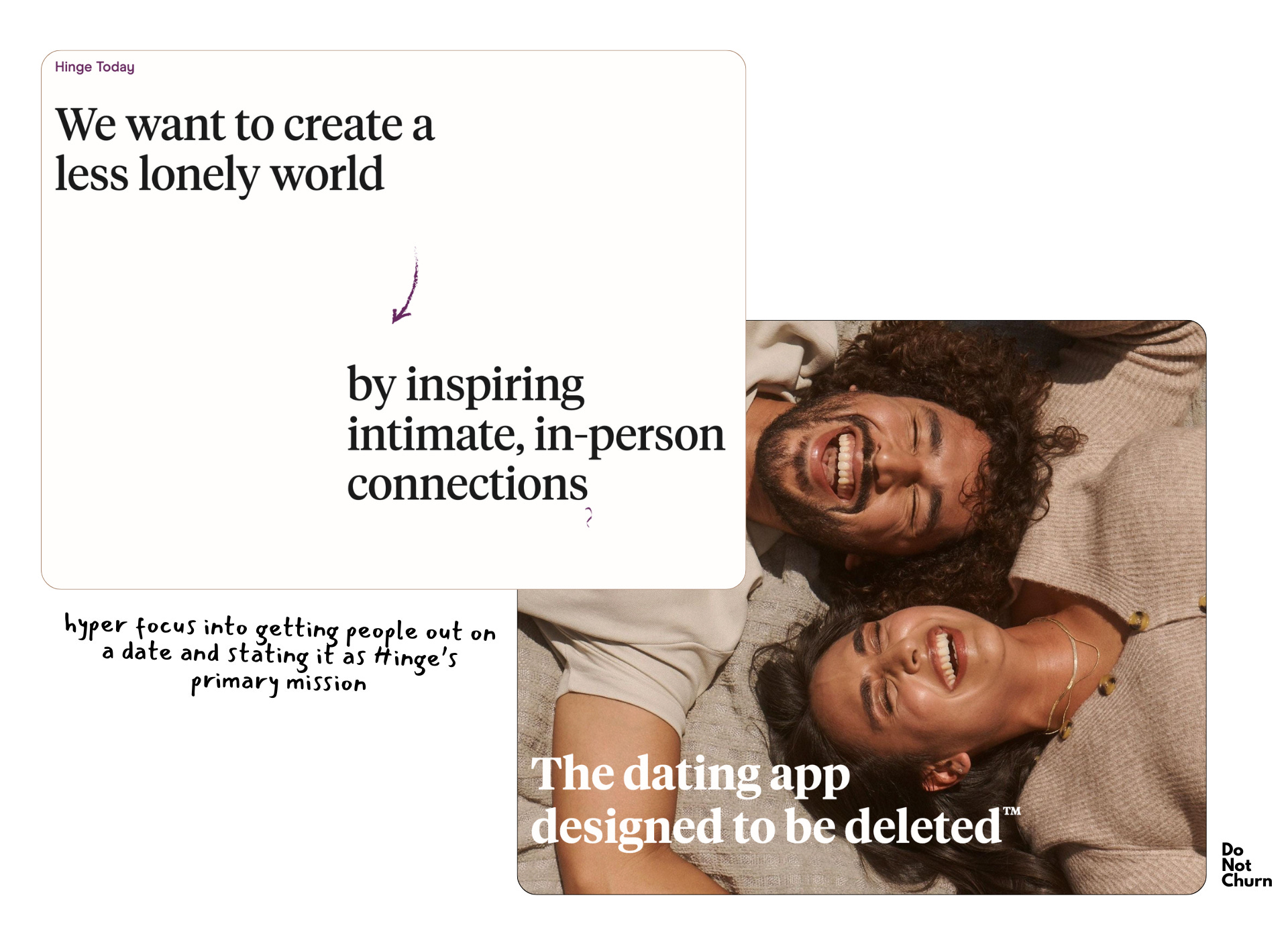
Today: 30 million users, $550 million in 2024 revenue (up 38% year-over-year), #3 in the US (18.75% market share, behind Tinder and Bumble but fastest-growing of the big three), and #1 in the UK, Ireland, and the Nordics (Business of Apps).
Primary intent: Serious relationships
Job it does:
"I'm tired of conversations that go nowhere. I want to know if we're actually compatible before investing an hour getting ready for a date that crashes in the first five minutes. And if this works... I want to be done with apps entirely."
It translates to:
✔️ Signal over noise (profile prompts reveal personality, not just photos)
✔️ Friction as filter (limited likes = users take each match seriously)
✔️ Outcome tracking (We Met feature closes the feedback loop)
✔️ Proof of success (35% of couples married via dating apps in 2023 met on Hinge - beating Tinder and Bumble)
Best user: •Deliberate romantics who read profiles, not just photos • Efficiency maximizers tired of texting-for-weeks-then-ghosting • Users who want algorithms to do the filtering so conversations can start deeper

In May 2023, Maxime Barbier and his co-founders were nearly out of money and ideas. They’d pivoted three times - social bucket lists, event discovery, networking for remote workers - and nothing stuck.
“One last try,” Barbier told his team. What if they stripped away everything - no profiles, no photos, no DMs - and just got people to show up for dinner?
They built a Typeform quiz, a WhatsApp group, and a Stripe payment link. No app. No code. If five strangers paid €10 each to have dinner together on Wednesday night, Timeleft would book a restaurant table and send the address that morning.
The first dinners sold out in hours.
Today, Timeleft operates in 200+ cities across 50 countries, connects 150,000 people per month, and generates €18 million in annual recurring revenue.
(check out this outstanding article breaking down Timeleft growth in more detail by Timothe Frin )
Primary Intent: Make friends
"I want to meet people who might become real friends, not just matches. I want a low-pressure conversation with a built-in structure so it's not awkward. I want to try this once without committing to weekly therapy sessions or expensive hobby classes. And if it works - I want it to be a standing Wednesday thing I don't have to coordinate myself."
As Zara Zaman observed in her loneliness essay: “The hardest part is rarely meeting someone brilliant. It’s spending enough time near them to notice that they are. To see the quiet ways their presence could change your life.”
Timeleft’s insight was that a three-hour dinner forces that time investment upfront, in a group setting where the stakes are lower but the exposure is deeper.
It translates to:
✔️ Group dynamics over 1-on-1 pressure (6 strangers = diffused attention, easier to be yourself)
✔️ Personality matching without photos (algorithm uses Big Five traits, age, language, budget - optimizing for conversation chemistry)
✔️ Structured spontaneity (you book, they handle logistics, you just show up)
✔️ Repeatability (weekly cadence builds habit; €10-15/week sits below "night out" threshold but above "commodity subscription")
Best user:
• Deliberate romantics who read profiles, not just photos
• Efficiency maximizers tired of texting-for-weeks-then-ghosting
• Users who want algorithms to do the filtering so conversations can start deeper
Churn watch: The risk metric isn’t first-dinner no-shows (those are low at ~8%). It’s second-dinner attendance.
If users don’t return within 3 weeks, they likely never will - the experience was fine but not habit-forming. Timeleft needs 50%+ of first-timers to book again within 30 days to sustain growth.
Another watch-out: restaurant dependency. If quality control slips - slow service, bad food, noisy venue - it worsens the entire experience. Timeleft can’t afford more than a 5-10% “bad dinner” rate or word-of-mouth flips negative.
If retention holds, lifetime value is massive. A user who attends 2 dinners/month for 18 months = €360 revenue per person at near-zero marginal cost.

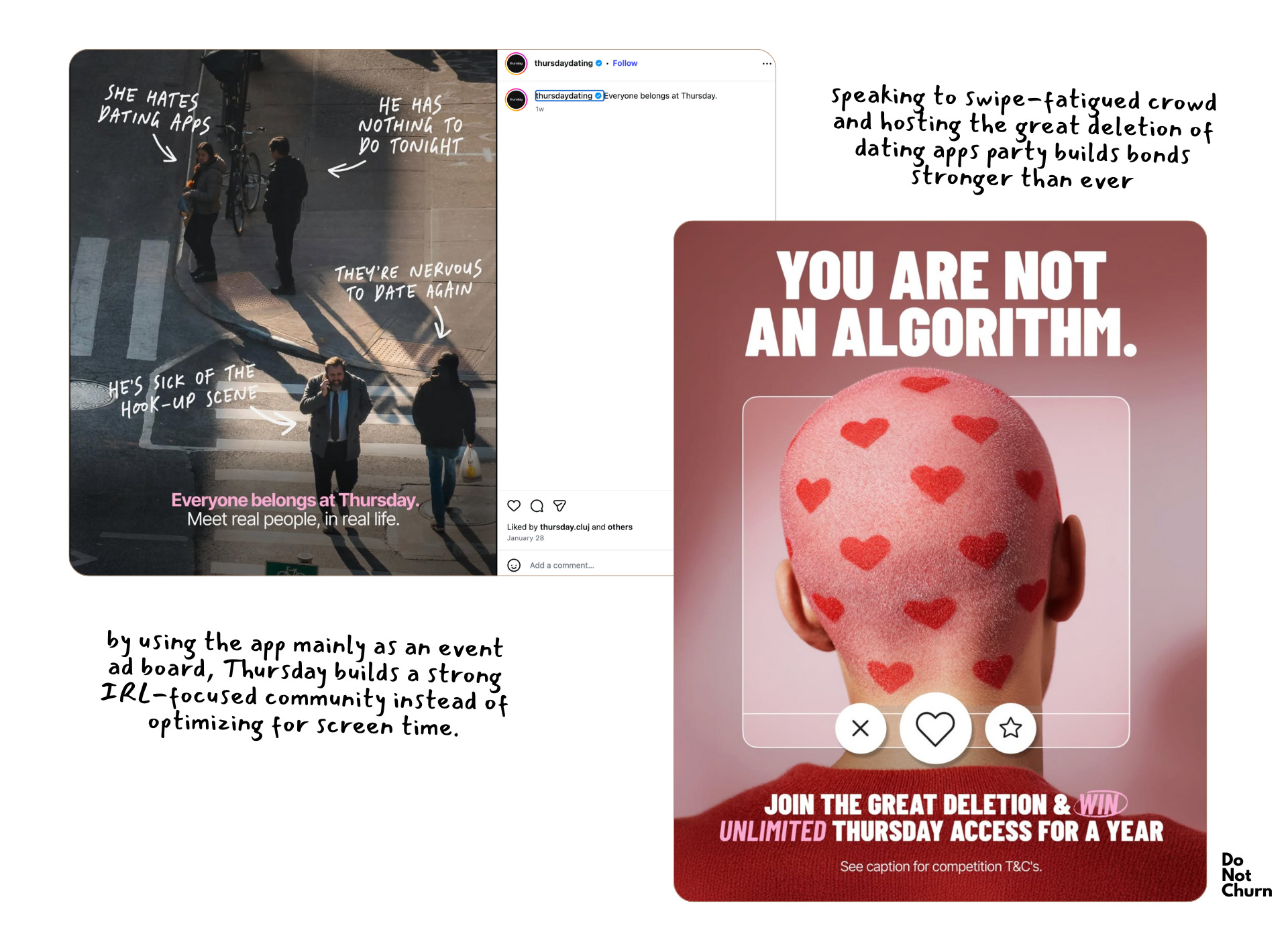
Thursday launched in 2021 with a provocative constraint: the app only worked on Thursdays.
Your matches disappeared at midnight. Conversation threads vanished. The idea was to create urgency - stop endless chatting, start an actual meeting. Investors loved it. Early adopters thought it was clever. Within 24 months, Thursday hit 2 million users and raised £2.5 million in seed funding.
Then in January 2025, co-founders George Rawlings and Matthew McNeill Love did something unthinkable. They shut down the app entirely.
They realized the app was the path, not the destination.
Thursday now operates as a pure IRL events platform across 75+ cities globally (expanding to 150+ by mid-2026). No swiping. No matching algorithm. Just curated bar nights, run clubs, dinner parties, and international trips where everyone attending is verified single and looking to meet people.
Last year’s numbers: Thousands of weekly attendees. Hundreds of brand partnerships (Femfresh, Bolt, Extra Gum - campaigns reaching 500K+ impressions each). And according to their own count: 100+ marriages and 29 babies from Thursday connections.
Primary Intent: Get on an IRL date
Job it does:
"I want to walk into a bar knowing everyone there is single and open to meeting people - so I'm not guessing whether someone's interested or just being polite. I want the 'first date' to be a fun event, not a coffee interview. And I don't want to coordinate logistics - just tell me where and when, I'll show up."
It Translates To:
✔️ Pre-screened environments
✔️ Event variety (bar nights, running clubs, pottery classes, ski trips - different contexts for different personalities)
✔️ Built-in icebreakers
✔️ Community over matching
Best user: •“Better in person” personalities who treat dating apps like homework
• Selectively social types (structured events yes; random bar, cold-approach no)
• Efficiency maximizers tired of catfishing and texting-that-goes-nowhere
• Users who want real-time vetting over weeks of digital back-and-forth
Churn watch: Thursday’s risk is quality dilution at scale.
The magic happens when an event hits critical mass (50+ attendees, balanced gender ratio, good venue vibe). But scale too fast, and you get: 15 people in a massive bar feeling awkward, or 200 people where it’s just a nightclub with extra steps.
Repeat attendance is the key metric. If <30% of first-timers return for a second event within 60 days, Thursday is just “something I tried once” rather than a community. If >50% return, network effects kick in - regulars recruit friends, the scene develops, and word-of-mouth becomes the primary acquisition channel.
Another watch: Copycat risk. Unlike Timeleft’s personality matching or Hinge’s algorithm IP, Thursday’s model is embarrassingly replicable. Any nightlife promoter can host “singles night” events. Thursday’s moat is brand trust and operational execution- hard to defend if competitors undercut on price or over-deliver on experience.
The six retention mechanisms
that keep users coming back (or deleting successfully)
These platforms aren’t guessing. They’ve identified specific levers that prevent the silent churn—where users don’t officially quit but stop showing up. Here’s what’s working:
1. Outcome Visibility
(Hinge’s “We Met” Feature)
Traditional dating apps are black boxes. You swipe, match, message, maybe meet - but the app never knows if you actually went on a date.
Hinge closes this loop by asking both parties: “Did you meet? How’d it go?”
This data feeds back into matching recommendations. Over time, the algorithm learns which profile combinations lead to real dates, not just matches. Users who see improvement (better conversation quality, higher meet-up rates) develop trust in the system.
Why it prevents churn: Visible progress creates the belief that effort compounds. Without it, dating feels like spinning wheels.
2. Scheduled Cadence
(Timeleft’s Weekly Dinners)
Humans are terrible at coordinating spontaneous plans. “Let’s get dinner sometime” dies in calendar Tetris. Timeleft removes that friction by making Wednesday night standing plans.
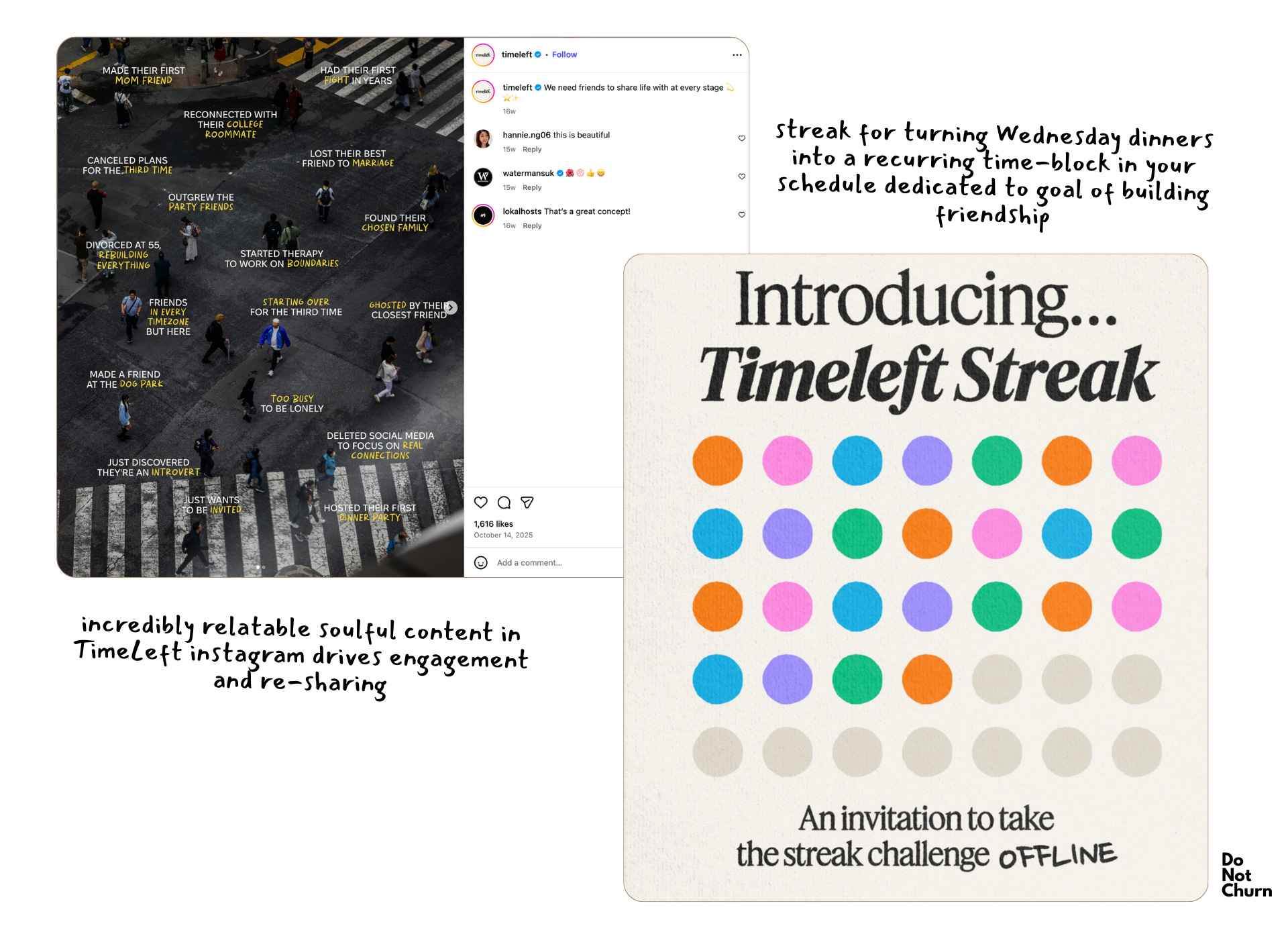
Subscribe once, show up weekly, meet different people each time. The habit forms fast - within 4 weeks, “Wednesday dinner” becomes part of your routine.
Why it prevents churn: Behavioral science shows habits need consistency + trigger + reward. Timeleft provides all three. Breaking the streak feels like missing yoga class—you notice the absence.
3. Curiosity Loops
(Timeleft's Mystery Box Model)
Timeleft withholds who you’ll meet until you show up. You know the restaurant, the time - but not their names, faces, or profiles until you’re physically at the table.
Instead of endless browsing creating decision paralysis, mystery creates anticipation.
Why it prevents churn: First-timers show up because curiosity is a stronger motivator than confidence (”Who are these 5 people I’m 85% compatible with?”)
4. Intentional Friction
(Hinge’s Limited Likes)
Hinge caps daily likes at 8-10 for free users. This sounds anti-growth, but it’s retention insurance.
Unlimited swiping creates decision fatigue and devalues each match. Limited likes force users to actually read profiles before committing. The result: higher match quality, better conversation rates, and less burnout.
Why it prevents churn: Paradoxically, constraint increases satisfaction. Users feel like they’re making real choices, not passively consuming an infinite feed.
5. Group Buffer
(Timeleft’s 6-Person Dinners)
One-on-one first dates are high-pressure. If there’s no chemistry, you’re trapped for 90 minutes faking interest. Timeleft’s group format diffuses this anxiety.
If one person is boring, you pivot to someone else. If conversation lags, the group carries it. There’s no “failed date” feeling - just a fun dinner where you happened to click more with some people than others.
Why it prevents churn: Lower stakes = higher willingness to try again. Users who have one mediocre dinner will still book another because the format itself is enjoyable, not dependent on perfect matching.
6. Anti-Vanity Metrics
(All Three Platforms)
None of these platforms show follower counts, likes, or “hotness” scores. Hinge hides mutual likes until both parties engage. Timeleft doesn’t show photos until after the dinner is booked. Thursday doesn’t rank attendees.
This removes the “am I hot enough for this?” anxiety that plagues Instagram and swipe apps.
Why it prevents churn: When success isn’t defined by external validation, users stay engaged longer. You’re not chasing likes - you’re showing up for experiences.
Key Takeaways
For Product Teams:
Optimize for outcome, not engagement. Hinge’s “designed to be deleted” works because it aligns business goals with user goals. If your product succeeds when users leave, build the churn loop into the moat - users will pay more and refer more.
Structure beats choice. Infinite options create paralysis. Timeleft’s “we pick the restaurant, you pick the week” removes 90% of coordination friction. Users aren’t asking for more control - they’re asking to stop making decisions.
The app is not the product. Thursday learned this the hard way. Their matching algorithm was fine - but nobody cared. What users wanted was a bar full of singles on Friday night. Evaluate whether you’re building a product or the process
Social proof must be real-time. Post-event photos, user testimonials from last week, live counters of “43 people attending tomorrow”- these work because they’re immediate. “Trusted by 1M users” does not tell you anything. “Sarah met her boyfriend at last Thursday’s event” is a signal.
For Investors:
Look for inverted metrics. Healthy churn can be bullish if users are graduating to outcomes. Track: (a) DAU drop + NPS spike = users succeeding, (b) Repeat rate >50% = habit formation, (c) Referrals from churned users = proof it works.
The TAM is loneliness, not dating. 300M people have zero close friends. Dating apps address a subset. JoyTech platforms address the root problem. Timeleft users aren’t all looking for romance - they’re looking for connection. That’s a 10x larger market.
Watch for unit economics, not growth hacks. Timeleft grew without ambassadors or influencers - just ads that hit break-even on the first dinner. Thursday scales through venue partnerships that cover venue costs. Hinge users pay 2x Tinder pricing. If LTV doesn’t cover CAC in 60 days, the model is broken regardless of user count.
Retention is the real moat. Network effects in social products flip fast. Clubhouse had 10M users and died in 18 months. The question isn’t “how fast can you grow?” It’s “what happens in month 3 when novelty fades?” Platforms that build weekly habits (Timeleft) or community identity (Thursday) survive. Those relying on algorithms alone - don’t.
If you’re finding this newsletter valuable, share it with a friend, and consider subscribing if you haven’t already.