

In 2025, I purchased more than 20 tickets and traveled to more than 15 countries. Every month it takes me a couple of hours to figure out logistics and find the right option. My main goal was to optimize my time around this monthly chore and to maximize outcomes - spend less money, have more comfort. So I’ve dug into 11 different products to buy plane tickets – I’ll share some CX insights on a few in this article.
Act I. The Shift.
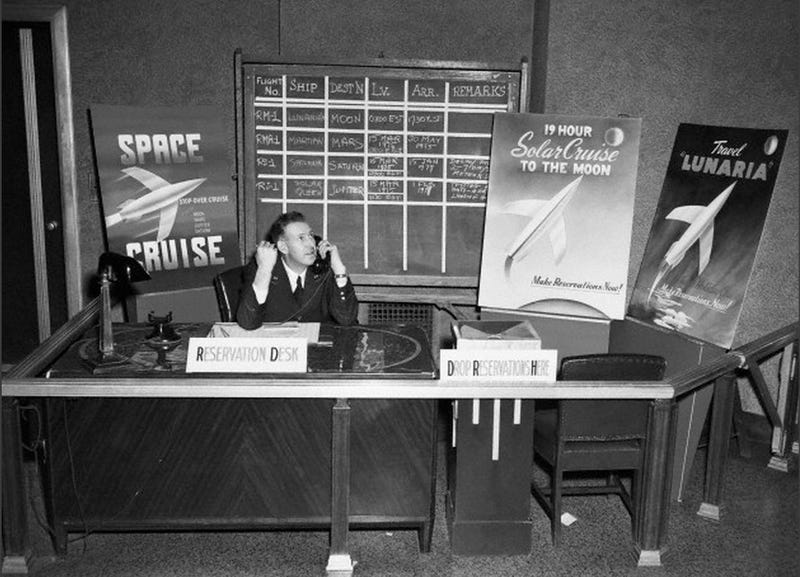
Let’s start with a throwback to the 1990s. To plan a large family trip, there was really only one choice: to get in touch with a travel bureau that would do all the work for you. All you had to know was where you wanted to go, how long you planned to stay, and your preferred booking dates. Planning a trip felt like a big event, ending with printed tickets and vouchers that you had to have on hand when you headed to the airport. The entire system was built on a foundation of delegated trust.
The incentive for travel agents was an ~8% commission, paid by airlines. The travel agent was an unavoidable element of the ticket-purchasing cycle. Airlines would publish fares in GDS systems available to a range of travel agencies. Pricing policy was less volatile compared to today: fares were built from distance, route, seasonality, and refundability.
Airplane companies stuck to an inventory model: planes were split into fare buckets (Y, B, M, Q, etc.) Each bucket had a fixed price and fixed rules. Once one bucket was sold, the next bucket would become available.
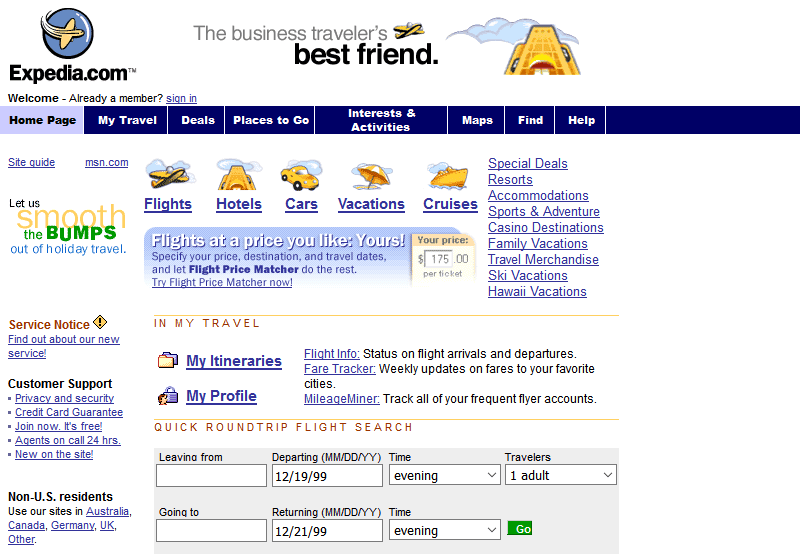
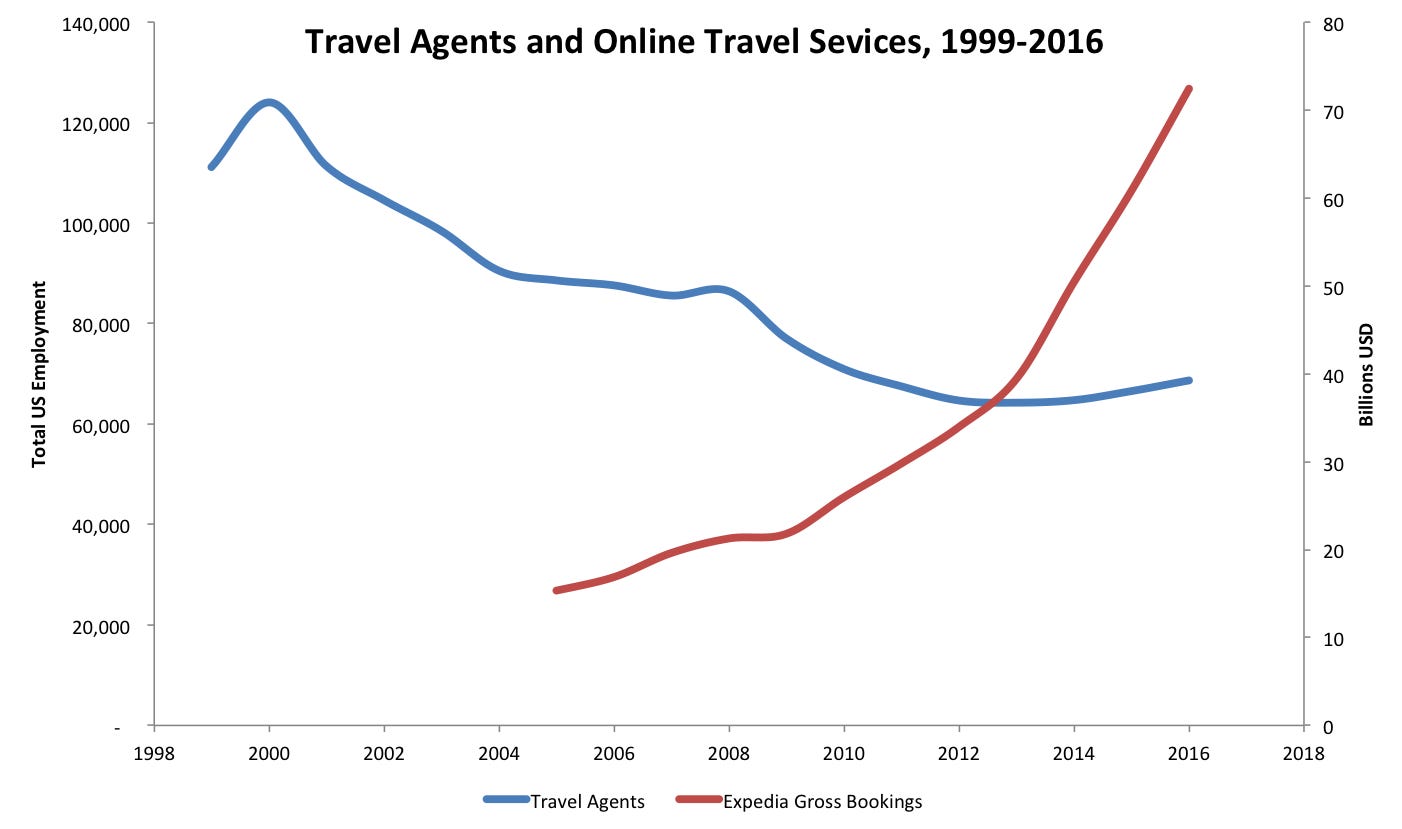
This system lasted until the 2000s. The Dot.com era arrived with personal computers available to everyone. Airlines felt brave enough to kill commissions to travel agencies and sell directly to consumers at scale, leveraging websites like Expedia.com.
This changed the pricing model completely:
Agents lost the incentive to buffer complexity
Prices became demand-based – a ‘Saturday night stay’ being the most expensive option
Prices began to fluctuate daily and sometimes even multiple times per day.
Act II. New Fears.
1990s: price was a published rule —> 2000s: price was a competitive tactic —> Today: price is a real-time guess.
The ‘official price’ is gone. There is only what the system believes you might accept right now. This is psychologically brutal.
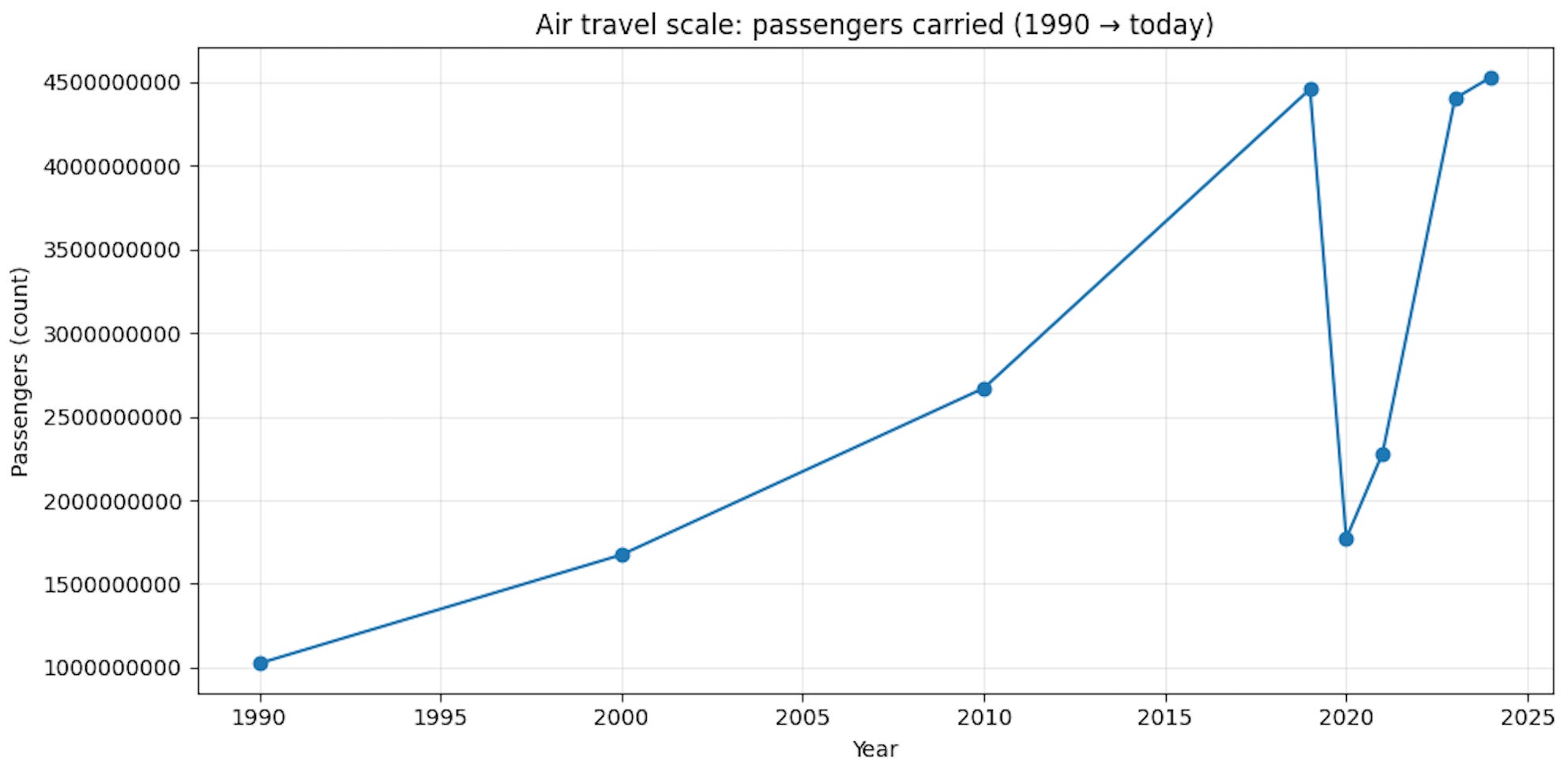
Travel became four times more available than before, and booking airline tickets no longer felt like an event; it became a background task to complete between Zoom calls.
This, combined with an emerging optimisation culture – just like me, all people want to find the best value for their money. We all became deal-hunters.
Decision paralysis became a new churn. The moment of buying was delayed by a long cycle of comparing, thinking, tracking, and endless browsing. Responsibility shifted to the consumer, and the price of a mistake became quite high.
What if I overpay?
Book with an airline that sucks?
What happens if something goes wrong after booking?
Most business models are just not incentivised to build a great post-purchase experience, to nurture loyalty, and generally don’t care to provide any customer support.
Worse, some companies don’t even care if you buy your ticket on their platform. Shocking, right? All they want is for you to be stuck in an endless cycle of hunting and comparing.
Act III. Airline Ticketing CX.
Today, there are generally three categories of products for purchasing airline tickets:
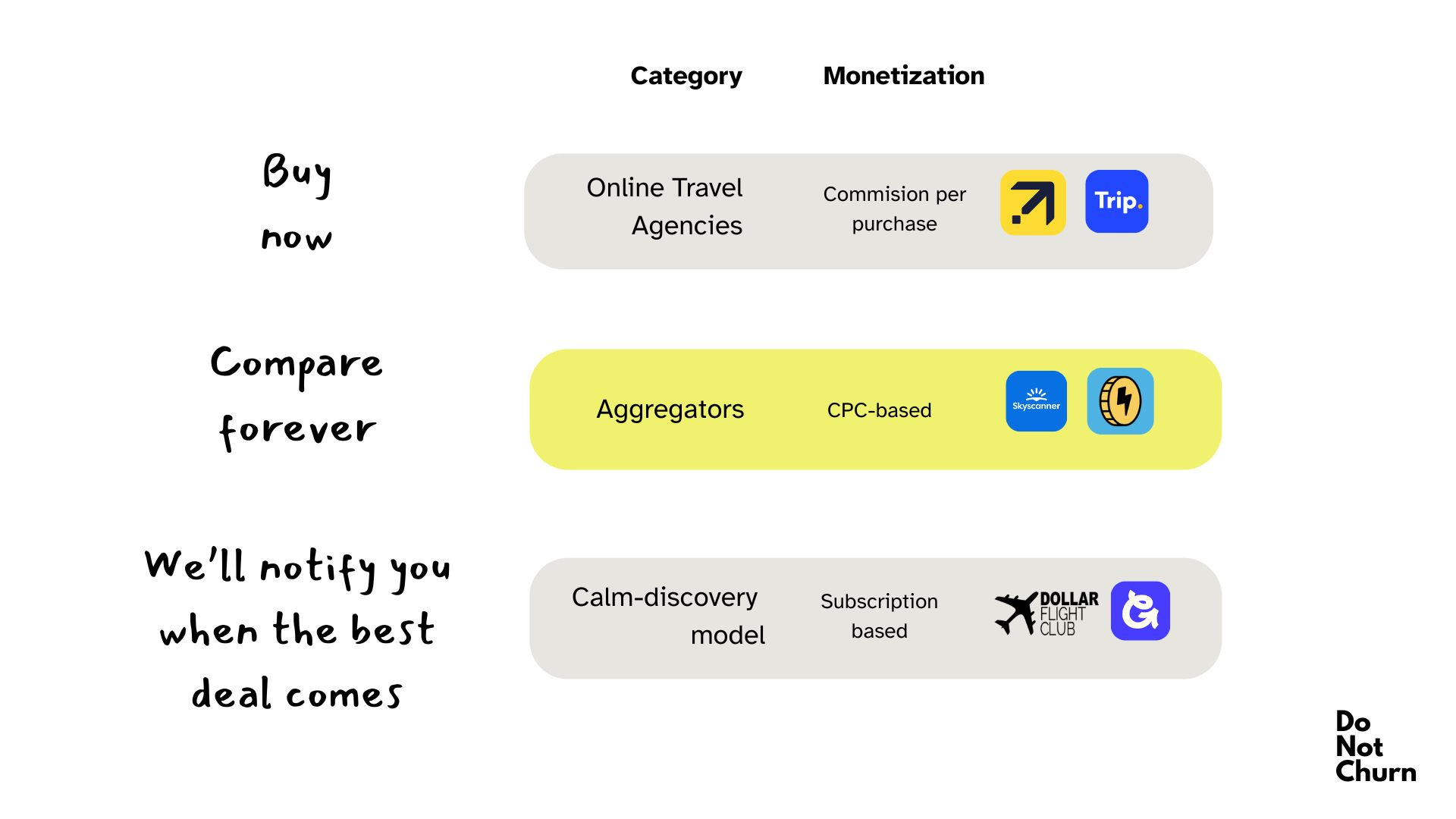
Let’s walk through the CX journeys of these products to uncover both the moments where users quietly drop off and the subtle cues that reduce anxiety and keep them around.
Trip.com
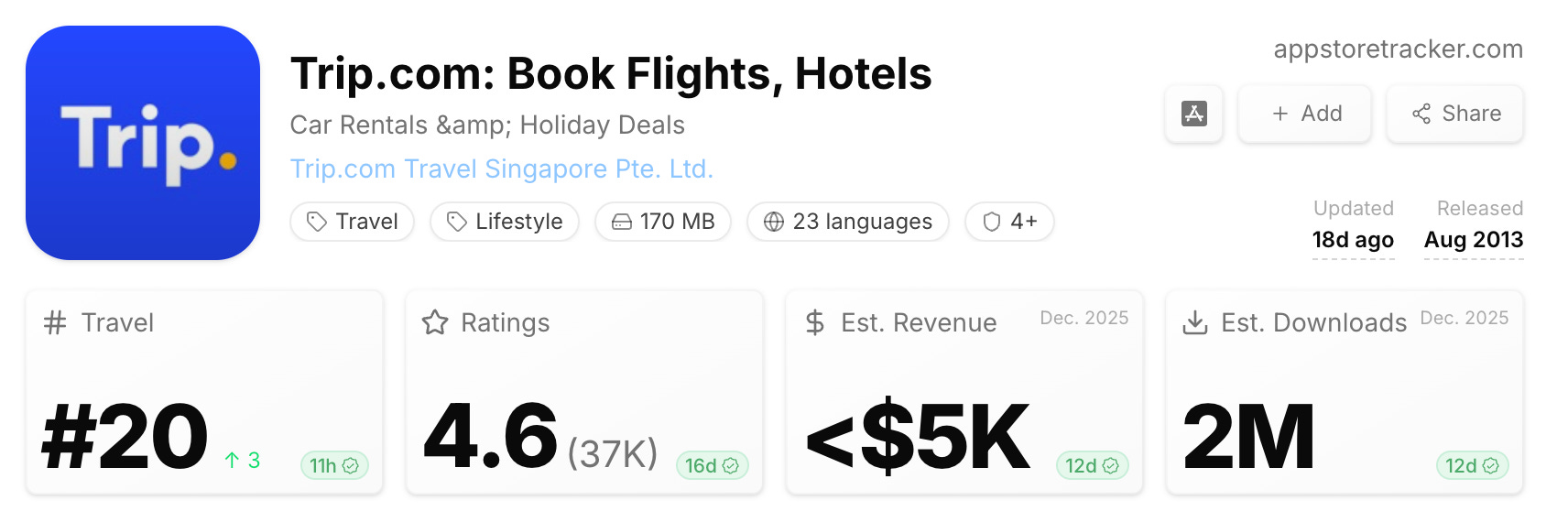
Trip.com is a modern equivalent of the old-school travel agency, where you can find tickets across various airlines, along with hotels and car rentals.
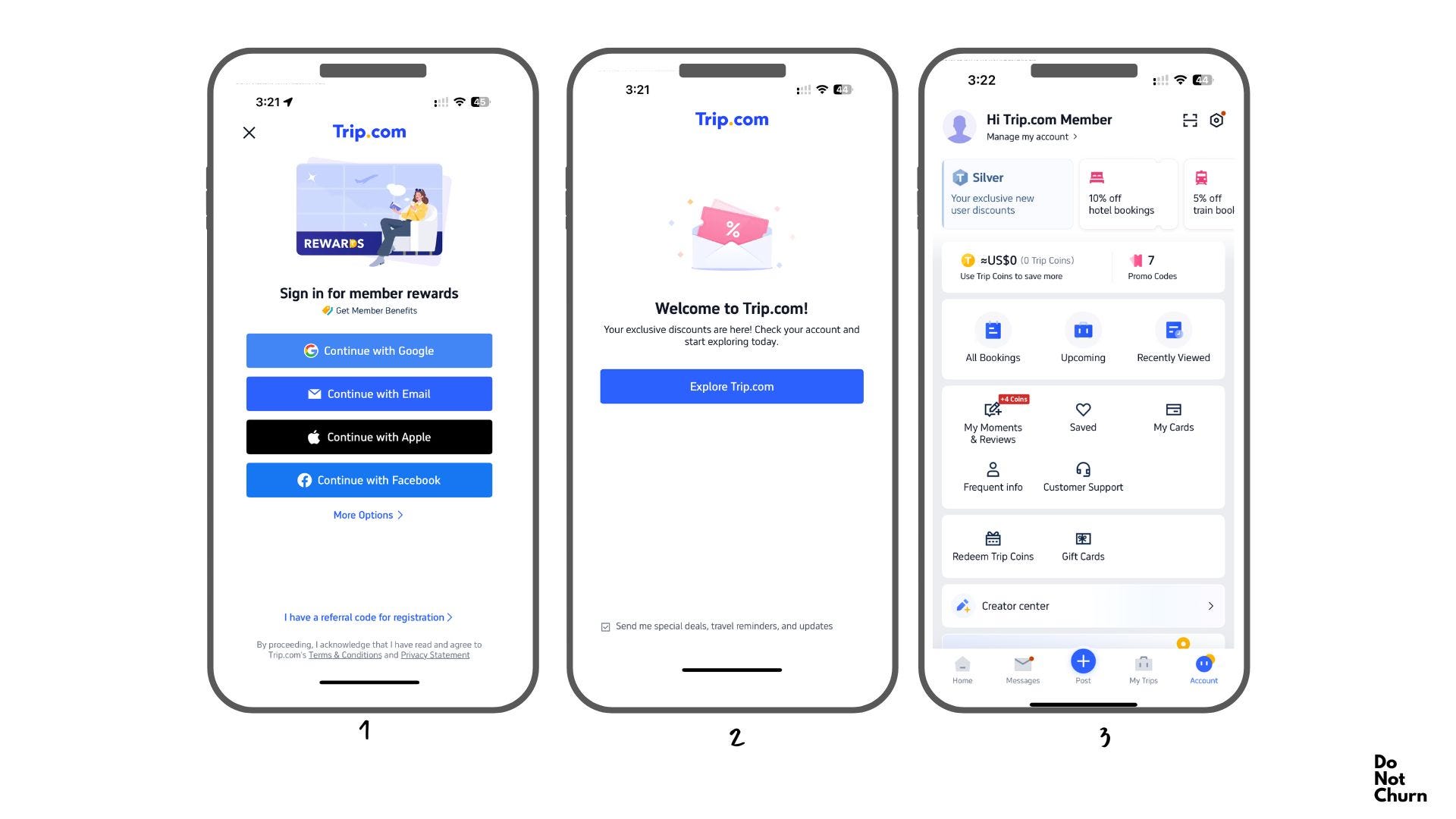
3 Click Onboarding
They have the quickest onboarding I’ve seen: three quick screens, and you have a set up account, and you can start browsing tickets - get straight to what you came for. Only after selectingthe ticket, you’ll be asked to fill in more info necessary to complete the purchase. The full purchase cycle happens within Trip.com app, so you deal with them from beginning to end, so it’s like making a hotel reservation on Booking.com.
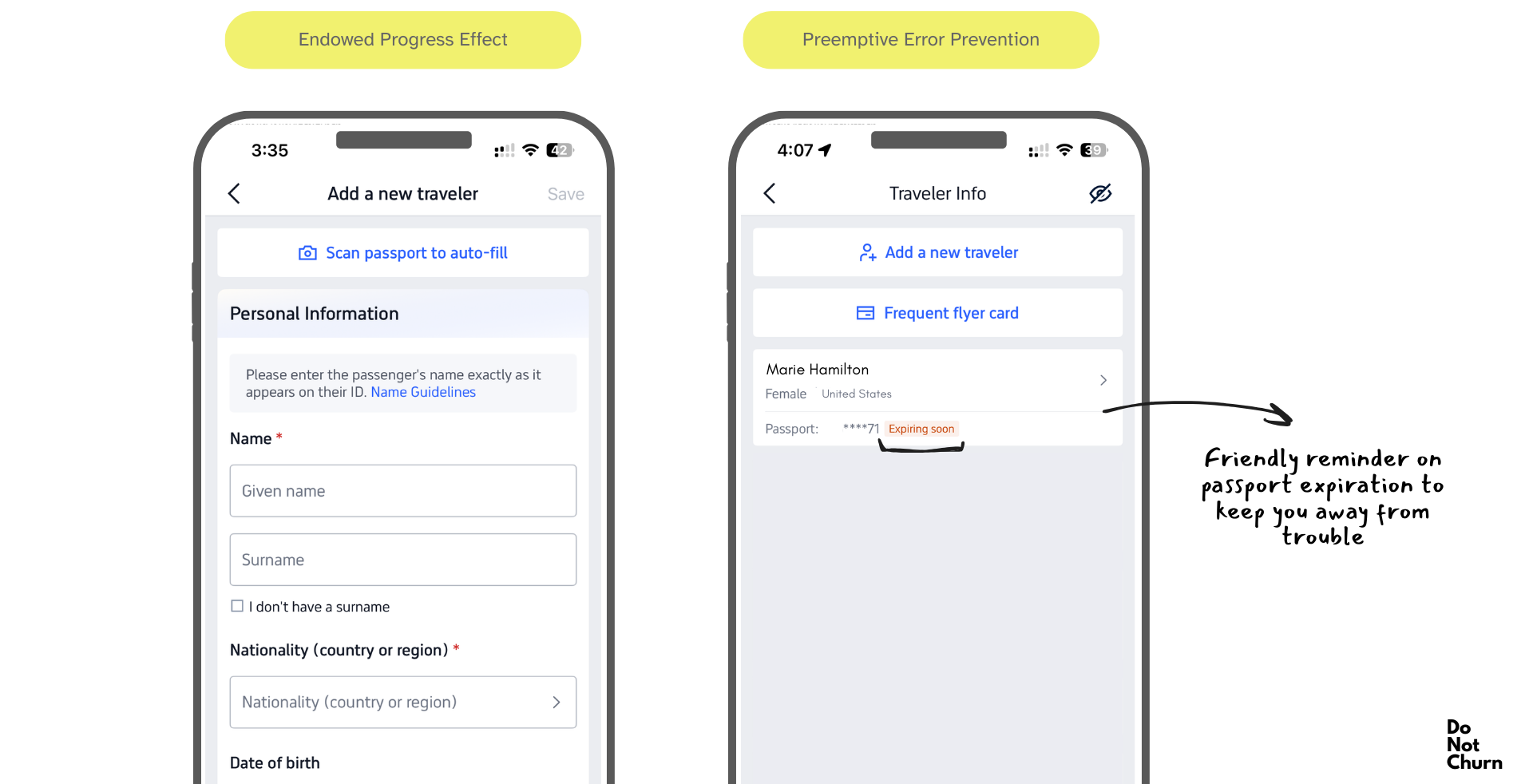
Traveler Info saved in your profile
Once you attempt to buy a ticket, you enter your data, and you can keep it in your account under the ‘Traveler Info’, so you can save multiple passengers and don’t have to fill everything in again every time. After entering data user will have less friction to go buy tickets elsewhere, as it will be faster with Trip.com. Given how often deals on Trip.com match all available ticket deals on other resources, switching might really feel like it’s not worth it.
Post-purchase support
Their great benefit is that they own full experience: before and after ticket purchase. Sometimes, after buying tickets, you might need a purchase confirmation for visa purposes, or once I even had to change passport number details, and it took me 5 minutes to get it sorted. It’s really rare, and it builds trust!
On a negative note:
App interface feels a little too cluttered and heavy with many small rubrics and additional features like Hotel Bookings, which, on the other hand, don’t have a good selection that Booking.com would beat every time. It’s extremely hard for an app to conquer two categories and make them perfect. Trip.com feels like an app for ticket booking, first of all.
Rate Punk
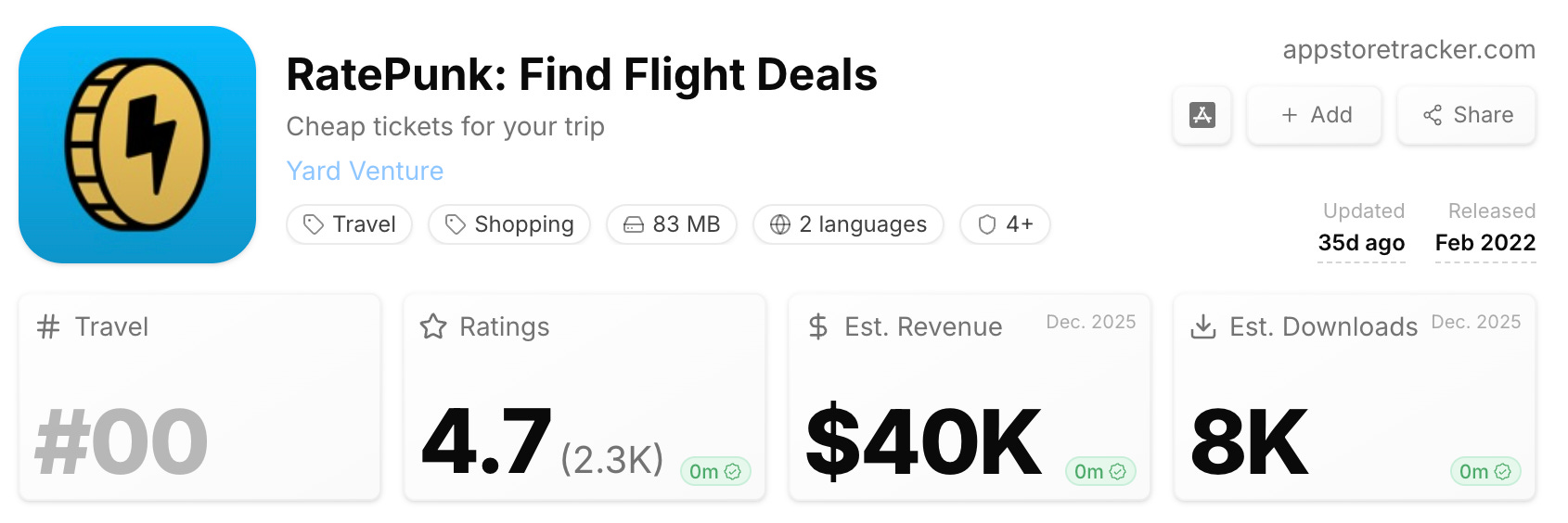
RatePunk is an app that recently went viral on TikTok and is famous for their adds about getting a business class ticket for the cost of economy. It falls into the aggregator category, so they don’t sell tickets but forward users to - not even an airplane company, but another aggregator. So it is an aggregator of aggregators that has been promising to break us free from overpaying for air travel. Watch me go through it!
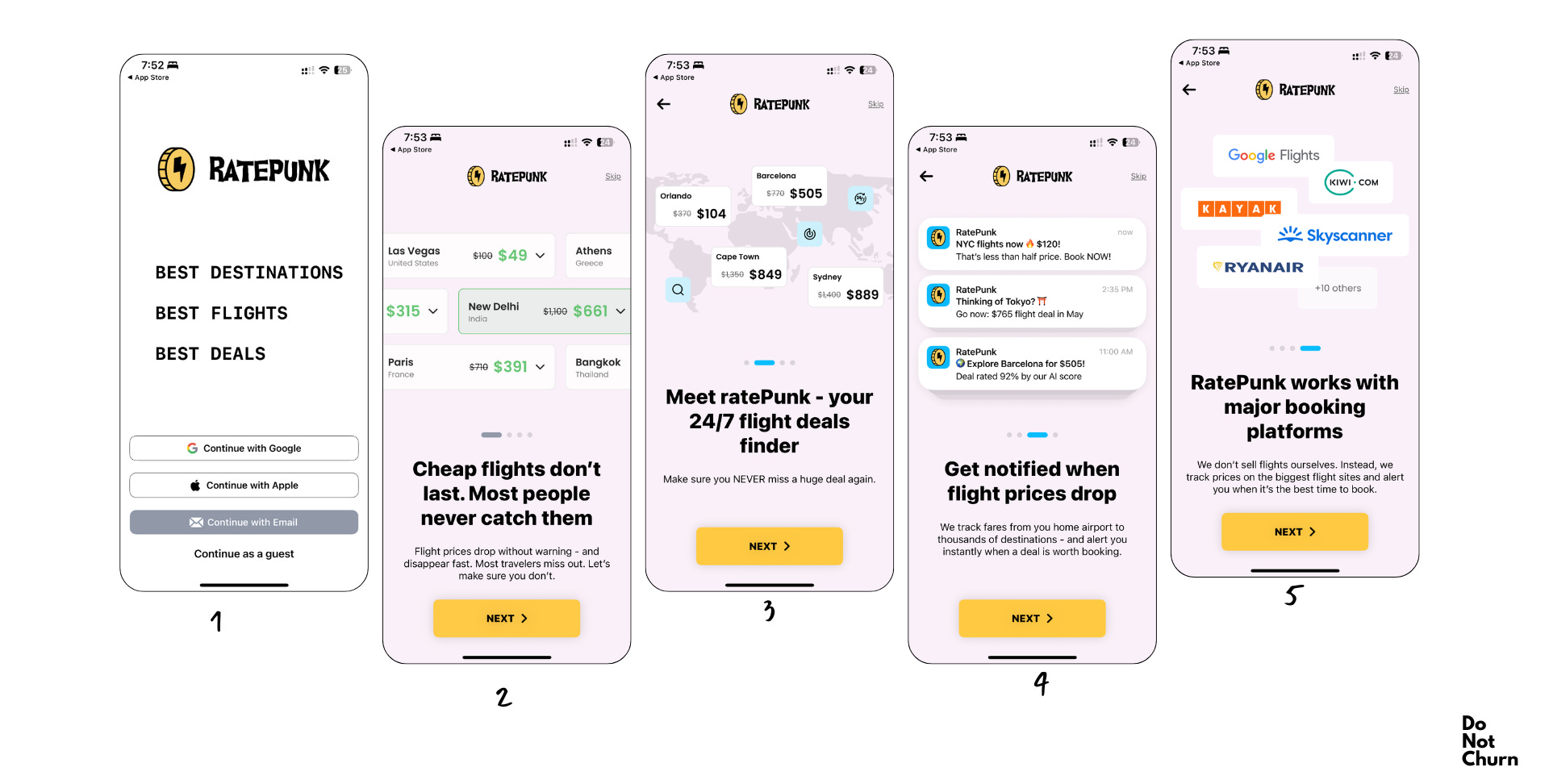
Cognitive Offloading
Starting on note of introducing a fear of missing deals user is taken right into a comforting promise to help you get the best deals. At first look, here’s a clear pattern of taking a load of constant tracking and deal hunting for you so you could get notified only when the price drops to lock in your ticket. However, context framing around the % of discount and AI deal score pushes you into hunting mode and endless scrolling and clicking. Cognitive offloading? Yes, it does a bit of it. But drives your anxiety over a potentially missed deal.
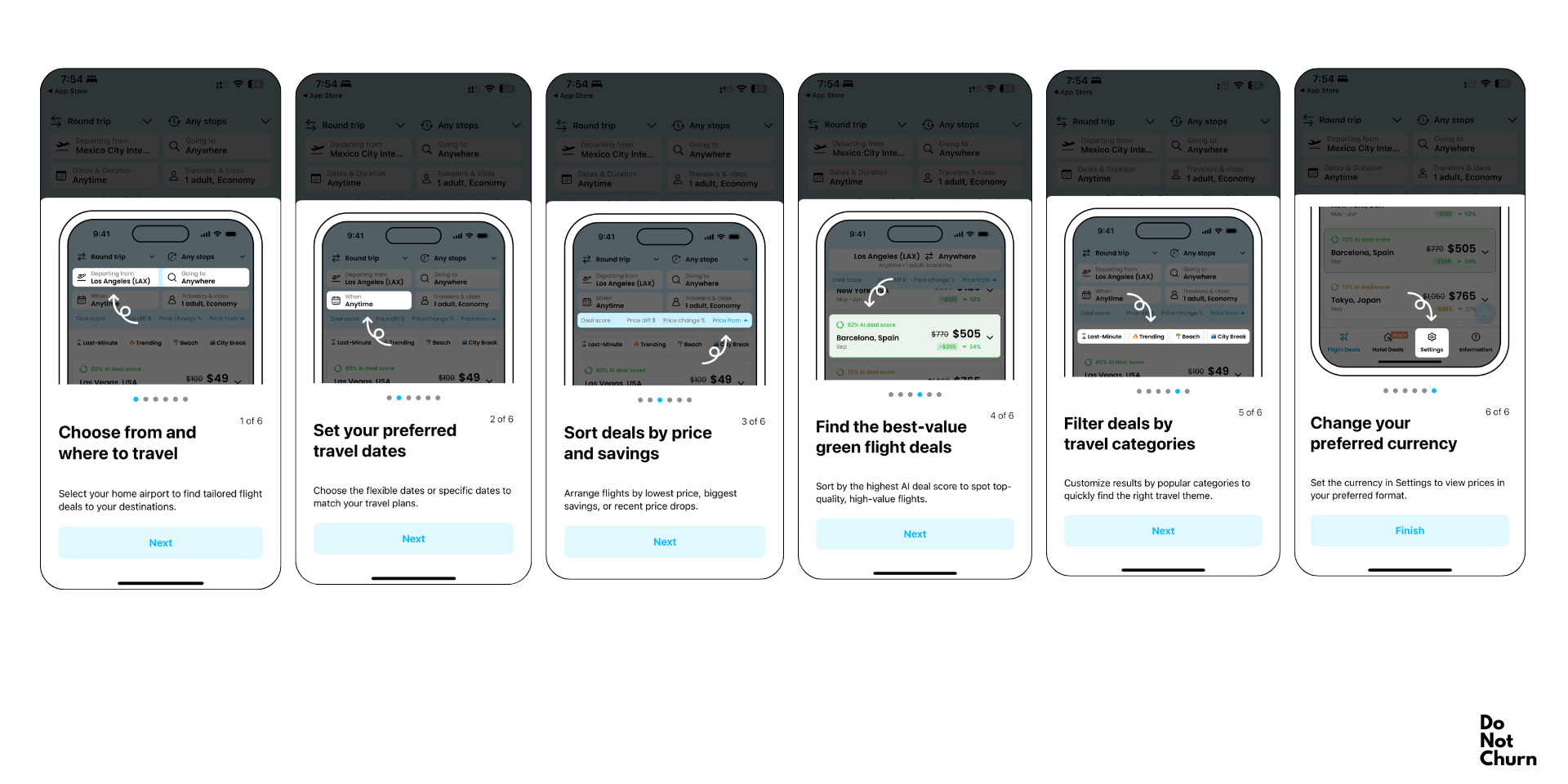
Followed by 6 screens of onboarding walkthrough that adds the taken load back again, before showing any real value upfront.
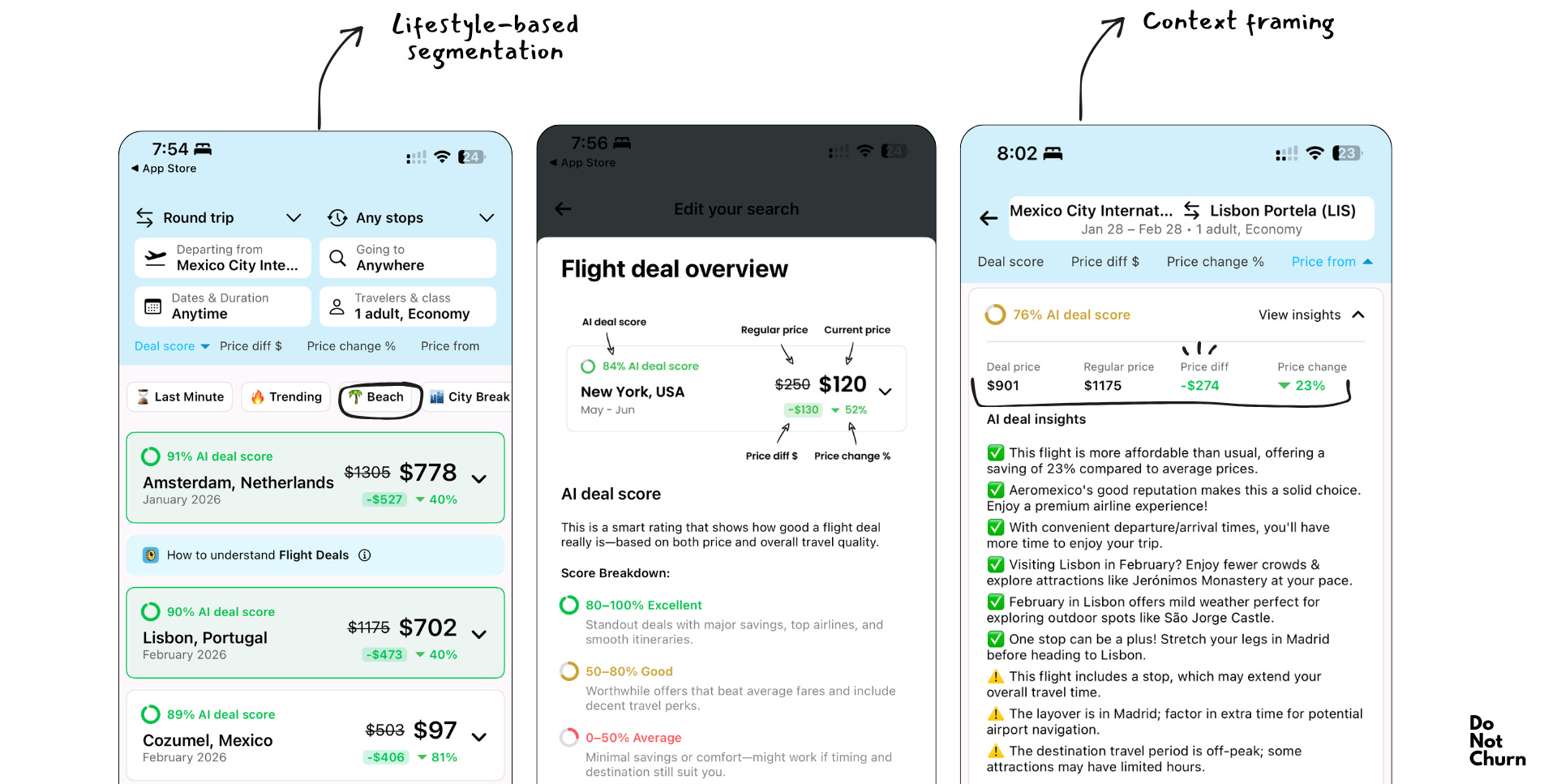
Lifestyle-based segmentation
Helps to think in terms of ‘What experience do I want to have?’ and have some picked destinations that allow that: having a beach getaway or weekend in the city.
Context framing
AI scoring helps to understand how good the deal is, which makes it feel ‘smart’ and thoroughly analyzed for you.
ChatGPT-style summary makes the screen feel heavy, though, and some insights are a little too obvious.
Monetization
RatePunk has a typical for aggregators CPC (Cost Per Click) model, so they’re incentivised for users to view as many ticket deals and click through each of them to learn more, as possible. That is totally misaligned with what consumers are looking for - find a good deal quickly. In the end, you end up with constant scrolling, looking for a good one. And after subscribing to a few destination you’ll be pinged and pulled back in to view some more. On top of that, after 14 days free trial, RatePunk is not available without a yearly $29,90 subscription, which users have a hard times to justify the value of (Redditors reviews are less than flattering).
Btw, how do you buy your airplane tickets? Let me know if there’re more tips I’m not aware of!
Going
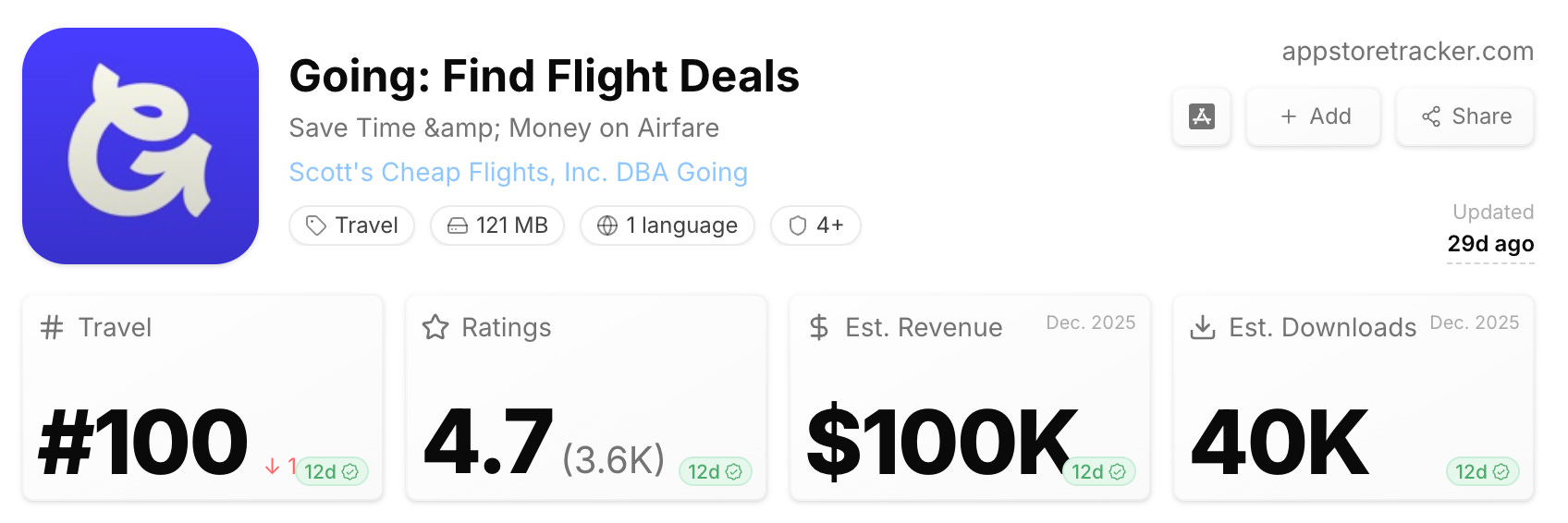
Going, a company that was previously called Scott’s Cheap Flights, was founded by Scott Keyes and has been greatly influential among the early Digital Nomads community for more than a decade. It started as a newsletter with great deals built out of the desire to share good deals with people who are down for a trip with open dates.
Onboarding process, even though it doesn’t take three screens, it doesn’t feel long, because you’ve been asked short questions, and the screen is not loaded with text.
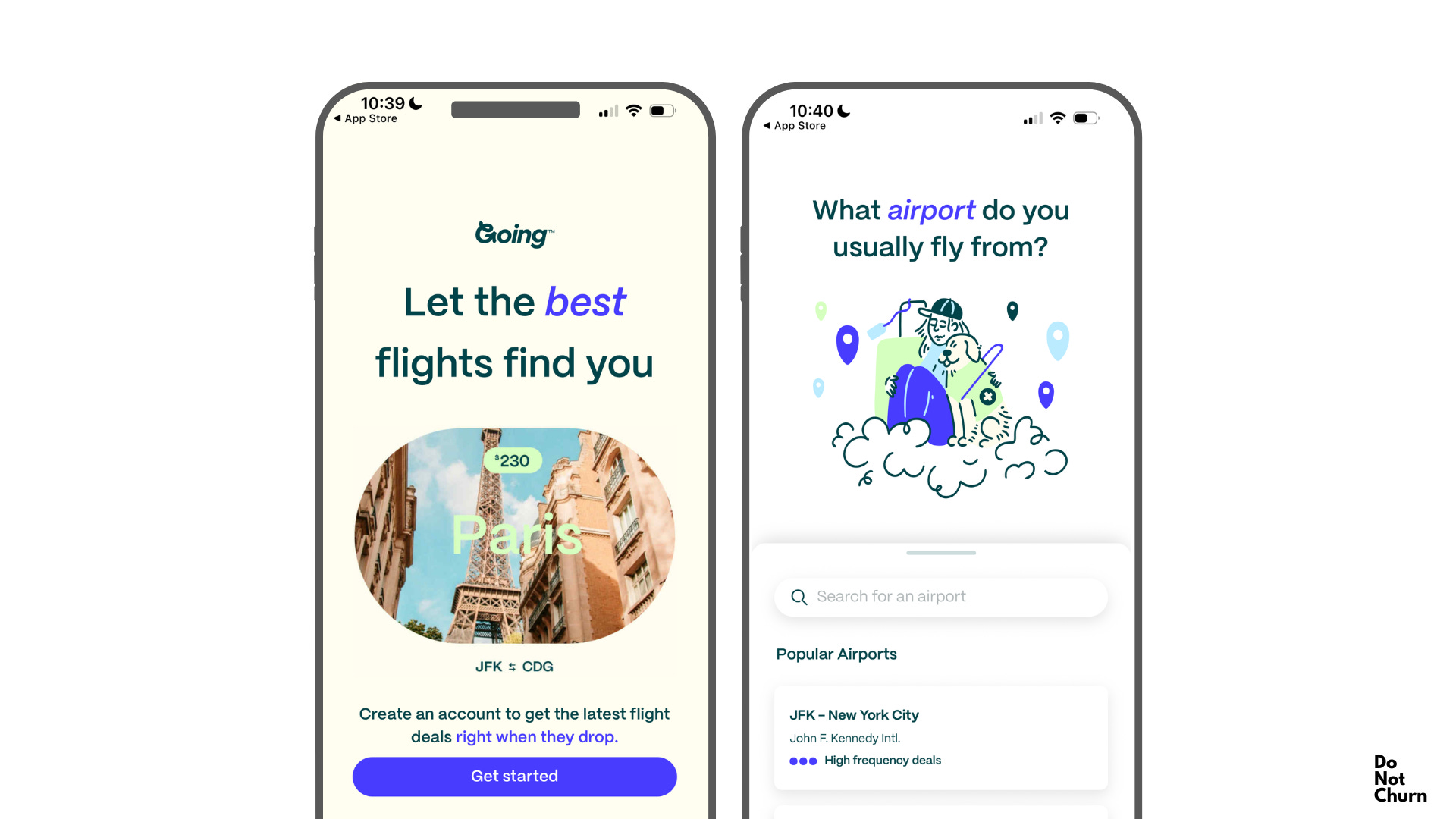
It’s built around travel from the US only, which initially solved a problem of airplane companies charging an insane amount of money for any ticket (200%–300% higher in the U.S. than Europe per-mile ticket cost).
By the time they launched an app, they already had thousands of subscribers and a warm customer base who trusted them, as it has been proven to really work.
Hick’s Law
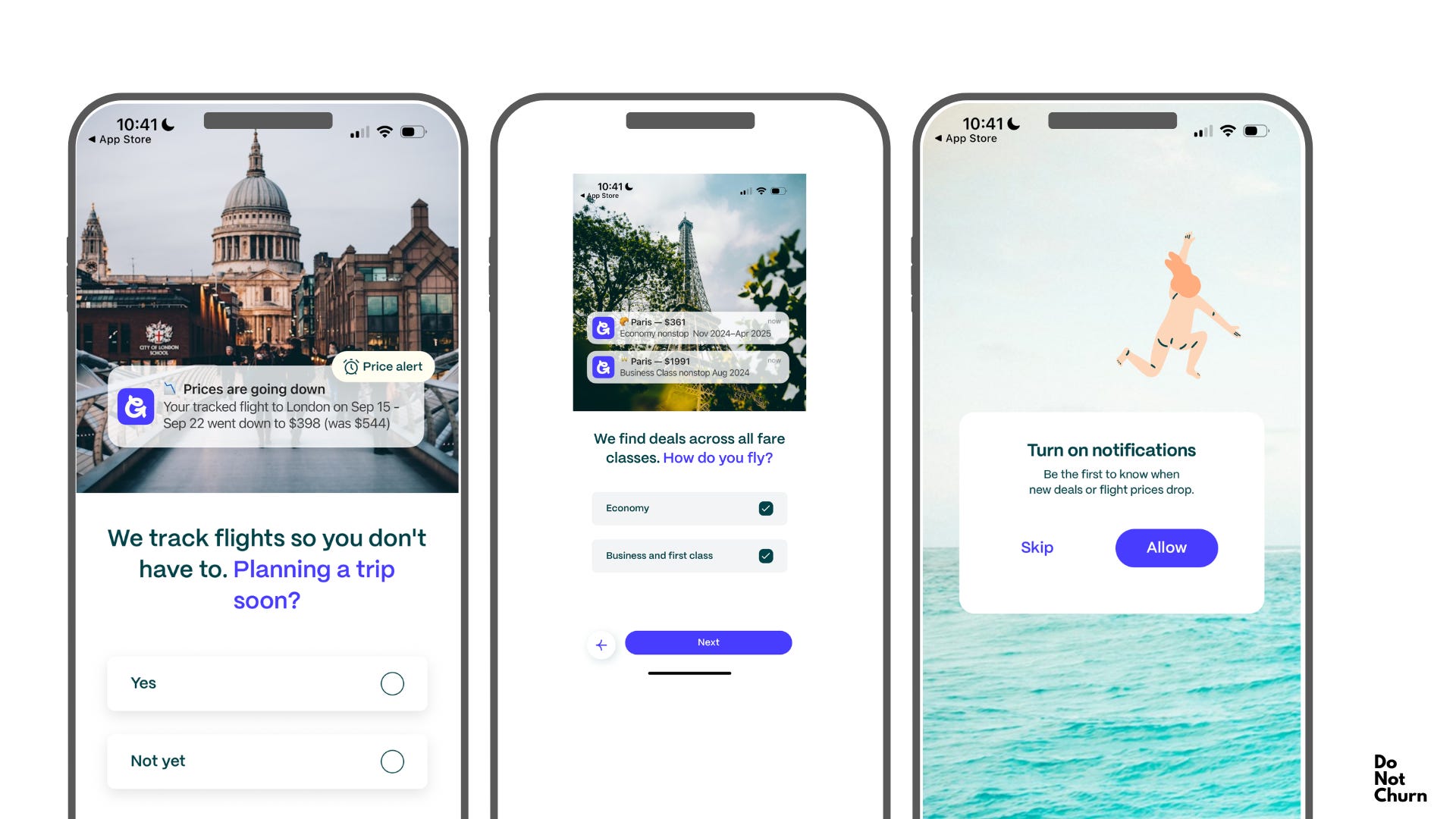
After you enter your e-mail, you’re asked to answer a few more questions to customise your experience. Hick’s Law applied to let the user choose from only 2 options, which drives faster decisions. With a little touch of FOMO, you are asked for permission to notify you first about the best deals. But that’s exactly why one would come!
Constraint-First Personalization
Total flip of the mental model happens right here. Instead of:
“Where are you going and when?”
User is asked:
“How flexible are you?”
“Where can you realistically depart from?”
Contrary to other platforms, users would start from availability, not logistics.
So instead of asking users to act, the product asks them to describe themselves. That’s much lower friction.
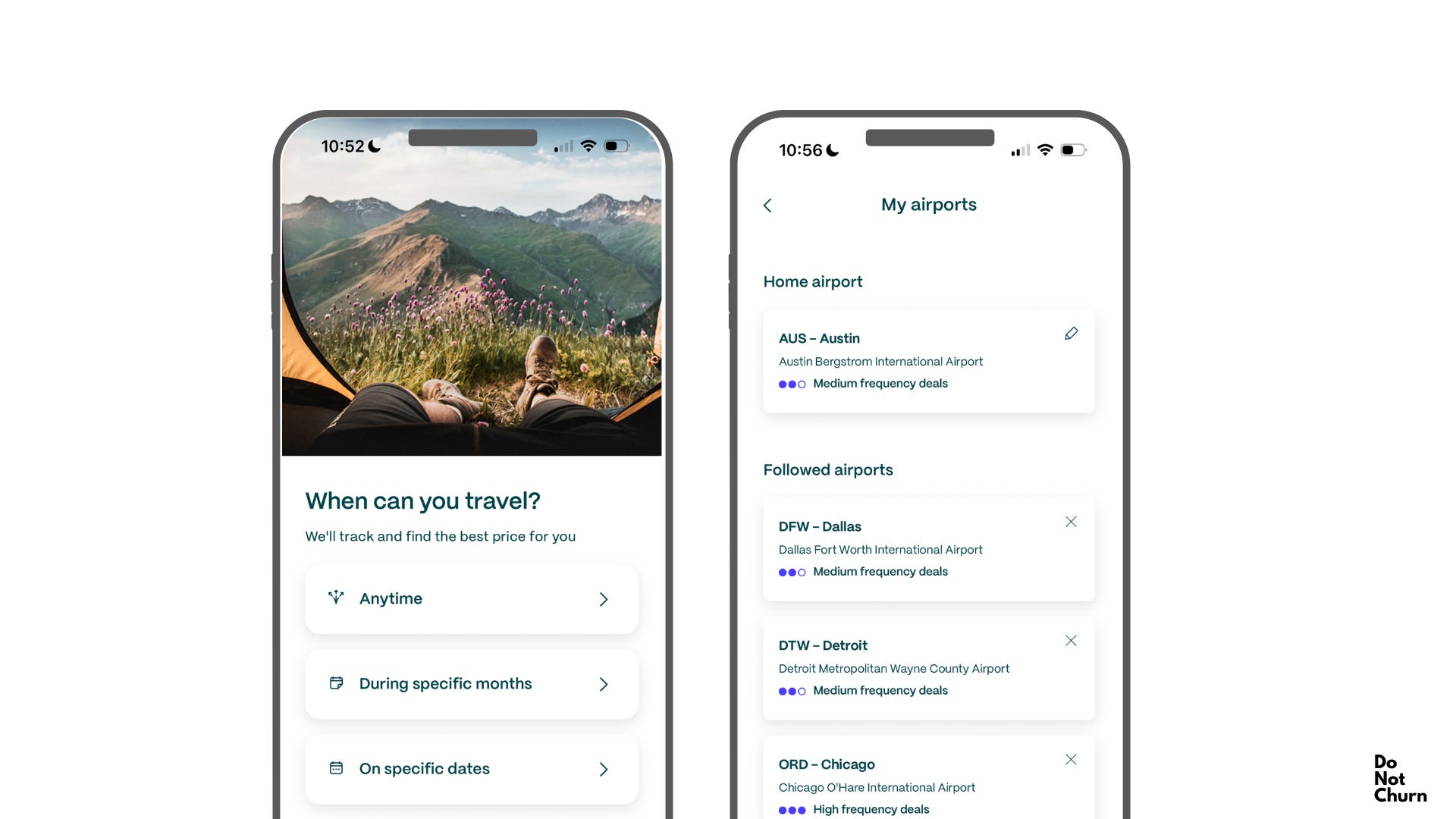
After setting up availability next step would be to ‘subscribe’ to a few destinations you considered going to. And wait for the best deals, tailored for you, to come your way.
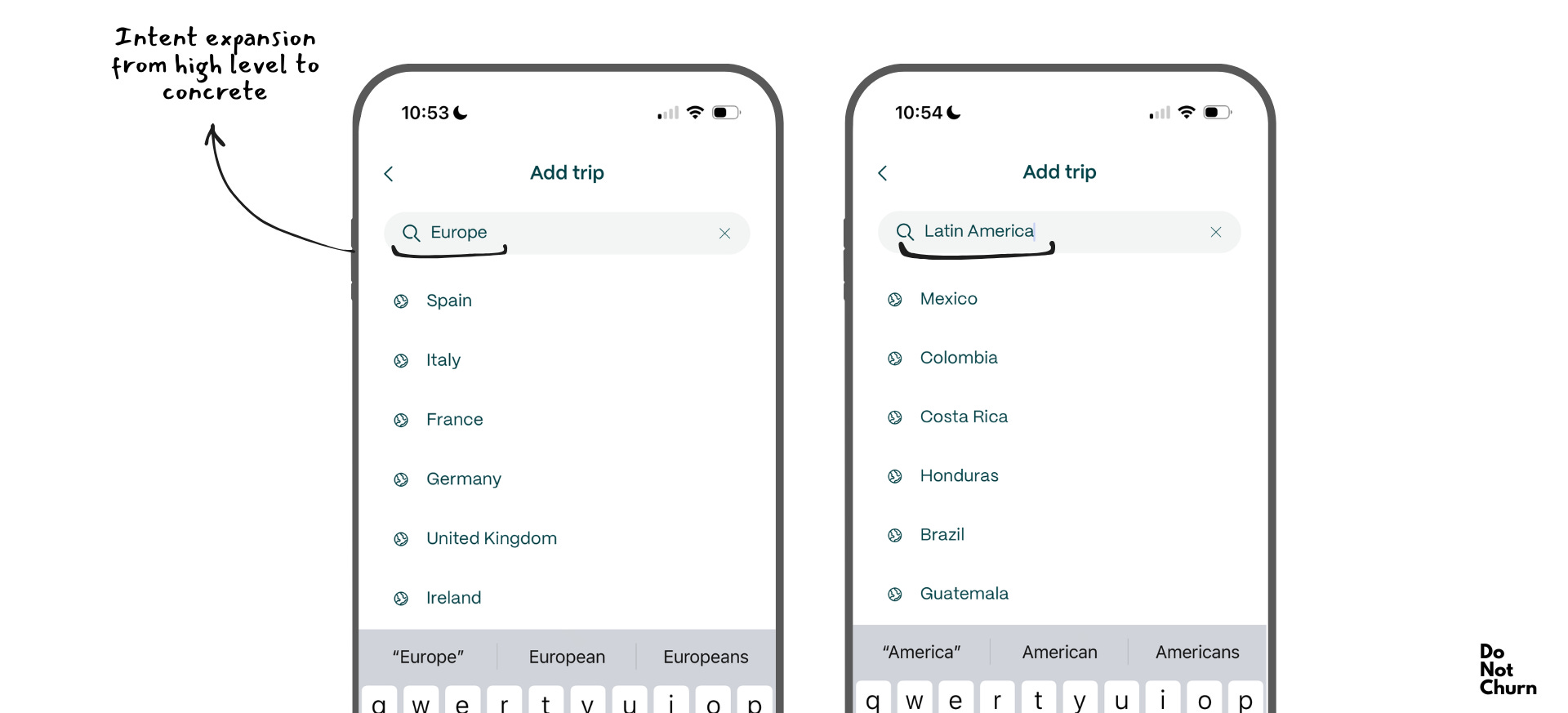
Intent Expansion
Going uses intent expansion to turn a vague destination like “Europe” into a concrete set of options. Instead of forcing users to think in airports or country codes, the product scaffolds the decision, reducing cognitive load and making exploration feel less overwhelming.
Monetization model
Going falls into a very special category that stands between aggregators and online travel agencies. They don’t get any commission pay, so they have to monetise through a yearly subscription, which is very affordable ($49, billed monthly at just $4.08). Say, if you’d save 40% on 3-4 flights, you’ll get through Going - it would be 300% worth it.
You are likely spending more on coffee per day than you are saving on flights per month.
Winning products today do 3 things exceptionally well:
1. They compress decisions
2. They manufacture confidence and trust in the long run
3. They own post-purchase experience
Honestly… there’s no perfect product built in this niche just yet. And there are reasons for that: the margins are tiny, the average recurring purchase is really less than once a month, and to charge a subscription, it should deliver enough value to justify billing your card $40 a year.
If only Trip.com and Going had a baby - with post-sales support and keeping your travel docs in one app and with curated great deals that are legit - that would have been a 12/10 product.