


I remember when I was a high school kid myself, in the 2000s, online learning, which was on the rise, was mostly content delivery. I’d watch a video, or read a module, and do a quiz where the system told me whether I was right.
The intelligence in the loop was the teacher, who wasn’t in the room, and the parent, who was trying to help with long division at 9 pm using methods that no longer matched the curriculum. Learning technology existed to scale content, not to close the gap between content and comprehension.
When ChatGPT launched in November 2022, educators didn’t know whether to panic or celebrate. Here, finally, was the thing every edtech founder had been promising since the MOOC (massive open online courses) era - a genuinely intelligent system that could answer any question, explain any concept, and meet a student exactly where they were. Writing for The Atlantic, English teacher Daniel Herman declared it “The End of High School English”; in the same publication, Stephen Marche declared the college essay “dead.”
The argument spread fast in the other direction too: technologies had made rote memorization unnecessary in most cases, and our educational system simply hadn’t caught up - why spend a lesson on knowledge retrieval when access to any fact was three seconds away?
The optimists argued that we were finally separating the low-order work (remembering things) from the high-order work (thinking about them).
About this newsletter:
I’m Daria Littlefield
I spent a decade running customer operations at a $400M ARR portfolio
of 35+ consumer apps.
That taught me more about why products lose users than any framework ever could.
Do Not Churn is where I put that to use. Every week, I break down the retention mechanics behind the products we all use - what keeps people, what loses them, and why the difference is rarely what you’d expect. If that’s useful to you, subscribe below.
It sounded reasonable; however, the response from institutions was less convinced: Los Angeles Unified, the second-largest school district in the US, immediately blocked access to ChatGPT from its network, and by January 2023 districts across the US, UK, and Australia had followed.
It took about two years to realize both sides had missed the real problem.
![30+ ChatGPT Memes Madness [Not generated by ChatGPT 🤣] | Engati](https://substackcdn.com/image/fetch/$s_!BLbI!,f_auto,q_auto:good,fl_progressive:steep/https%3A%2F%2Fsubstack-post-media.s3.amazonaws.com%2Fpublic%2Fimages%2F3d371075-5f12-42f1-b290-4f5af42dbf73_579x800.jpeg "30+ ChatGPT Memes Madness [Not generated by ChatGPT 🤣] | Engati")
The optimists were wrong about what high-order thinking requires - you cannot think critically about something you have no internal model of, and offloading retrieval to a machine doesn’t free up cognitive capacity, it atrophies it. The pessimists were wrong about the threat - the danger wasn’t cheating, it was something way harder to measure. MIT’s Media Lab made it concrete in June 2025: across 54 students monitored over four months with EEG equipment, those relying on ChatGPT showed measurably lower prefrontal cortex activation than those using search or no tools at all, with cognitive effects that lingered after they stopped using the model - the students who never had to retrieve information failed to build the memory traces that retrieval practice produces. The brain stops practicing what it no longer needs to do. The problem was never the model, but the design pattern: give the answer, skip the struggle, get it done for me.
A small number of products looked at that interface decision and made the opposite choice.
On the surface, this looks like a feature upgrade on top of existing edtech products. In reality, it reflects something more structurally significant:
The democratization of the moment that used to require a human.
The moment of productive struggle - the point in a learning session where you’ve encountered something your existing model can’t resolve - has always been where learning actually happens. And it has always been where self-directed digital learning falls apart, because the options are: give up, search the internet, or ask someone. AI tutors are the first technology that can intervene precisely at that moment with something more than a search result. Whether they intervene well - whether they guide or give away, whether they scaffold or surrender - is the design question the entire category is now splitting along.
Brilliant
Founded 2012 by Sue Khim, Silas Hundt, and Sam Solomon. Khim - a University of Chicago mathematics dropout and Forbes 30 Under 30 honoree - built Brilliant after a previous edtech startup, Alltuition, pointed her toward the gap between access to education and genuine comprehension. 10M+ learners globally.
Brilliant is optimized for what I’d call conceptual mastery with visual guidance, and it does that job with a degree of technical precision that most edtech products can’t reach.
Primary intent: Understanding, not performance
Job it closes:
“I want to actually understand this concept so that next time I see it, I’m not starting from zero. And… I don’t want to work through yet another explanation that tells me the answer instead of showing me how to think.”
It translates to:
Enroll in the course
Attempt an interactive visual lesson
Encounter the moment of being stuck
Invoke Koji
Koji asks guiding questions and can annotate the live lesson on screen
Return to attempting the problem
Progress tracked against mastery
Optimized for:
Conceptual math and coding, Adult learners returning to STEM, Older students approaching material their school hasn’t taught well, Parents buying for curious kids, not struggling ones
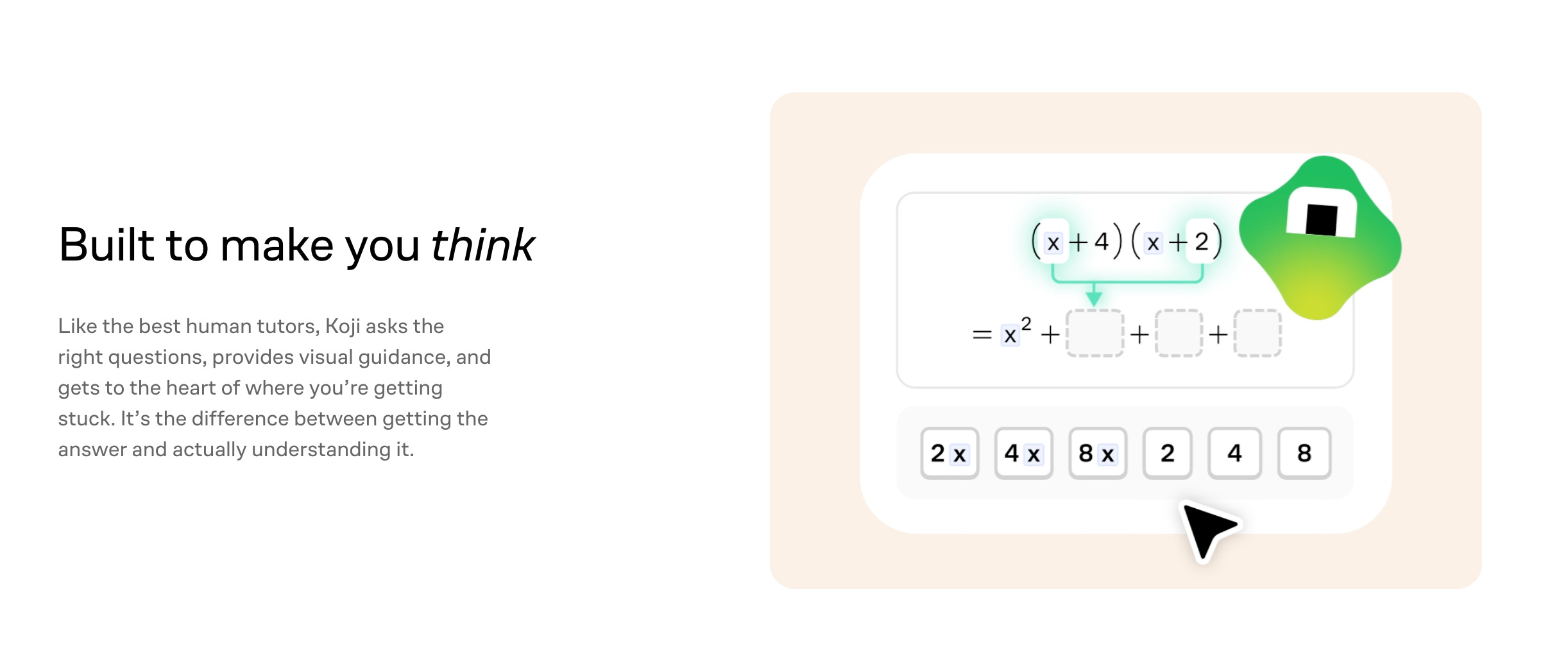
Brilliant’s structural advantage is the one that took a decade to build. Koji can see everything on the learner’s screen - the exact problem, which choices they’ve made, where they’ve paused - because the lesson infrastructure was built as code from the beginning. Koji doesn’t just read a problem description; it reaches into the interactive itself and annotates it, highlights a region, poses an intermediate question. The blog post announcing Koji makes this explicit: the goal is for Koji to eventually make himself unnecessary, gradually handing the thinking back to the learner until they’re asking themselves the questions Koji used to ask. That’s the only tutoring philosophy that structurally compounds value rather than creating dependency.
This is a product with real philosophical backbone.


Churn Watch: The risk lives in the acquisition promise versus the product reality. Brilliant’s founding audience was curious, self-directed learners - people who wanted to go deeper on things they already cared about. Koji widens the aperture to include students who are stuck and need rescue. Those two populations have very different tolerances for productive friction. A learner who opened Brilliant because they wanted to understand calculus will love that Koji won’t give them the answer. A learner whose parent subscribed to them because they’re failing pre-algebra will experience that same design choice as abandonment. The churn signal to watch is session-level abandonment before Koji is invoked - which would suggest the user hits the wall and exits rather than asking for help.
There’s a second structural exposure: Brilliant courses are Brilliant’s own, not curriculum-aligned to what a student is actually studying in school. That makes the product a supplement rather than a tool with urgency, and supplements are vulnerable to “I don’t need this this week” attrition.
Khanmigo
Khan Academy founded 2006 by Sal Khan - MIT triple-degree graduate and former hedge fund analyst who started tutoring his cousin Nadia in math over the phone in 2004, posted the sessions to YouTube, and quit his job in 2009 when the demand outgrew his evenings. Khan Academy is a nonprofit; Khanmigo launched in March 2023 as its AI tutoring layer. 150M+ registered users across Khan Academy globally. Backed by Google, Bill and Melinda Gates Foundation, and others.
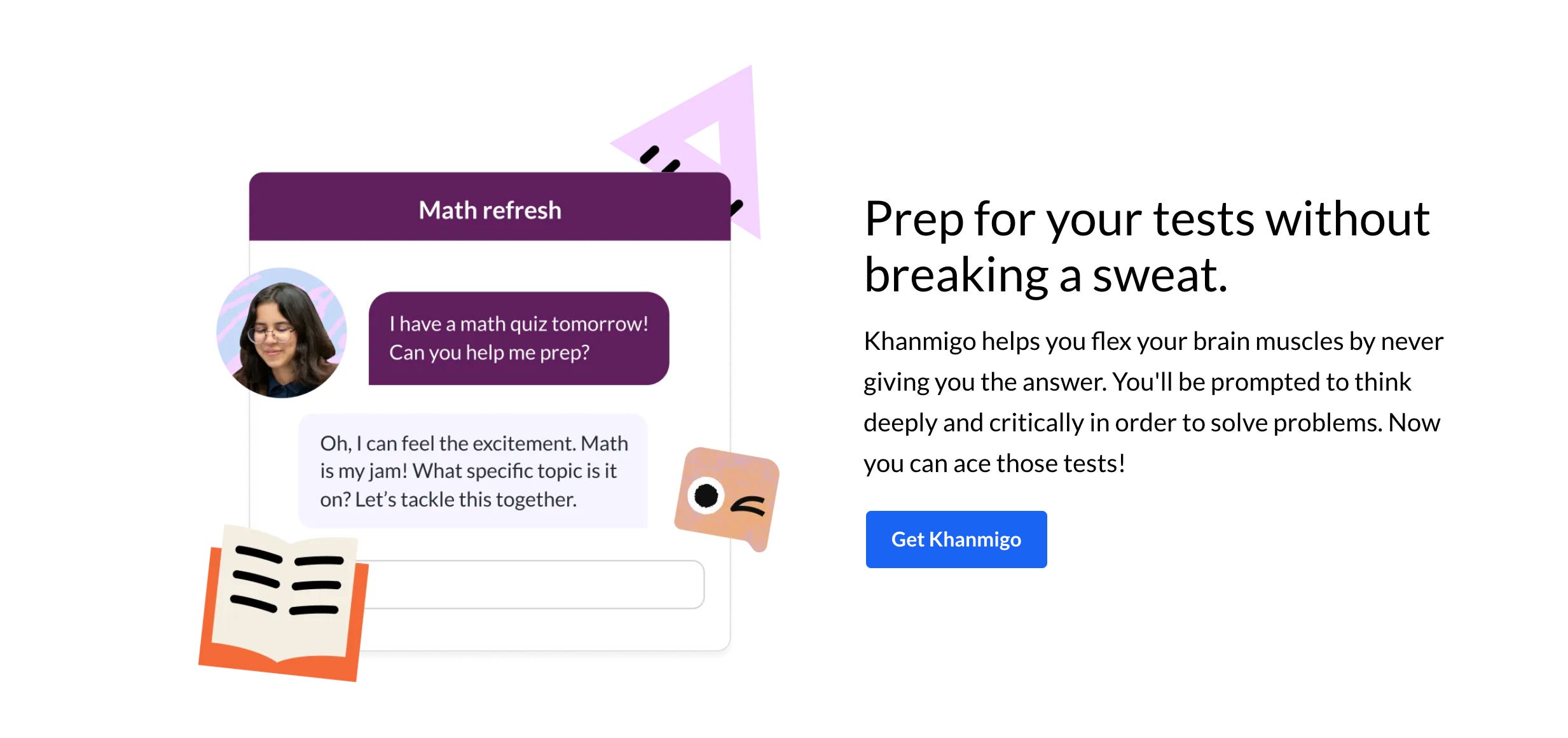
Khanmigo is a Socratic tutoring layer built directly on top of Khan Academy’s content library - the biggest free educational content archive ever assembled - and it is the only AI tutor on the market that has categorically refused to give students answers since its launch in March 2023.
Primary intent: Guided reasoning, curriculum-aligned
Job it closes:
“I need help right now, in the exact subject I’m studying for class tomorrow, and I want to understand it — not copy it. And… I don’t want my kid to just get better at asking AI for shortcuts.”
It translates to:
Log in via Khan Academy
Navigate to active subject
Invoke Khanmigo on exercise or reading
Khanmigo asks probing questions rather than resolving the problem
Student reasons through each step
Progress recorded in dashboard
Optimized for:
K-12 students working through structured curriculum Teachers needing lesson planning, rubric generation, differentiation School districts evaluating AI readiness Students working in their native language (Khanmigo operates in over 34 languages)
Khanmigo grew from 68,000 users in the 2023-24 school year to over 700,000 in 2024-25, expanding from 45 to more than 380 US school district partners in a single year, with projections to pass one million students in 2025-26 (K-12 Dive, 2025). That growth rate tells you something: institutional buyers don’t purchase products they believe will make their students dependent. They purchase products they believe will make their students think.
Churn Watch: The engagement gap is the most honest data point in this category. Industry reporting has confirmed that only around 15% of students in Khanmigo-enabled classrooms use it regularly, a number Sal Khan has acknowledged publicly and that is driving a product redesign shipping in summer 2026. The structural problem is not the pedagogy, but an activation model. Khanmigo waits to be asked. Most students in academic distress want fast relief, not a guide who will make them figure it out themselves; they want the answer and they will find it elsewhere if Khanmigo won’t provide it. The product’s most reliable retention vector is the teacher side - where Khanmigo for lesson planning and rubric generation has sticky, habit-level daily use. The redesign needs to solve for proactive student-side engagement; the Socratic method is only as good as the student’s willingness to start the conversation.
Synthesis Tutor
Founded 2022 by Josh Dahn, who previously ran Ad Astra - the experimental school Elon Musk commissioned for SpaceX employees’ children in 2014. Dahn built Synthesis to take the game-based, mastery-driven philosophy from Ad Astra and make it available to any family, not just those with a rocket scientist parent. Headquartered in Austin, Texas. Consumer subscription, $300/year or $95/year family plan. On pace for $10M+ revenue in 2025.
Synthesis Tutor is a K-5 AI math tutor built around the insight that confidence is the prerequisite to learning, and that for young children especially, the feeling of being capable and making progress is what everything else runs on.


Primary intent: Math confidence and fluency, ages 5-11
Job it closes:
“I want my kid to actually enjoy math and feel good at it before school teaches them they’re not. And I don’t want to drill them on worksheets they already associate with failure.”
It translates to:
Parent subscribes
Child opens colorful adaptive interface
AI tutor assigns age-appropriate math content with visual manipulatives
Voice-guided instruction walks the child through the problem without triggering frustration
Difficulty adapts in real time based on the child’s responses
Parent receives progress dashboard
Optimized for:
Young children aged 5-11, building foundational numeracy
Neurodiverse learners who need multi-sensory input
Homeschooling households wanting structured math progression
Parents who want measurable acceleration, not just engagement
When Synthesis went public in 2022, it brought a specific design philosophy with it: that schools are structured to produce average performance, and that the right technology could produce genuinely exceptional outcomes for ordinary children. When a child gets a wrong answer on Synthesis, the AI doesn’t say “try again” - it adjusts the visual representation, breaks the problem into a smaller step, and tries a different sensory approach. The system is optimized for the moment just before frustration, which is exactly the moment most kids exit.
Churn Watch: Synthesis has graduation churn written into its architecture. The product covers K-5 only, which means every family with a child approaching age 11 is on a countdown to forced attrition - as the product runs out of content for their child. The company has stated plans to expand to K-12, but until that ships at scale, subscriber tenure has a ceiling.
The second churn vector is parental confidence: without visible academic improvement within roughly 60-90 days, the subscription shifts from “investment in my child” to “expensive educational entertainment.” Unlike Khanmigo, Synthesis has no institutional safety net - every subscriber is a direct consumer decision, renewed or canceled on a parent’s subjective read of whether their child is measurably ahead.
Six Retention Mechanics in AI tutoring
for you to steal
1. Context access as a moat. The retention mechanic that most of this category can’t replicate is Brilliant’s: Koji has full visibility into the live lesson state - every choice made, every pause taken - which allows it to intervene with precision no generic LLM can match. When an AI tutor can see exactly what’s on your screen and reach into the interface to annotate it, the tutoring session is irreplaceable. This is technically non-replicable for anyone who didn’t build the underlying curriculum infrastructure.
2. Institutional lock-in as a substitute for habit formation. Khanmigo’s 380+ district partnerships mean the product’s retention is often not about the student’s relationship with the tool at all - it’s about whether the district renews. This is a fundamentally different churn model from consumer edtech, and it explains why a 15% individual engagement rate is survivable. Institutional churn operates on annual cycles and is driven by administrator satisfaction, not student activation.
3. Emotional confidence as the actual product. Synthesis has identified something the rest of the category under-invests in: for young children, the affective experience of the learning session is the product, not the curriculum. A child who finishes a Synthesis session feeling capable will return without being asked. A child who finishes a session feeling inadequate has already churned - they just haven’t cancelled yet. Building the AI to intervene before frustration, rather than after it, is a retention lever disguised as a pedagogical choice.
4. The MIT study as institutional tailwind. In June 2025, MIT’s Media Lab published research showing that students who relied on ChatGPT showed lower brain activity in the prefrontal cortex compared to those who used search or no tools, with cognitive effects that lingered even after they stopped using AI. This study did not hurt this category - it turbocharged it. Every institutional buyer now has a citation that justifies choosing a guided AI tutor over a generic LLM. Products whose design philosophy predates the study suddenly have peer-reviewed wind in their sails.
5. The anti-dependency frame as an acquisition mechanic. All three products lead their positioning with some version of “we don’t give you the answer.” This is now the category’s primary conversion message, targeted directly at the anxiety every parent has about AI making their child intellectually lazy. But it cuts differently depending on who’s hearing it: a parent choosing Synthesis is reassured; a student in distress choosing between Khanmigo and ChatGPT at 11 pm will choose ChatGPT. The frame that wins on acquisition may not be the frame that wins on retention if the student population skews toward distress rather than curiosity.
6. Progress visibility for the buyer, not the user. In consumer edtech, where the payer (parent) and the user (child) are different people, retention depends on keeping both satisfied - and they measure different things. The child needs to feel competent and not bored. The parent needs to see evidence that the money is working. Products that give parents rich, specific, visible progress signals buy themselves substantially more time to prove value, because the parent’s renewal decision is not purely based on the child’s enthusiasm for opening the app.
Read more:


