

If you tracked what you ate yesterday, you probably took a photo. Not typed a name into a search bar. Not weighed anything on a kitchen scale. Just point your phone at a plate and let the app figure it out. That felt normal. Maybe even obvious. Hard to imagine it was a feature that didn’t exist two years ago in any app that actually worked at scale.
That was then. This is now, and now just got more interesting.
That wasn’t always the case.
In the early 2010s, calorie tracking was a discipline. MyFitnessPal had already cracked the habit loop - build the streak, log the meals, watch the numbers compound. But logging required effort. You searched a food database. You estimated portion sizes. You picked the closest match from a list of 47 variations of “grilled chicken breast.” Memory was distributed and manual.
That design reflected the user it was built for: someone motivated enough to learn the system and disciplined enough to maintain it. That’s a real user. That user still exists. But it’s not everyone.
The broader population -- the one that downloaded a wellness app for January and deleted it by March -- was never going to sustain that workflow. Logging required a willingness to confront every calorie, in real time, with precision. For many people, that precision felt like punishment.
Then AI-native photo recognition arrived. OpenAI’s Vision API matured. Two high school students -- Zach Yadegari and Henry Langmack -- looked at what was newly possible and built Cal AI: point your camera, get a calorie estimate, move on. Just a photo and a number.
The product was not trying to be accurate to three decimal places. It was trying to remove the activation cost of logging entirely. That turned out to be exactly the right bet.
The real shift happened with the collapse of the effort barrier.
For two decades, calorie tracking had been evolving -- from paper food diaries to searchable databases to barcode scanners to photo logging. On the surface, this looks like an incremental tooling improvement. In reality, it reflects something more structural:
The moment nutrition tracking stopped requiring nutritional knowledge.
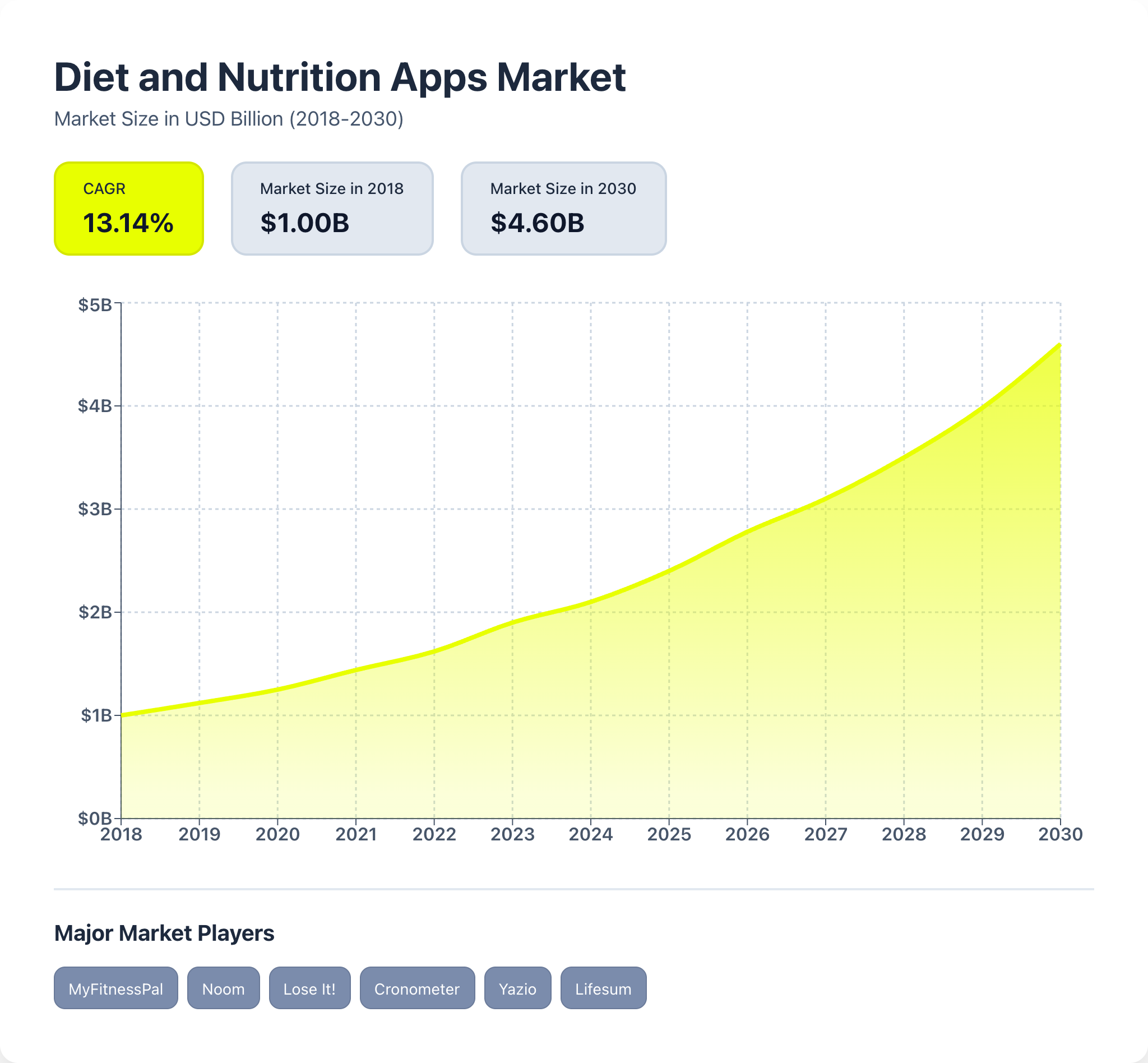
Market at a glance:
The diet and nutrition apps market reached $2.14 billion in 2024 and is forecast to hit $4.60 billion by 2030, advancing at an 13.14% CAGR. Growth drivers include rapid improvements in AI-based food recognition, expanding corporate wellness budgets, and wearable ecosystems that link continuous biometric data with dietary guidance. Zooming out, the broader digital fitness apps market stood at $13.59 billion in 2025 and is forecast to climb to $24.74 billion by 2030, at a 12.7% CAGR. The broader gravity includes digital therapeutics, GLP-1 companion apps, and corporate wellness platforms -- making this a consolidating category, not a fragmenting one. The players with data depth and distribution will absorb the players with UX breakthroughs.
Key market drivers:
1 - AI food recognition: AI-driven portion-sizing is reducing logging friction at a projected 13.89% CAGR to 2030
2 - Subscription monetization: Premium tiers are advancing at 14.5% CAGR as users pay for AI coaching and clinical analytics
3 - Corporate adoption: Enterprise B2B licensing is poised to rise at 15.37% CAGR through 2030 as employers bundle subscriptions to curb healthcare costs
Source: Grand View Research, 2025

Cal AI soared to over 15 million downloads and $30 million in annual revenue in under two years, with seven full-time employees, built in a classroom. That number deserves a second read, not just for what it says about Cal AI, but for what it says about the new economics of app building.
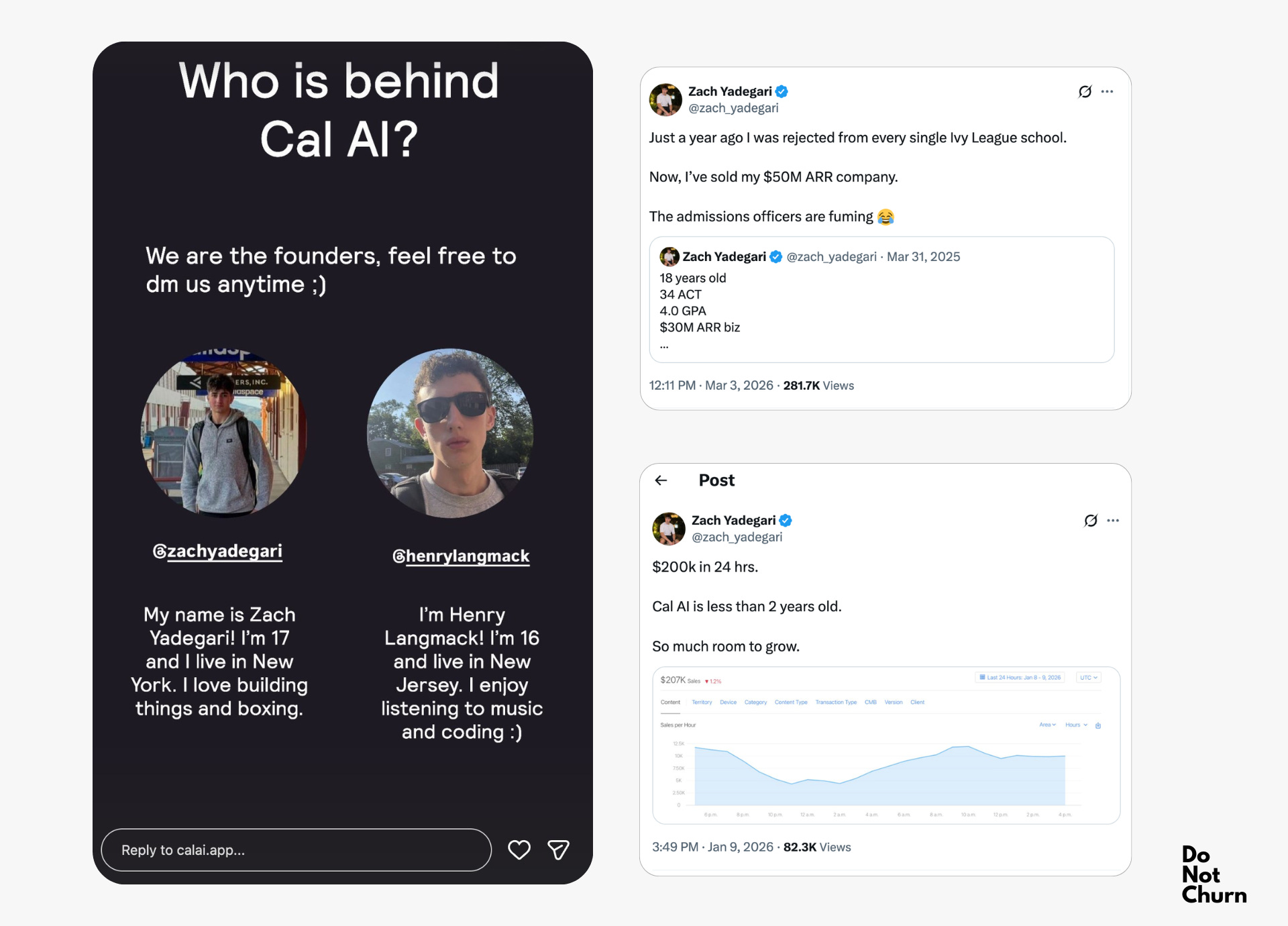
What made it work wasn’t the technology alone -- OpenAI’s Vision API was accessible to anyone willing to build. What made it work was the founder’s clarity about the job, and the distribution machine he built to scale it.
Cal AI is optimized for what I’d call frictionless entry -- and it executed that positioning nearly perfectly.
Primary intent: Speed-first calorie tracking
Job it does:
“I want to have some sense of what I’m eating without it becoming a part-time job. And… I don’t want to build a system, maintain a streak, or feel guilty every time I skip a day.”
It translates to:
Snap photo ✔️
AI estimates calories and macros ✔️
Log confirmed ✔️
Move on ✔️
Optimised for:
• Fitness-oriented users who already have dietary intuition but want tracking confirmation
• First-time calorie trackers are intimidated by database navigation, Gen Z users with high expectations for AI
• Performance athletes who want macro awareness without logging overhead
The distribution ladder. Yadegari has been unusually candid about Cal AI’s growth engine in public interviews, and the detail is worth unpacking. It was a deliberate progression that hit each ceiling in sequence. He started with fitness influencers -- which got Cal AI to roughly $2 million per month -- then stalled. The fitness influencer audience is finite and heavily overlapping; the marginal impact of the 40th fitness creator collapses quickly. So he expanded to non-fitness creators, then made one of the boldest bets in the story: a $500,000 Mr. Beast sponsorship. Front-end ROI was slightly negative on direct conversions. The brand authority it unlocked -- legitimising the product for tens of millions of viewers, making future creator deals easier to close -- made it profitable in hindsight. Then came paid Meta and TikTok ads, managed in-house after a failed agency stint, layered on top of a creator affiliate program run through Tribe that pays creators a revenue share rather than flat fees.
January 2026 revenue: $5.7 million. ARR at the time of sale: approximately $50 million.
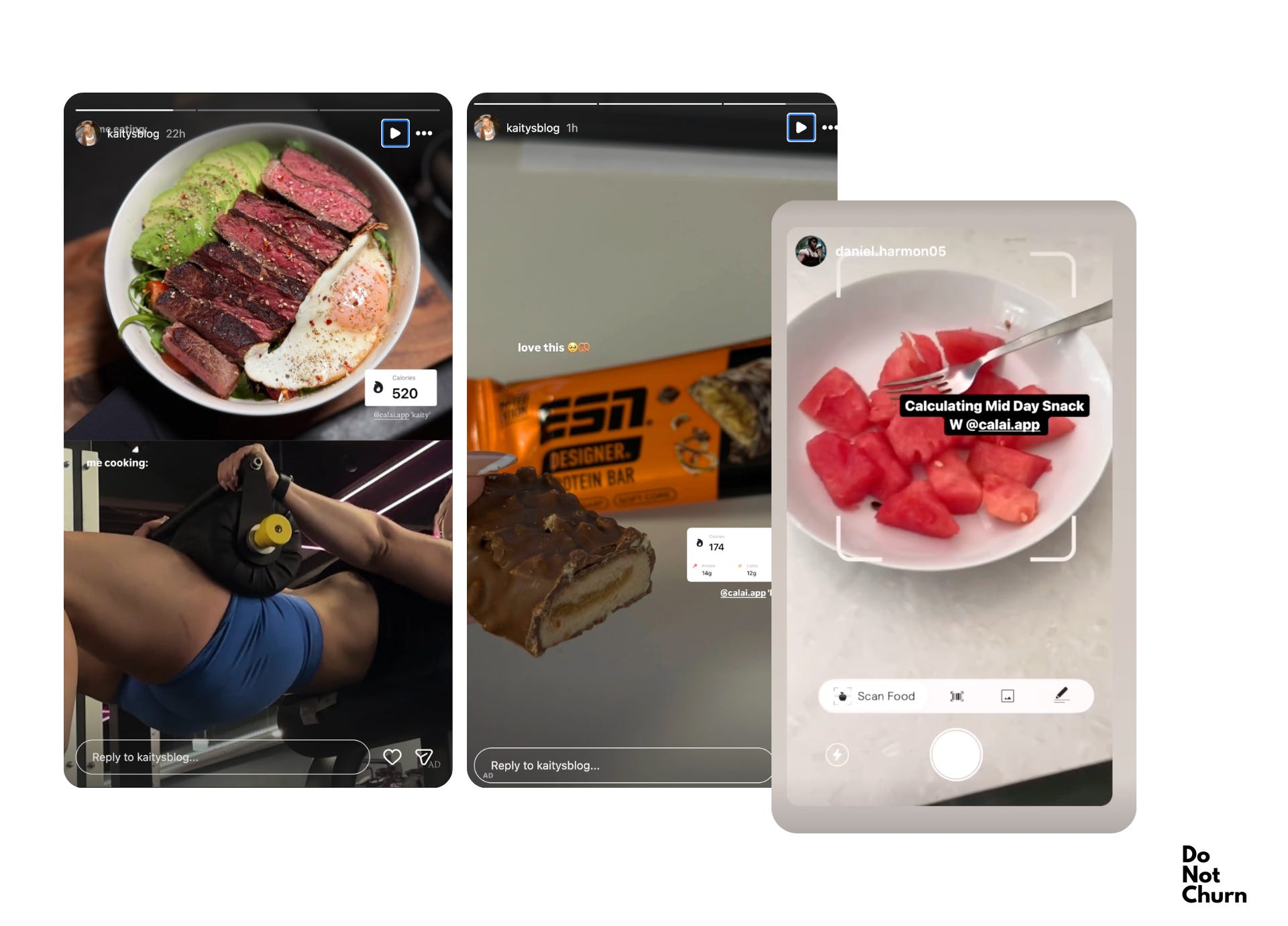
The product detail no one talks about. Cal AI built two versions of its app -- one for regular users, and a parallel version designed exclusively for content creators. The creator version displays the Cal AI brand prominently on every screen and shows a perfect multi-week logging streak regardless of actual usage. It is built to be filmed. When an influencer records a morning routine and holds their phone for four seconds, the app on screen looks like a product people actually commit to -- long streaks, clean UI, prominent logo.
Yadegari described it plainly: it’s the difference between a real hamburger and the hamburger in a McDonald’s ad. The design was not an afterthought. It turned every creator video into a brand moment that appeared completely organic.
The attribution insight. Most founders running multi-channel acquisition have no clean way to separate paid ad revenue from influencer revenue. Yadegari’s team built a partial solution using App Store custom product pages -- one per paid campaign, each with a trackable conversion path isolated from the main listing. Users who see an ad and click through hit a dedicated page; the revenue that page generates is directly attributable to that campaign. Yadegari estimates about 30% of conversions still happen off-attribution -- users who see an ad but then go search the app name manually -- requiring a manual uplift correction.
But the floor is clean enough to make real capital allocation decisions: kill underperforming sets, double down on winners, and stop confusing influencer halo with paid performance.
The onboarding machine. I went through the full Cal AI onboarding, and it’s worth reading screen by screen -- because the conversion psychology is deliberate and layered. The flow opens with a trust-building claim before asking for anything: “80% of Cal AI users maintain their weight loss even 6 months later.” That’s not a feature. That’s an anxiety reducer placed at the exact moment a new user is deciding whether to bother.
Then the quiz begins -- goal, date of birth, desired weight, pace preference, barriers, aspirations, diet type, Apple Health connection. Ten questions. Each one increases the user’s felt investment before any paywall appears. By the time the “Congratulations, your custom plan is ready!” screen lands -- with a specific calorie target, a specific macro breakdown, and a specific goal date -- the user has mentally committed.
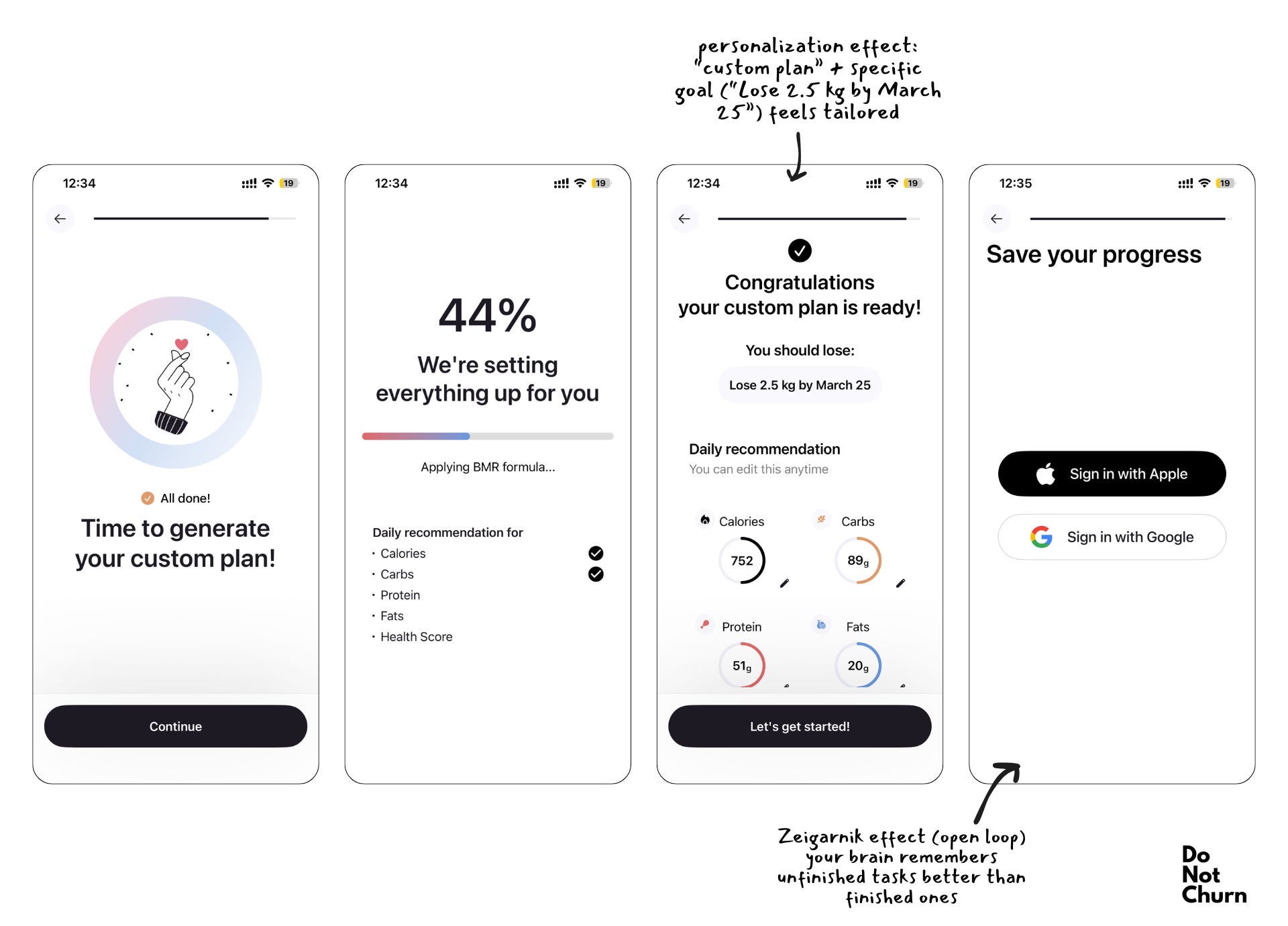
The plan feels personalized because the data they gave was personal, even if the underlying logic is a standard BMR formula. The “We’re setting everything up for you — Applying BMR formula...” loading animation at 44% completion makes a spreadsheet calculation feel like a personalized AI build. It’s not deceptive. It’s just good design.
The social proof is strategically embedded again right before the paywall: “90% of users say the change is obvious after using Cal AI.” At that point, the user has a custom plan, a goal date, and two data points telling them this works. Only then does the subscription screen appear -- Monthly €9.99/mo versus Yearly €2.91/mo, with the yearly pre-selected, a “No Payment Due Now” reassurance, and a transparent timeline showing exactly when the reminder and billing will hit. This is a textbook commitment-escalation funnel.
The paywall doesn’t feel like a gate. It feels like the last step in an already-started journey.
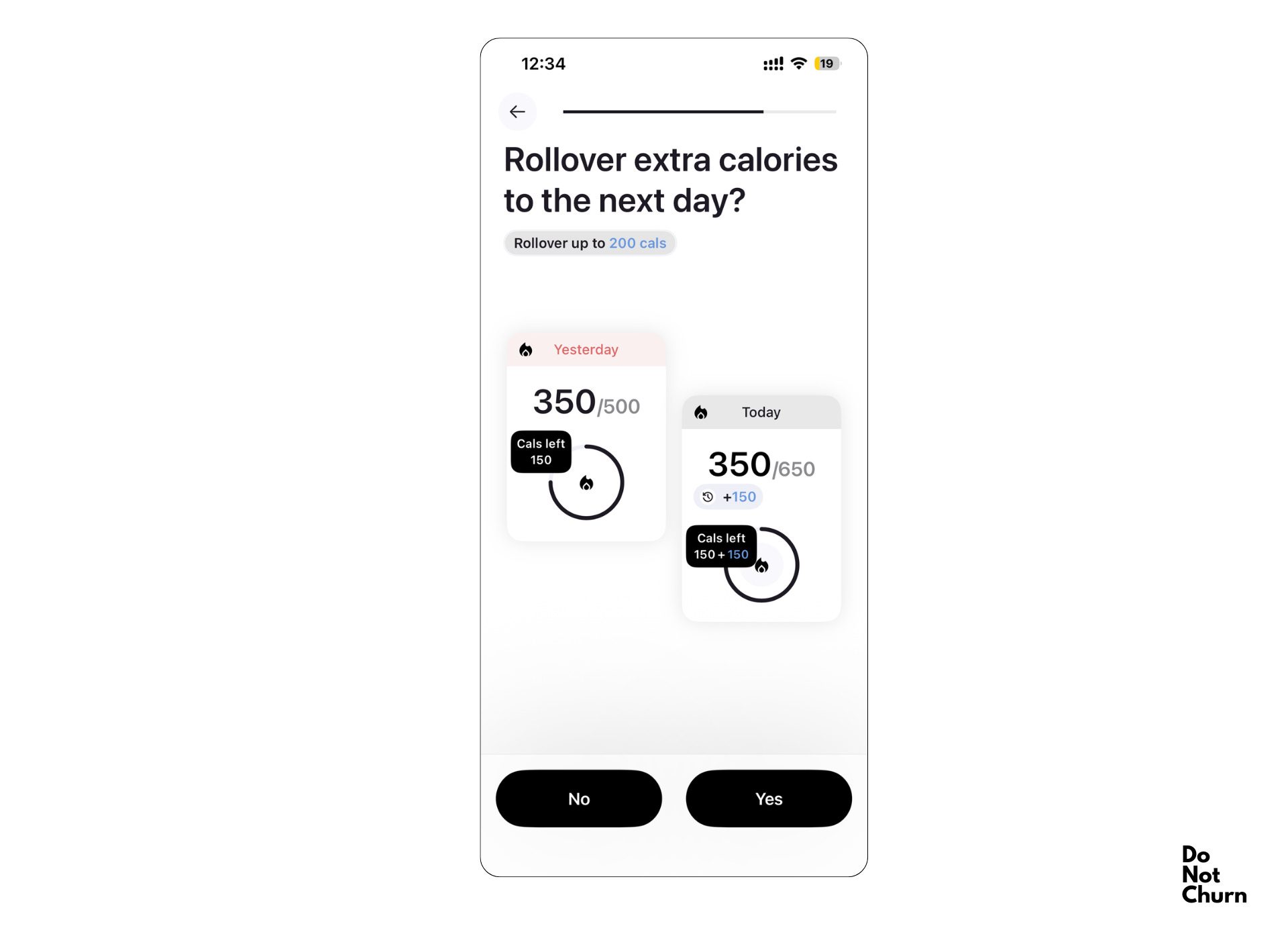
Rollover calories. Cal AI asks during setup whether you want to carry unused calories from one day to the next -- up to 200 -- as a credit toward the following day. This is a behaviorally sophisticated design. Traditional calorie apps punish under-eating with nothing: you had a great day, and the app simply resets to zero. Cal AI’s rollover makes discipline feel rewarding and prevents the catastrophic “I had a bad day, I’ve blown it, why bother” churn spiral. Good days compound. Bad days are buffered. The app is subtly teaching users that consistency beats perfection -- which happens to also be the mindset most associated with long-term subscription retention.
Churn watch: Cal AI’s most serious structural risk isn’t accuracy credibility. It’s the calorie targets it recommends during onboarding. At the “Recommended” pace setting, the plan generated for a user trying to lose 2.5 kg gives a daily calorie goal of 532 calories. The “Fast” setting -- which the app allows users to select -- generates targets as low as 201 calories per day.
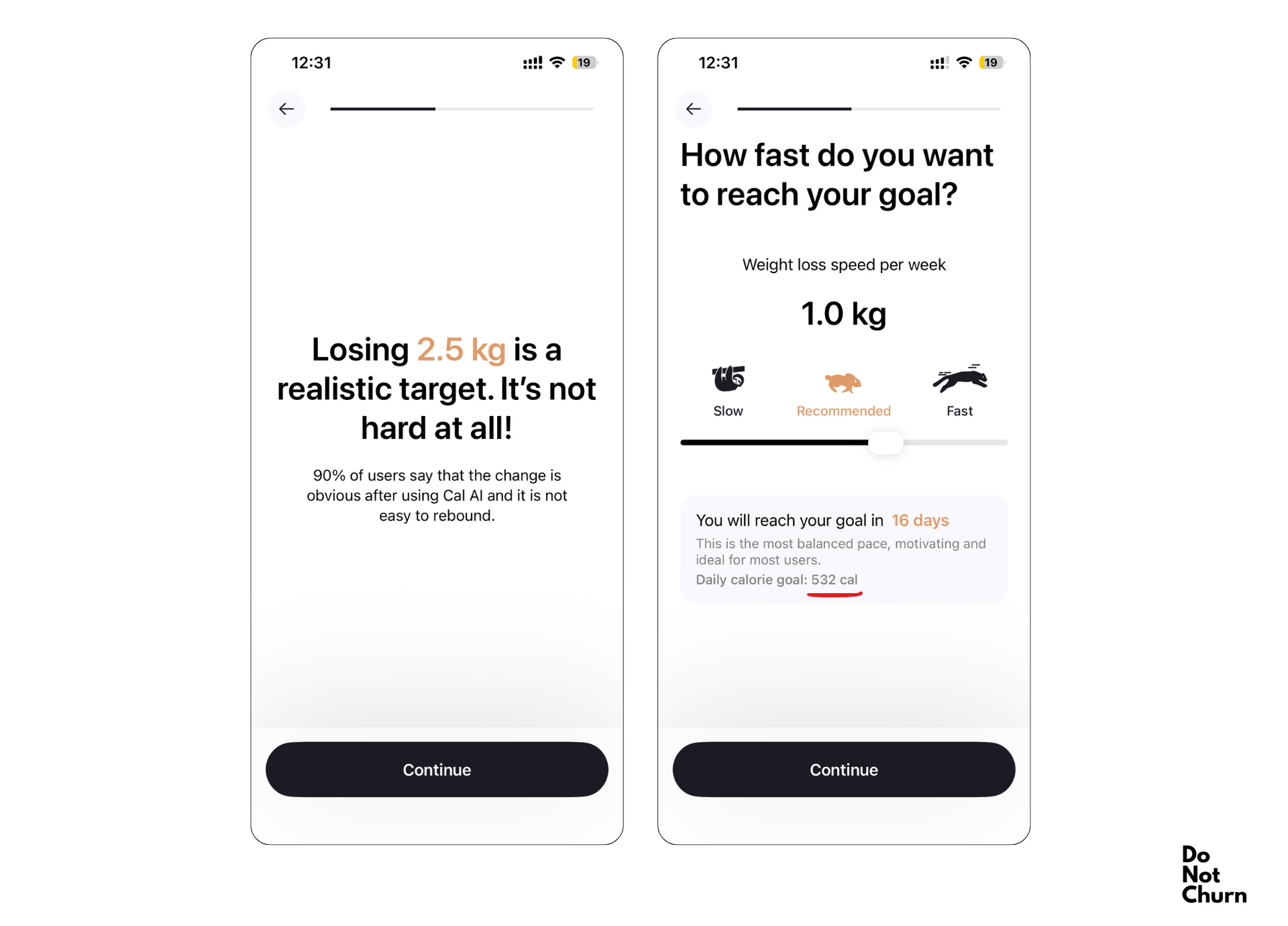
These are clinically dangerous numbers. The medically accepted minimum for adults is typically 1,200 calories for women and 1,500 for men; below that, the body enters conservation mode, energy crashes, adherence collapses, and the weight typically rebounds. The fast-setting screen does include a small warning -- “Fast loss can cause fatigue or loose skin” -- but the warning sits below a prominently highlighted “You will reach your goal in 12 days” badge in orange. The incentive architecture points toward urgency, not safety. A user who follows a 532-calorie plan will not fail because Cal AI’s photo scanning was wrong.
They will fail because the target itself was unachievable. And when they fail, they will blame themselves, delete the app, and not renew.
Industry annual subscription retention for health and fitness apps sits at approximately 30% -- meaning roughly 70% of annual subscribers don’t renew. Cal AI’s onboarding arguably accelerates that number by setting expectations that its own recommendations cannot deliver. This is the churn risk that matters, and it’s one MFP’s 20 years of science-backed nutritional data infrastructure is uniquely positioned to fix -- if they choose to.
Who acquired Cal AI - and why it matters
MyFitnessPal is the #1 global nutrition and food tracking app, founded in 2005, with 280 million members across 120 countries and a food database spanning 20 million foods, 68,500 brands, and meals from 380+ restaurant chains. That database is a 20-year data moat that no startup can replicate with a Vision API and a weekend.
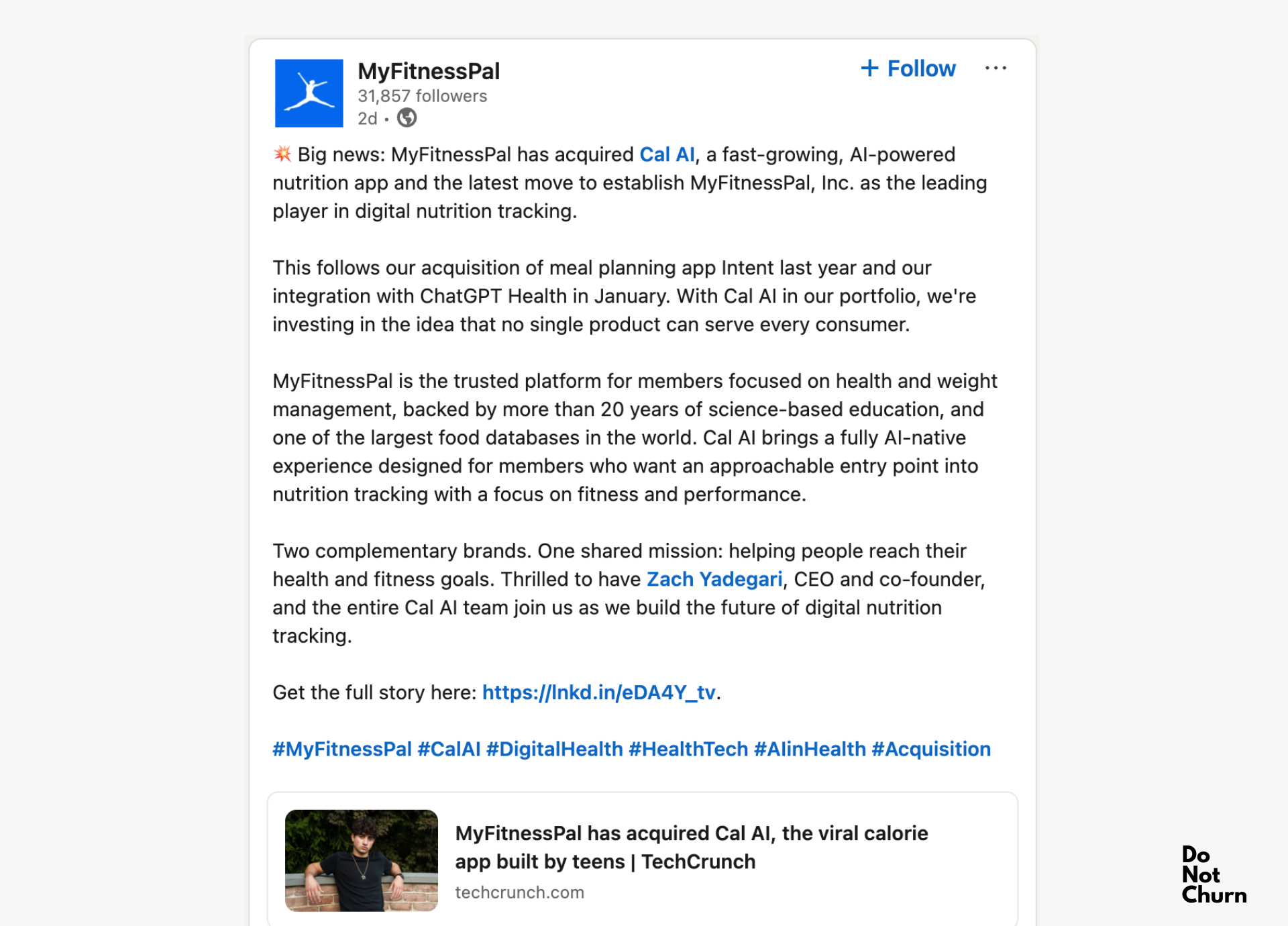
MFP monitors a competitive suite of some 70 rivals using tools like Sensor Tower -- and when Cal AI started climbing the charts neck-and-neck with MFP in their category in early 2025, outreach started almost immediately. The deal closed in December, marking MFP’s third significant move in just over a year -- following the acquisition of meal planning app Intent and an integration with ChatGPT Health. This is not reactive M&A., but a move made by a company with a competitive intelligence infrastructure running a deliberate portfolio strategy.
Why not merging is the whole strategy
MFP has no plans to integrate Cal AI into its core product or replace its existing meal-scan features. Both apps serve different segments: Cal AI for speed, MFP for nutritional precision.
That decision is the entire thesis.
Most acquirers absorb their targets -- migrate the user base, fold the features, retire the brand. Sometimes that’s right. Here, it would be wrong, and Fisher knows it. The Cal AI user is not an MFP user who hasn’t upgraded yet. They are a structurally different user who has opted against the MFP experience. Merging the products wouldn’t unlock a new audience. It would just make both products worse.
The immediate proof of concept: Cal AI users already have access to MFP’s database post-acquisition -- 20 million foods, 68,500 brands, 380+ restaurant chains -- without the apps merging at all. Cal AI gets more accurate. MFP’s database investment compounds across two surfaces. No brand dilution required.
As Fisher put it: “People come to nutrition with different goals and different levels of experience, and they need tools that meet them where they are.”
The moment Cal AI starts meeting users where MFP is, it stops meeting them where they came.
The six mechanics that built a $50M ARR app in 18 months
1. The distribution ladder, not a single channel
Cal AI didn’t pick a channel and scale it. It moved through channels sequentially as each one hit its ceiling - fitness influencers, then broad creators, then Mr. Beast, then in-house paid performance, then creator affiliates. Each stage built the brand awareness that made the next stage more efficient. Why it prevents churn: users acquired at the top of a warmed-up funnel - people who saw an influencer, then saw an ad, then searched the app name - arrive with higher intent and lower early dropout rates than cold paid installs.
2. Engineering the product to be filmed (the creator-mode app)
A parallel version of Cal AI with a prominent logo on every screen and a perfect fabricated streak turns influencer videos into credibility demonstrations without looking like ads. Product-led distribution design. Why it prevents churn: users who download after seeing the product in use arrive with a more realistic mental model of the experience. Expectation alignment is one of the most underrated early-churn levers in subscription apps.
3. Attribution architecture as a capital allocation tool (App Store custom product pages per campaign)
By isolating paid traffic to campaign-specific App Store pages, Cal AI could distinguish paid performance revenue from organic and influencer baseline - giving the media buyer clean enough signal to kill underperforming creatives and scale winners with confidence. Why it prevents churn: better attribution routes acquisition spend toward higher-intent users, not just higher-volume installs.
4. Database moat as accuracy backstop (MFP’s 20M food database now powering Cal AI)
Post-acquisition, Cal AI’s estimates are grounded in MFP’s two-decade food database. The switching cost for a user is now historical, not technical. Why it prevents churn: accuracy is Cal AI’s single biggest retention variable. Every marginal improvement in calorie estimate credibility extends the window before a user decides the numbers aren’t trustworthy enough to act on.
5. Rollover calories as a behavioral safety net (Cal AI’s carry-forward calorie mechanic)
Cal AI asks during onboarding whether users want to carry unused daily calories forward - up to 200 - as credit toward the following day. This design choice is easy to miss and worth studying closely. Most calorie apps treat a day’s end as a hard reset: under-eat today and the app gives you nothing for it tomorrow. Cal AI’s rollover makes discipline feel cumulative. More importantly, it softens the psychology of imperfect days - the “I had a bad day, I’ve blown it, might as well quit” spiral that drives a measurable percentage of early churn in every habit-based subscription app. Why it prevents churn: the product implicitly teaches that consistency beats perfection, which happens to be the mindset most correlated with long-term subscription retention. It’s a small feature with an outsized behavioral effect.
6. Speed as an operating system, not a value statement
In interviews, Yadegari described speed as Cal AI’s number-one company value - operationally, not aspirationally. His practice: identify bottlenecks in real time, get the blocking party on a call immediately, resolve on the call. No waiting. No process theater. For a seven-person team competing against a 20-year incumbent, cycle time is the only structural advantage that can’t be bought. Why it prevents churn: features that reduce friction get shipped faster. Bugs that erode trust get fixed faster. The product improves at the rate needed to keep early adopters engaged long enough to become habitual users.
Key takeaways
Nutrition apps no longer compete on database size or feature depth -- they compete on how much effort they remove from the act of logging, and how well the commitment architecture in onboarding converts investment into subscription.
Cal AI’s onboarding is a masterclass in commitment escalation: ten personalized questions, embedded social proof at two anxiety peaks, and a paywall that appears only after the user already has a custom plan, a macro target, and a goal date. By the time billing is introduced, the decision has already been made.
The rollover calories mechanic is the most underappreciated retention design in the product -- it rewires the “I had a bad day, I’ve blown it” churn trigger into a compounding reward for consistency.
Cal AI’s most serious structural risk isn’t photo scan accuracy -- it’s the calorie targets its own onboarding recommends. A 752 cal/day “recommended” plan isn’t sustainable; a 201 cal/day “fast” plan borders on dangerous. Users who follow the plan and fail won’t blame the plan. They’ll delete the app. MFP’s science-backed nutritional infrastructure is the most strategically valuable thing in this acquisition — not for the database, but as a guardrail for what Cal AI’s algorithm actually prescribes.
Retention follows effort alignment; churn begins when the product demands more from the user than the user signed up to give — and accelerates when the plan the product designs is physically impossible to sustain.
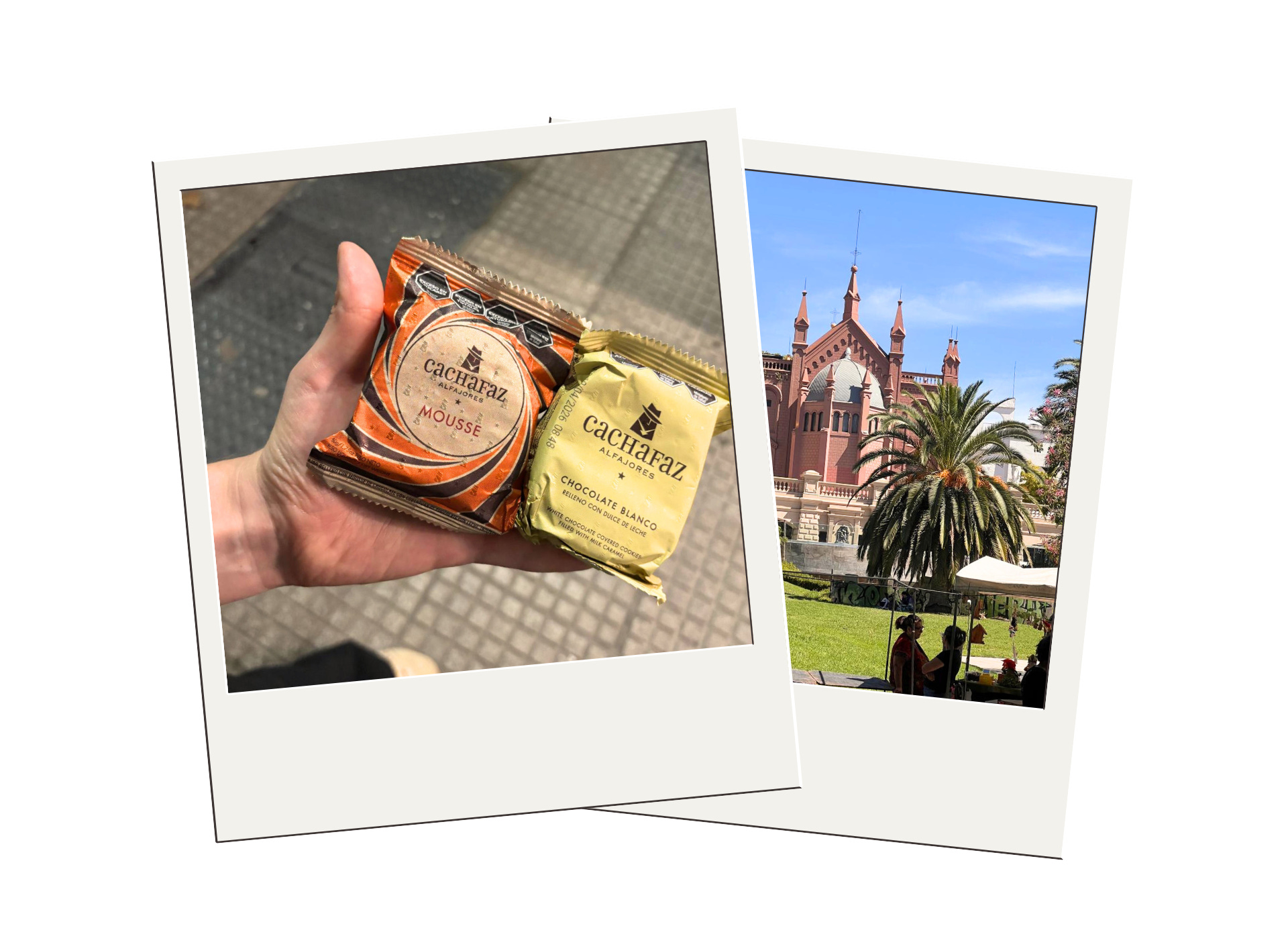
Written right after an alfahores tasting in Buenos Aires, Argentina
If this one resonated, these are worth reading next:
✨ From swipe fatigue to IRL: Inside the apps racing to get you off your screen How Hinge, Timeleft, and Thursday built apps that optimize for outcomes rather than session length - the same shift Cal AI is attempting in nutrition.
🤍 Search to Swipe: what three decades of Dating Apps reveal about customer experience and churn How consumer apps built for engagement accidentally trained users to disengage - the longer version of the same argument this article makes.
📱Is ‘app-of-apps’ becoming the new interface for work and life? If the standalone brand strategy in this article caught your attention, this issue maps exactly how that portfolio model creates retention - and where it creates fragmentation risk.