


For most of the 20th century, getting something done that you didn't fully understand meant finding a person who did, and letting them operate the interface on your behalf. Take booking trips before travel aggregators: you didn't compare hundreds of fare classes across a dozen airlines; you just called a travel agent, named the destination, and they navigated a reservation system you never had to see. Before the web, booking a flight meant visiting a travel agent who consulted a printed schedule book on your behalf — speed improved over decades. Still, the shape of the interaction didn't change: you spoke your intent, and someone else operated the tool.
That model held until self-service software made it economically pointless. Online travel agencies let ordinary consumers reach the same reservation systems agents once monopolised, and the effect was brutal on the intermediary layer — U.S. travel agent employment fell from a peak of roughly 340,000 around 2000 to roughly 60% below that by the mid-2020s, driven by airlines cutting agent commissions and by Expedia-style platforms proving people would rather click than call. Banking followed the same arc on a different clock: ATMs first made tellers more productive by taking over routine cash transactions, but mobile banking finished the job — commercial bank branches per capita have fallen by nearly 30% since peaking in 2009, and Bank of America alone cut headcount from 288,000 to 204,000 between 2010 and 2018 as branch visits stopped being necessary at all.
Life and Work through a Single interface
My life, just as much as yours, is split between a bunch of different interfaces where I keep things and get things done. Booking a weekend getaway via a hotel booking app, flights via a flights app, keeping notes, ideas, tasks, and thoughts in various documents on my Google Drive and some of them in the Notes app, and my business and personal schedule in Google Calendar. Hours of my life are spent just keeping track of everything and making sure that no important e-mail got missed, an important call got scheduled, and all that wouldn’t collapse or conflict with one another. A while ago, I wrote about context stitching being an outcome of the absence of one single product that would be solving the issue from top to bottom. Now, with AI racing through various sets of problems with enormous speed that makes everyone feel vertigo, we finally get to witness a gleaming solution to one of the nastiest problems — we figured out a way to manage everything through a single interface.
Grok Bot
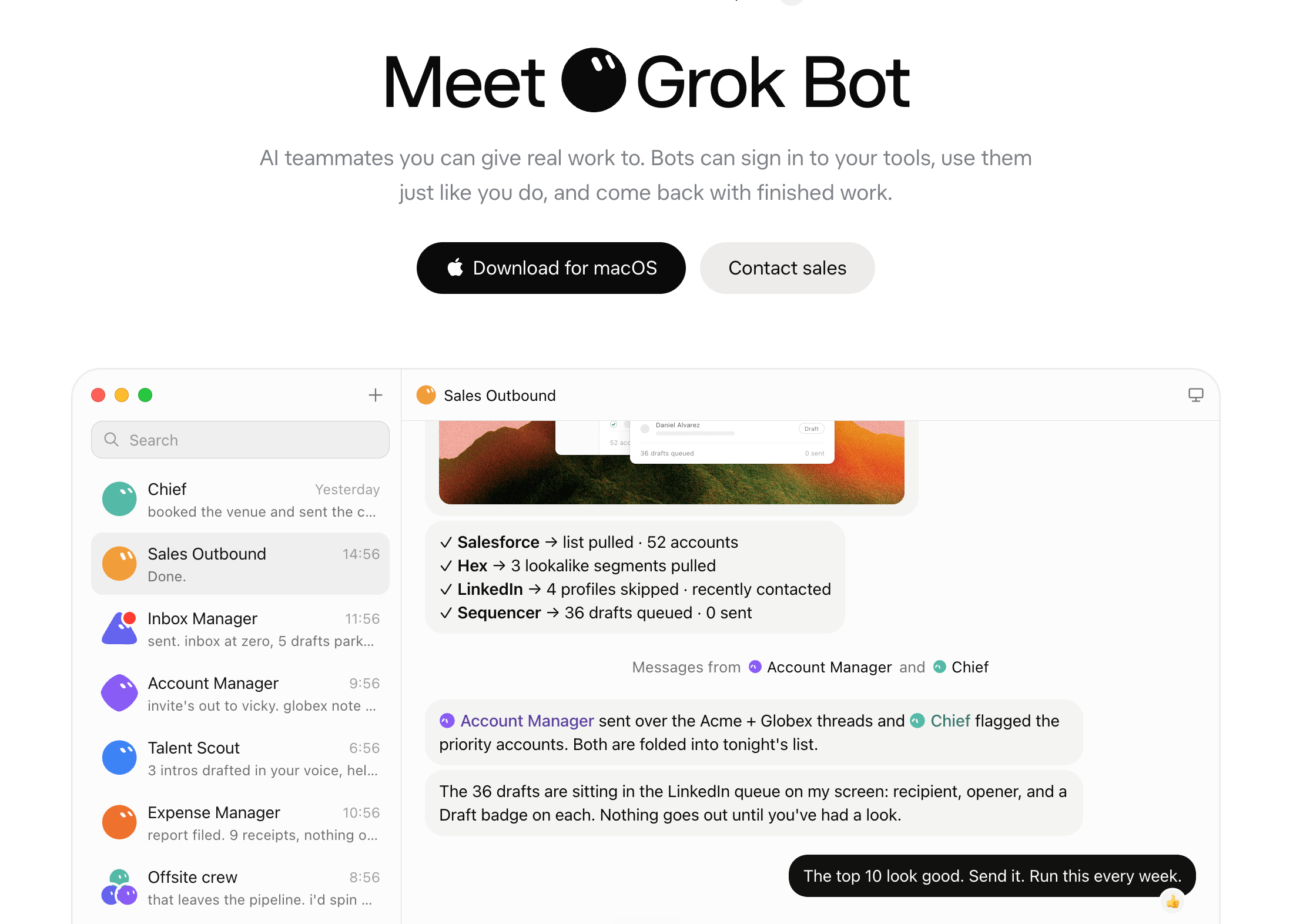
Grok Bot is xAI’s answer to this, launched into public beta on August 11, 2026, as part of the newly formed SpaceXAI group — Elon Musk’s merger of xAI, SpaceX, and Cursor into one vertically integrated stack. It isn’t a chatbot you prompt. It’s a roster of persistent, named AI agents, each with its own cloud computer, that you hire, train, and hand real work to.
Why Grok Bot’s “Let someone else handle it” actually lives up to expectations?
Computer use
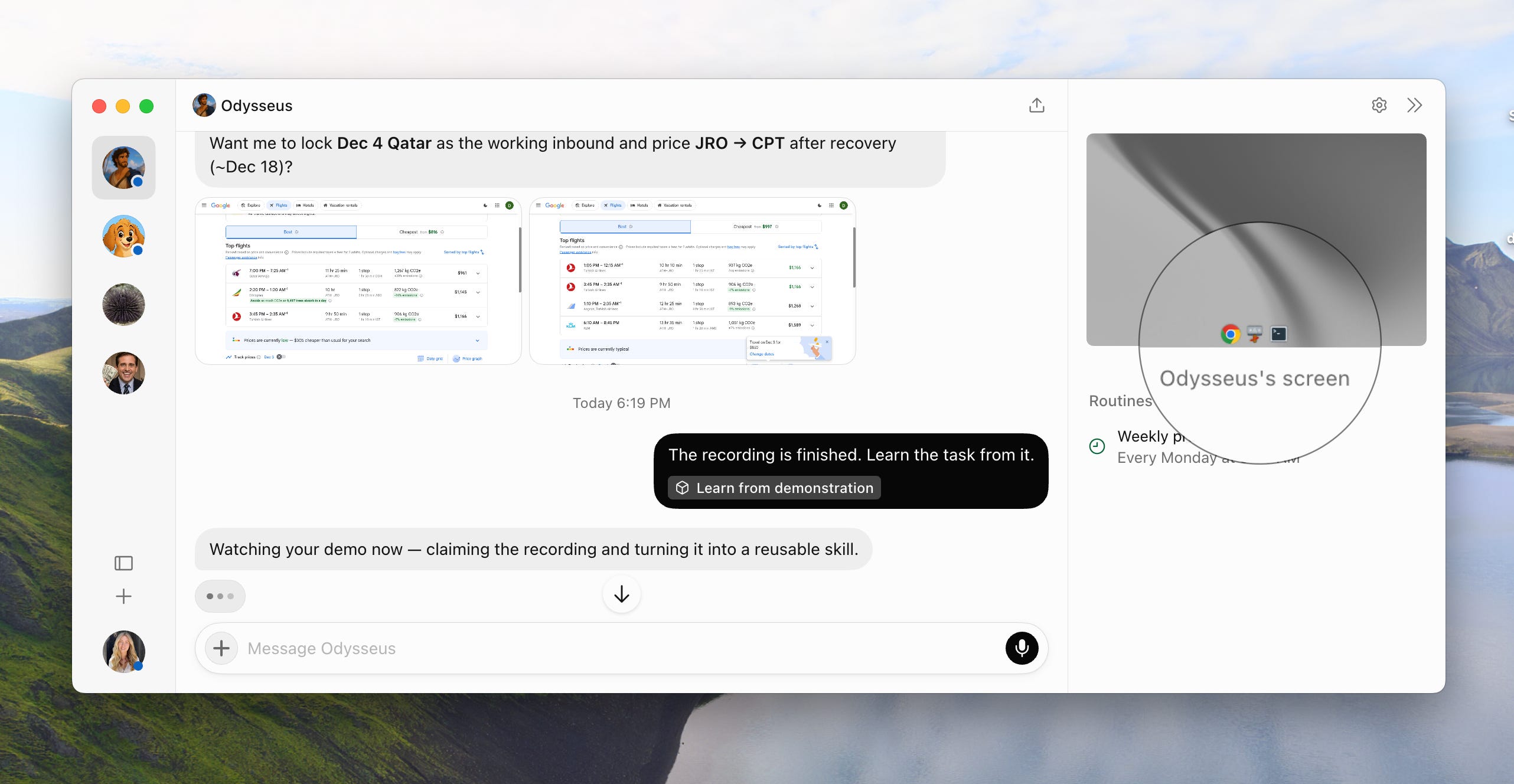
Grok Bot has its own computer, where it does things for you - just as if any human personal assistant that you hired, who would have their own personal computer and be there to get things done for you, with 24/7 availability and unlimited capacity.
Every single time you request it to run a task, it does it through what we now call 'computer use', when an agent can execute a task, like finding you plane tickets or buying you groceries - it actually browses the web and navigates an interface like a human would, scrolling through pages. It's very amusing to watch Grok going through a desktop window. Any other cloud agents are mostly accessing other apps through MCP or CLI, which works like an API call - it only works where a structured integration for that exact app and action already exists, and it breaks or simply can't reach the destination the moment it hits a site or workflow nobody's wired up yet. On top of that, you can show how you do things to Grok and teach him a task using his computer - your screen will be recorded, analysed, and Grok will execute the steps the same way you normally do it. It feels just like onboarding a new employee.
Wide range of integrations
Grok Bot has 20-plus integrations with other platforms like Figma, Notion, Gmail, Google Calendar, GitHub, and Salesforce, which allow seamless and cohesive navigation of all sources required for executing a task and closing a full loop without leaving “one last thing” that you need to do yourself manually.
It does payments on your behalf
We finally saw something that ChatGPT was trying to launch within Operator in January 2025, but couldn't quite make it work in a full end-to-end manner. What the SpaceX team was focused on is figuring out the last bottleneck, which is making a payment - by partnering with Stripe, they were able to set up a workflow that allows Grok Bot to make a payment on your behalf after your authorising it in the Grok Bot interface. Stripe’s Link issues a one-time virtual card for that specific purchase (merchant and amount) once you approve it, which Grok Bot enters at checkout without ever holding your real card. This works well with tasks like recurring routine shopping that you don’t want to babysit end-to-end (like buying one particular set of one-day contacts every 3 months or a cat litter refill every single month delivered to your address — you still approve each charge) or a one-off purchase that you don’t want to deal with yourself (like buying train tickets on a Spanish website for one particular day of your Euro trip leg).
Churn risk:
Context-insufficiency execution errors.
The most common case is when a user hands off a task without enough context (a name spelling, a contract clause, which "John" they meant) and the Bot executes anyway, confidently, because nothing told it to pause and ask. The counter-lever is a context-completeness check before anything leaves the system, not a review of the output after it's gone.Payment autonomy without a way back. The approval tap only catches an intent mismatch, not an execution mismatch — a user can approve “buy the flight” and still get charged for the wrong date or a duplicate booking, and because the charge runs through a single-use virtual card, there’s no issuer on the other end to reverse it the way a chargeback would. Confirm it by watching the ratio of “wrong but technically approved” refund requests against total Grok Bot-initiated transactions — this category has no fraud protection to fall back on, since the transaction really was authorised. The counter-lever is a cooling-off window above a set dollar amount, where the charge holds instead of settling before the user has a real chance to catch it.
Site friction and auth handoffs.
The chances are high for a Bot to get blocked mid-flow by a CAPTCHA, a “verify you’re human” wall, or a login / 2FA / SSO / passkey step only the user can finish. The task was going fine until the screen demanded a human, and every handoff is a chance they drop it and don’t come back. The counter-lever is designing for graceful pause-and-return (clear “your turn” handoffs, preserved cart/state, one resume path) rather than treating a blocked page as a failed agent.
I lived with Grok Bot for 2 weeks and handled various tasks I would have handled myself previously - either fully manual or partially done in Claude. I tried to live all my life’s admin through one single interface of Grok Bot, and here’s what I learned…
Breakdown of Grok Bot is coming next week!
Claude Cowork
Claude Cowork was born when Anthropic noticed people bending Claude Code, its terminal coding agent, into a general-purpose task tool - so it shipped the non-coding version in about ten days, built using Claude Code itself, and launched it on January 12, 2026.
The connector-first architecture
Cowork doesn’t reach for computer use by default. When you hand it a task, it follows a strict priority order: connectors first, computer use only as a fallback. If a connector already exists for what you’re asking — Gmail, Google Drive, Slack, GitHub, Google Calendar, Microsoft 365 — Cowork uses that connector to complete the task through the app’s own API, the same way any integration would. Only when there’s no connector available for the job does it fall back to interacting with your screen directly.
Beyond the built-in connectors, Cowork can also reach custom or remote MCP servers, which route through Anthropic’s cloud infrastructure rather than your local machine — true even when you’re running Cowork locally. Through a broader integration layer, that extends to more than 1,500 managed third-party integrations beyond what ships natively.
Where the infrastructure won’t go
A few boundaries are built in deliberately:
Consequential, unattended actions. Anthropic’s own safety guidance is explicit: don’t schedule tasks that make purchases, send messages on your behalf, or take other hard-to-reverse actions. This applies in every approval mode, including “Skip all approvals.” Permanent file deletion is the one action that always requires confirmation, regardless of mode.
Anything outside your own access. Since permissions are inherited rather than granted independently, there’s no path for Cowork to reach a file, channel, or account you personally can’t already open.
Unattended screen or file work. As above — no desktop app open, no computer use, no local files, full stop, regardless of what mode you’ve set or how the task is scheduled.
Custom-built agents
Trailblazer companies, like Lovable, Stripe, and AI-first companies that had a chance to think of all their workflows and processes reimagined and had an obvious advantage of being able to build everything from scratch, thought about a set of business problems that are similar in nature to what consumers are struggling with. Context stitching between several sources (design lives in Figma, comms live in Slack and email, finance lives in Stripe… list goes on and on), pouring data from one interface to another, having to type everything into each dedicated field, or having to delegate research tasks to someone with taste and judgement several times a day. The fact is that for them these problems are way more urgent, and business and financial incentives push them harder to fix those. Time is precious, and the price of taking too long to execute literally kills startups in this excellence race. Those companies are building internal systems, with the key execs shipping those themselves, that are customized to what their day-to-day workflow is like. And they're small enough to be able to do it fast and get everyone on board with that.
Lovable Head of Design, Felix Haas ( Design + AI) has built custom agents that bring all his daily stack down to a single interface with several.
Department of Product (Rich Holmes) shared how Uber is running more than 8,000 different agents internally, with McKinsey, Figma, and Ramp cited alongside it as companies building bespoke agent stacks instead of buying an off-the-shelf assistant.
Sharadh Krishnamurthy's engineering team at Stripe built what they internally call a "company brain" - shared context, governance, and a skills platform baked directly into how the whole org works, not a personal hack but a company-wide system.
Agents Talking to Agents
I’ve been experiencing this part for the past two weeks, where there’s an AI agent doing things for me: opening support tickets, scrolling the internet, and placing orders on my behalf. The obvious direction once you've watched it happen enough times: the next stop is my agent talking directly to the business’s agent, with neither of us watching the exchange happen in real time. That layer already exists in early form. Google unveiled the Universal Commerce Protocol at NRF in January 2026 - an open standard, backed by more than 20 partners including Shopify, Target, Stripe, Visa, and Mastercard, built specifically so an AI agent can discover, compare, and complete a purchase without a human ever loading a product page. OpenAI and Stripe built a competing version, ACP, sitting behind ChatGPT’s Instant Checkout, already processing something like 50 million shopping queries a day. And on the enterprise side, agents built on Microsoft Copilot or Salesforce Agentforce are already reordering office supplies and renewing SaaS subscriptions without a human approving each one - business to business, agent to agent, no browser in the loop at all.
It certainly raises a question nobody in marketing or growth has fully answered yet: if a meaningful share of shopping and browsing moves onto an agent that a business’s website never actually renders a page for, what happens to the businesses that don’t adapt - or that actively block agent traffic to protect their own analytics? Do they just quietly stop showing up in the consideration set, the way a vendor with no product feed on Google’s or OpenAI’s protocol becomes invisible to a shopper who’s delegated the comparison entirely?
And on the churn side, the problem gets wilder: how do you even notice a customer going cold when they never log in, never open the app, never generate a single session - because the entity doing all of that is their agent, running on a schedule, and the human hasn’t touched the product directly in weeks? The usual churn signals - declining logins, shrinking session length, fewer page views - stop meaning anything the moment the agent is the one logging in. Somebody is going to have to invent agent customer experience as its own discipline: what does it mean to delight an agent, keep it coming back, and notice when it’s quietly switched to a competitor on your behalf without your user ever making a conscious decision to leave?