

Today, you can open Claude, type “prototype a pricing page for a Python automation SaaS, three tiers, dark mode,” and, within a minute, have a clickable, on-brand prototype you can hand to Claude Code. Without Figma, a product manager and a designer, with no back-and-forth with anyone who lives in a Bay Area zip code. One release has changed the order of how things get from the idea to the product.
I’d been planning this article for months and kept setting it aside. Every design tool I looked at was solving the wrong endpoint - idea to prototype, when the job was always idea to product. Claude Design is the first release that picked the right finish line.
In the early 2020s,
shipping a product meant a chain of specialists: PM writes the spec, designer opens Figma, and engineer translates the file into code. It took three weeks if everyone stayed aligned.
Then the chain started collapsing. Vibe coding took the engineering step first - Lovable, Bolt, v0, Claude Code turned “describe an app” into “working app.” By early 2026, 25% of Y Combinator startups were shipping products where 95% of the codebase was written by AI.
But the chain had a stubborn middle. Somebody still had to design the thing. That judgment call - taste - was the last step outsourced to humans. Figma owned the tool those humans lived in.
On April 17, 2026, Anthropic shipped Claude Design. The middle link folded in too.
The moat wasn’t beaten on features. The workflow stopped needing the step Figma owned.
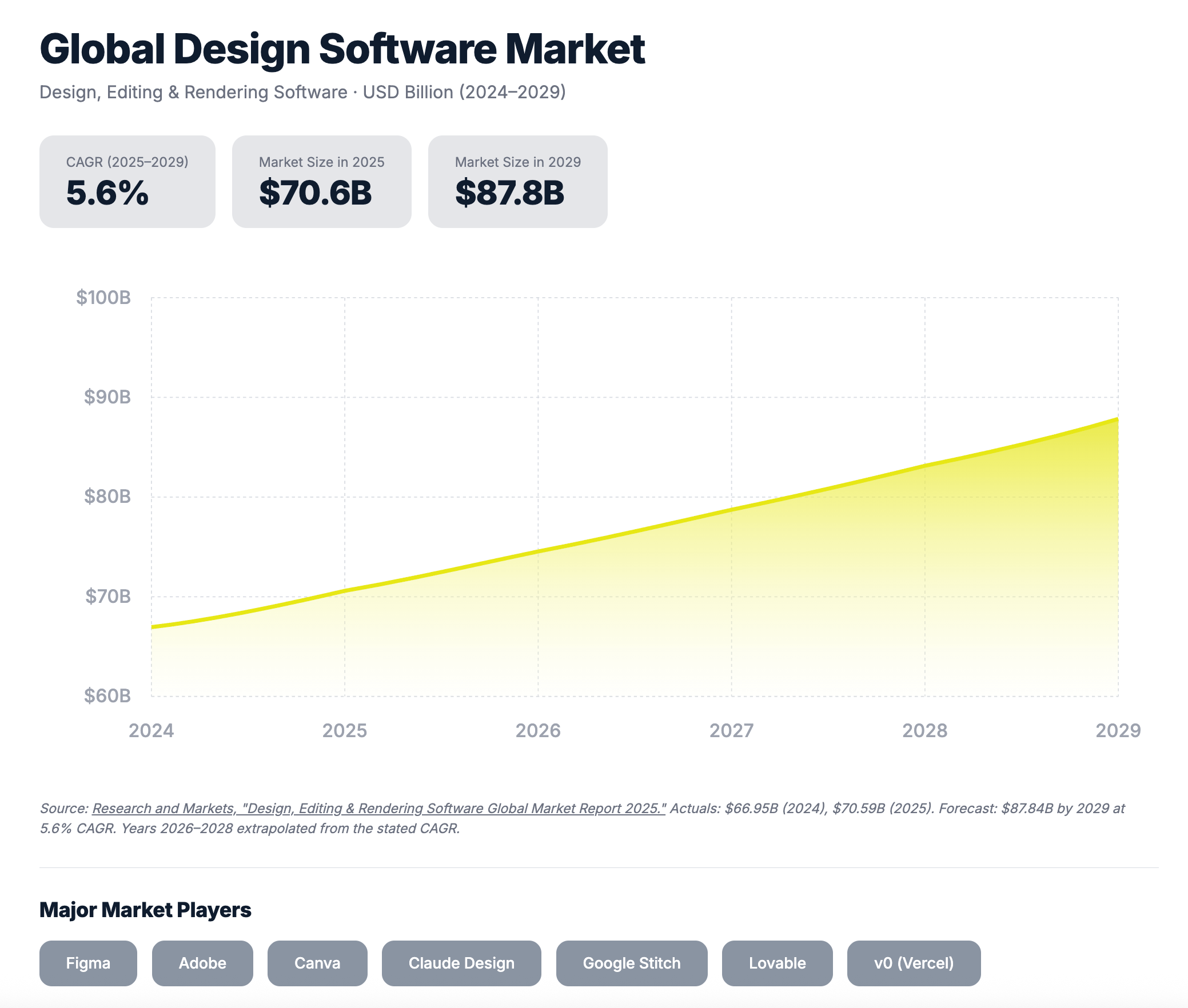
Market at a glance: the global design, editing & rendering software market was $66.95B in 2024, grew to $70.59B in 2025, and is projected to reach $87.84B by 2029 at a 5.6% CAGR (Research and Markets, March 2025).
Figma held an estimated 80–90% share of UI/UX design tooling going into 2026. Since its summer 2025 IPO, FIG stock is down more than 80% from its post-IPO high.
Claude Design launched to every paying Claude subscriber. Anthropic's traffic is up roughly 5x year-over-year, valued at $380B as of February. Eight of the Fortune 10 are customers.

Claude Design is optimized for what I’d call outcome delivery for the non-designer. Launched April 17, 2026, powered by Claude Opus 4.7. The product everyone is talking about because Figma’s stock moved.
Primary intent: Shipped prototype without a designer in the loop
Job it does:
“I want to turn my idea into a branded, interactive, production-ready prototype - without opening a design tool, finding a designer, or knowing any of standard design practices.”
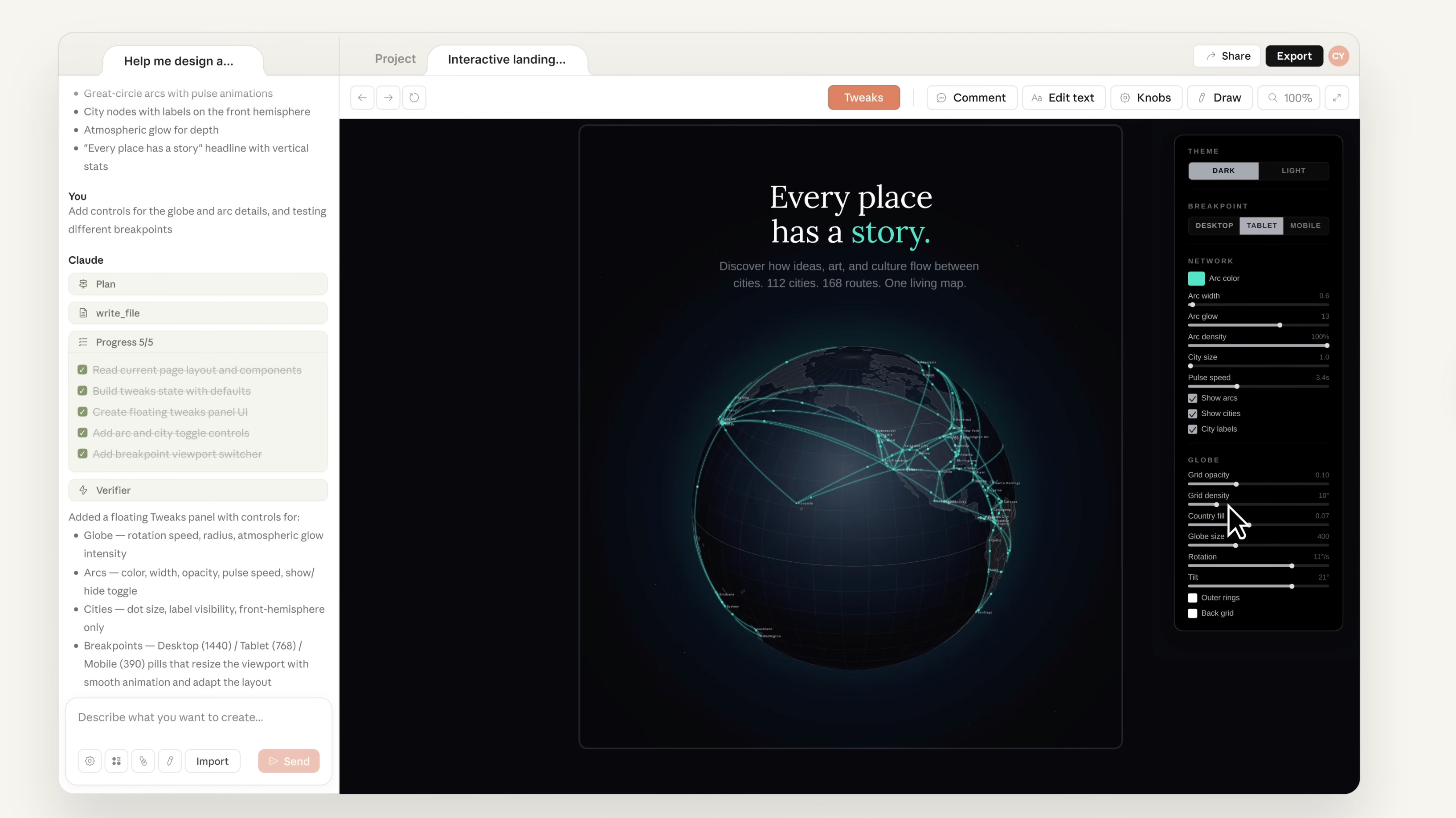
It translates to:
Point Claude at codebase, Figma file or screenshots of your website/app
Claude extracts design system
Prompt for screen or flow
Iterate via chat, inline comments, custom sliders
Hand off to Claude Code
Best users:
Solo founders who have never opened Figma
PMs who want to show, not describe, what they mean
Marketers producing on-brand assets without a design queue
ccount executives building pitch decks from a rough outline
Churn watch:
Token economics - early users on the $200 Max plan report rate-limiting after 20 iterations on a single project. If the cost-per-design exceeds hiring a junior designer, the product becomes a luxury most non-designers can’t afford.
Skill-graduation churn - Claude Design is built for the user who doesn’t know what good looks like. The moment a user develops taste, they notice the token burn and start looking for the cheaper loop. I’ll come back to this.

Figma is optimized for what I’d call multiplayer design as the source of truth. Dylan Field and Evan Wallace met at Brown in 2011, where Wallace was Field’s TA. Field took a Thiel Fellowship, dropped out, and the two spent four years building something heretical at the time: a full design tool that lived in the browser and let people edit together in real time. They didn’t launch a beta until 2015, didn’t charge a dollar until 2017. By the time Adobe tried to buy them for $20B in 2022, Figma was the design tool - so dominant the deal was blocked on competition grounds. It IPO’d in August 2025.
Primary intent: Collaborative design as the organizational source of truth
Job it does:
“I want my team to design, critique, and iterate together in one place - and I don’t want to lose what we built when we hand it to engineering.”
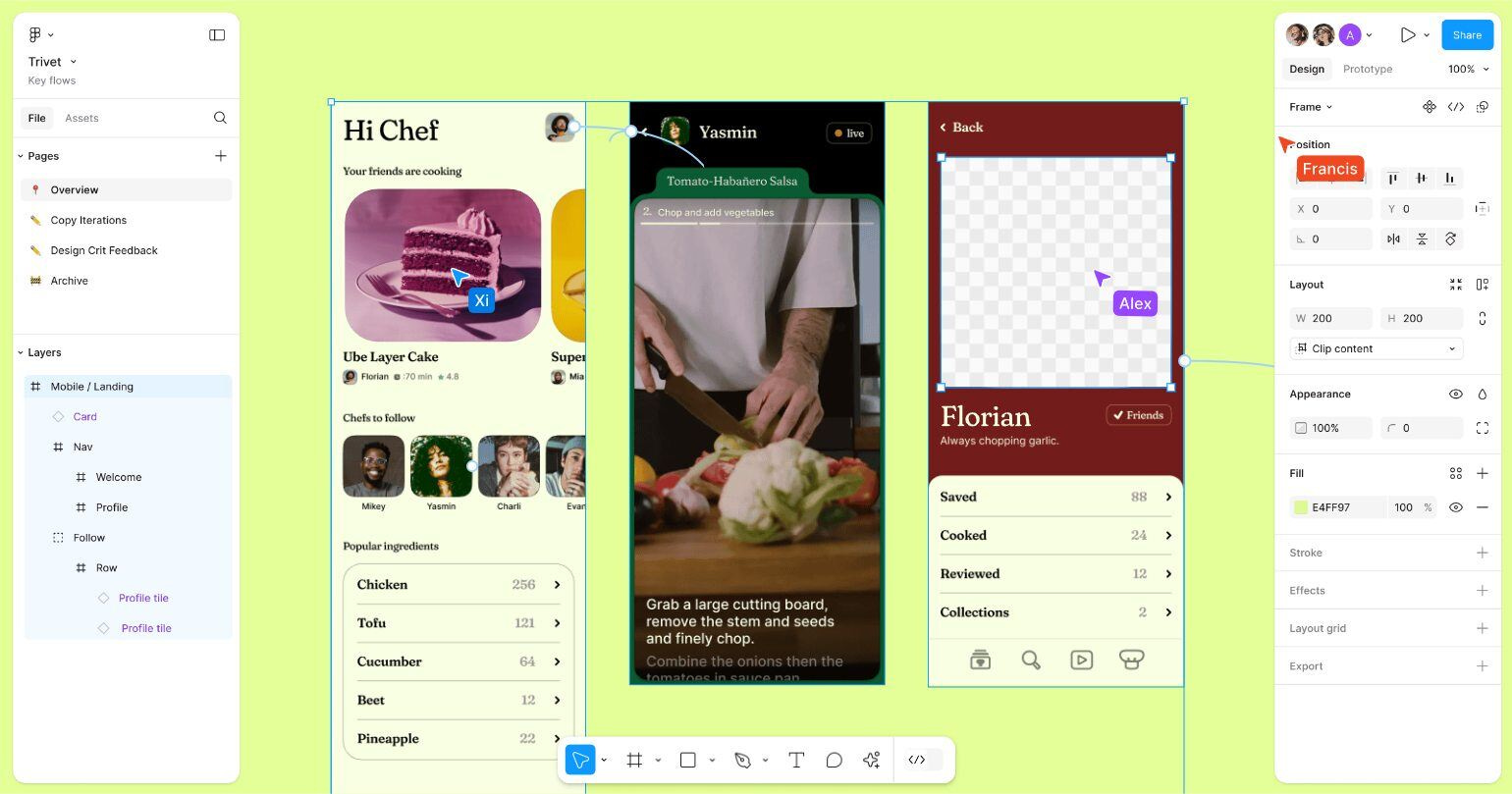
It translates to:
Build components
Edit with teammates in real time
Comment and iterate
Hand off via Dev Mode
Best users:
Product design teams of 5–50 at venture-backed companies
Design system owners maintaining component libraries
PMs who annotate designs alongside their designers
Agencies shipping client work through shared files
Churn watch: Figma’s churn risk is almost entirely external. The product hasn’t gotten worse - the workflow around it has gotten shorter. When a PM generates a good-enough prototype in a conversation with Claude, hands it to Claude Code, and ships it, Figma’s step becomes optional. Its moat (multiplayer, components, libraries) defends against competitors doing the same thing better. It was never designed to defend against the chain getting one step shorter.
Anthropic’s CPO Mike Krieger stepping down from Figma’s board three days before the launch wasn’t a coincidence; it was a market signal everyone read at the same time.
Google Stitch is optimized for what I'd call owning the format, not the canvas. . Galileo AI was founded in 2022 by Arnaud Benard and Helen Zhou - a two-person startup that hit 100,000 design generations in days during its public beta and raised $15M on the premise that designers wanted production-grade UI from a prompt. Google acquired them in May 2025, folded the product into Google Labs, and relaunched it as Stitch running on Gemini. For most of the last year, Stitch looked like the weakest of the three players in this space - a sketchpad people opened for ten minutes, got bored of, and exported to Figma. Then, four days after Claude Design launched, Google made a move nobody expected.
Primary intent: Defining the portable file format for design context
Job it does:
“I want my design system to live in a file that any agent, any IDE, any design tool can read - and I want to stop being locked inside one vendor’s canvas.”
It translates to:
Define your design system in DESIGN.md
Validate it with the open-source CLI
Use the same file in Stitch, Claude Code, Cursor, Paper, Figma
Update once, propagates everywhere
Best users:
Design system owners who want portability across tools
Agencies that move design context between client stacks
Developers tired of re-describing the brand to every new AI tool
Teams hedging against AI-tooling lock-in
On April 21, Stitch open-sourced a formal specification for DESIGN.md - the text-file format that describes a design system to agents. The spec includes a token section (every design decision expressed both as prose reasoning and as a machine-readable value), a components section with role-based references instead of hex codes, and a CLI validator that agents can run on their own output to catch WCAG violations before shipping. Published on GitHub, accepting pull requests.
The community reaction was immediate and telling.
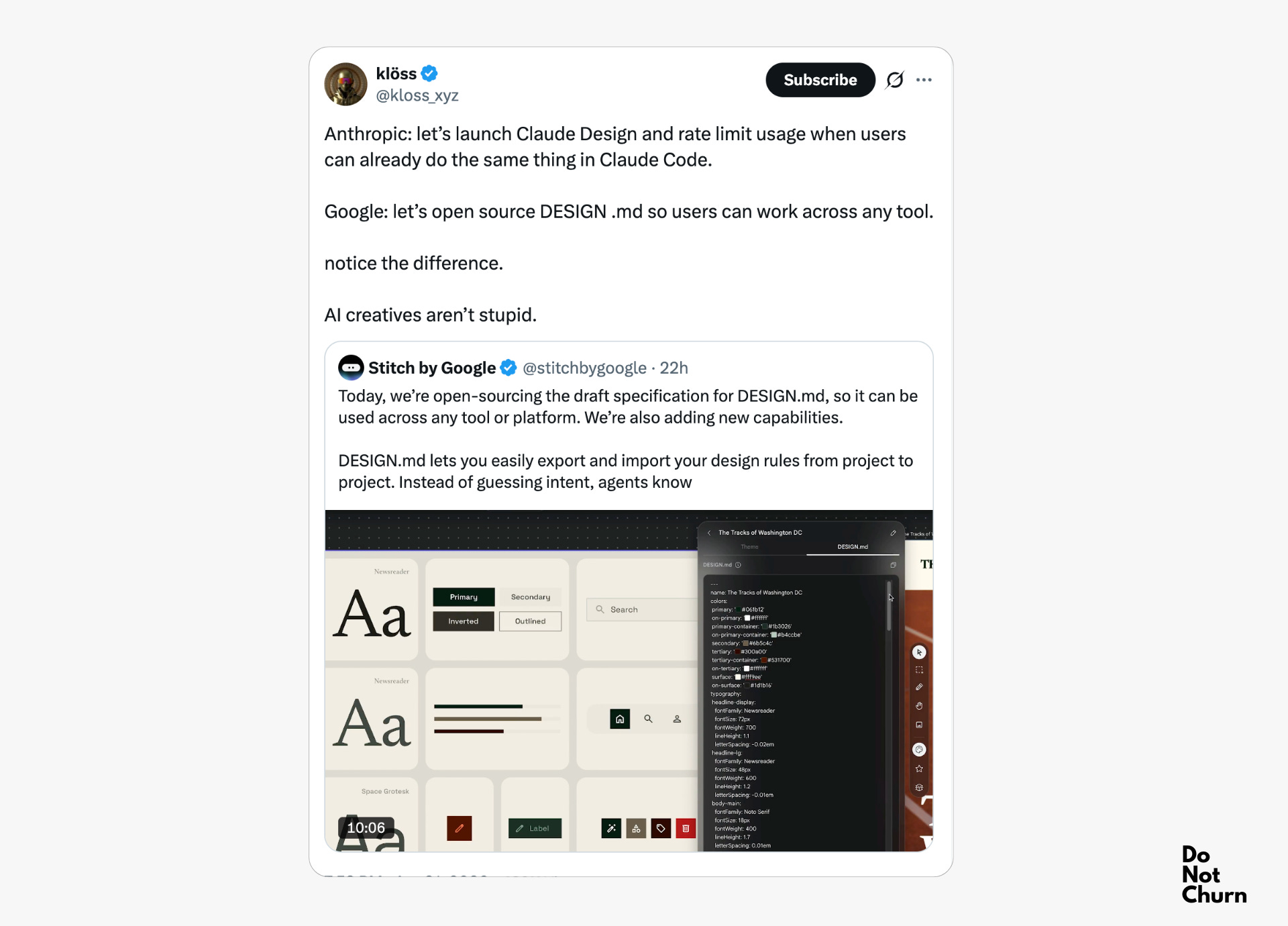
Stitch stopped trying to win the design-tool product fight. It moved up the stack and defined the substrate everyone else has to read from. If every IDE, every coding agent, every design canvas learns to parse the same DESIGN.md format, Stitch becomes infrastructure. Claude Design becomes a client of that infrastructure.
File formats outlast their creators - Adobe learned this with PSD, Autodesk with DWG. Google just tried to claim the same position for AI-era design context.
The six retention mechanics of the vibe coding chain
1. Workflow ownership, not step quality.
Claude Design doesn’t win on design quality - by most serious reviews, Figma still produces better output at the step level. It wins because it owns more of the chain. When the job is “ship the thing,” the tool that takes the user further down the chain wins, even with worse step-level output. Stitch owned the shortest span. Figma’s is longer, but bounded.
2. The design system as context, not artifact.
For a decade, the design system was a human-maintained artifact living in Figma. Claude Design reads your codebase and infers it automatically. Taste used to be a skill. Now it’s a file. Once taste is machine-readable context, it’s an input to a model, not a specialist you hire.
3. Cold-start-friendly onboarding for the non-designer.
Claude Design is built for the user with nothing - no codebase, no Figma file, no vocabulary. It generates something generic-but-coherent on the first try, and generic-and-shipped beats nothing-at-all. Figma was built for the user who was already a designer. Canva built a ~$40B business serving the opposite user. Claude Design inherits that user with a better handoff.
4. The real product isn’t the canvas - it’s the handoff.
Claude Design to Claude Code is a single click. The designer-to-developer handoff has been the most expensive coordination cost in software production for twenty years. Anthropic didn’t improve it; they collapsed it.
Figma isn’t competing with a better design tool. It’s competing with a pipeline: Opus 4.7 → Claude Design → Claude Code → Cowork. When your competitor owns the model, the design surface, and the code surface, no single feature fight matters.
5. Open formats as anti-churn insurance.
The DESIGN.md spec is a different kind of retention mechanic - it retains users to the format rather than to any single tool. If your design system lives in a portable file that every agent can read, you’re insulated against any one vendor rate-limiting you, raising prices, or shutting down. Stitch wins users not by keeping them inside Stitch but by making sure the next tool they use still speaks its language. This is how infrastructure beats product in categories that move fast: you don’t compete for the user’s session, you compete for the user’s artifact.
6. The pricing lever disguised as a feature.
The launch-week complaint wasn’t “Claude Design is bad” - it was “Claude Design repackages capabilities we already had for 20x the token cost.” That’s a distinct churn pattern. When a platform bundles cheap primitives (MCP + Claude Code + a third-party canvas) into a premium wrapper, power users notice the arbitrage instantly and post about it publicly. The product looks less like a new feature and more like a monetization surface. Trust with the most visible segment of the userbase erodes first - and those are the users whose tweets set the narrative for everyone else.
The power-user twist
Designer-developers already running Claude Code loops don’t need Claude Design. They have Paper - a canvas built on HTML and CSS instead of a proprietary vector format - connected to Claude Code via MCP. Because Paper’s canvas is the DOM, LLMs read it natively. The agent manipulates it in real time while the designer watches.
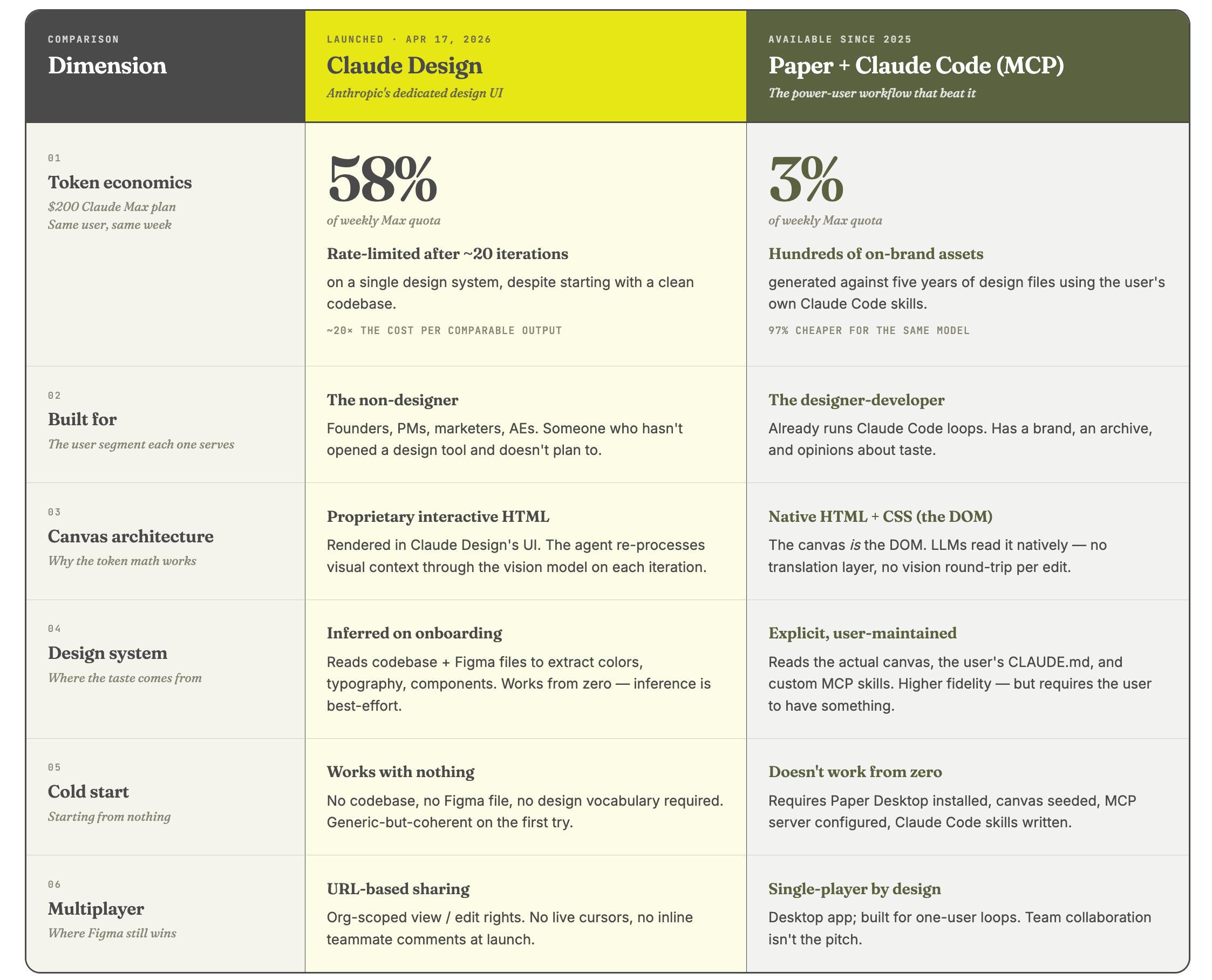
@kloss_xyz, posted the day after launch: Opus 4.7 + Paper MCP + five years of design files generated hundreds of on-brand assets at 3% of her weekly Max quota. Same model, Claude Design, rate-limited after 20 iterations on one project. The read is: “All Anthropic is doing here is throttling our usage with a new Design UI and calling it a feature.”
It’s right and wrong in the same sentence. Right, the power user had a cheaper path first. Wrong that Claude Design is aimed at people like her. Anthropic built it for the user who doesn’t have five years of design files, who’s never heard of MCP, who can’t set up Paper from scratch.
For that user, the inference of a design system from an empty codebase is the product. The power-user complaint is the sound of a tool being built for someone else.
On Lenny’s Podcast this month, Nikhyl Singhal - former CPO at Meta, Google, Credit Karma - said what a lot of product leaders were already thinking:
“There’s a split in the PM market where the information mover archetype is going to go obsolete. But the folks who like to build stuff are going to be wanted. Today, everyone wants a builder.”
His prediction: companies will shed 30,000 PMs and rehire 8,000 AI-first builders. Triple the wages, a fraction of the headcount.
The information mover - the PM who coordinates between engineering, design, and leadership without direct authority - becomes a liability in the same chain collapse that killed the designer’s gatekeeping role.
Claude Design is what the builder’s tool looks like. It isn’t a design app. It’s a way for one person with a thesis to ship a product without assembling a team. Figma’s decline isn’t only Figma’s story, but every middle-level specialist's story.
Design software didn’t converge into a single super-tool but split along lines of who owns the chain.
Some tools own the multiplayer canvas - Figma’s bet, still real, still shrinking. Others own the chain from idea to shipped code — Anthropic’s bet, locked to their surface. Others own the portable file format everyone else has to read from - Google’s bet, placed four days after Claude Design launched.
Churn emerges when a product’s moat defends the wrong layer of the stack. Figma defended its step and watched the workflow collapse around it. Anthropic defended its pipeline and watched the power users defect to the open-MCP path. Google stopped defending a product altogether and tried to claim the substrate. In categories that collapse into AI-native pipelines, retention grows when the product owns something that survives the next generation of tools. A canvas remains valuable only if the workflow still needs a canvas. A pipeline remains valuable only if users stay inside it. A file format survives both.
Key takeaways
Products that deliver a step churn to products that deliver an outcome. Figma delivers the design step. Claude Design delivers the shipped prototype. When “ship the thing” is the job, chain length beats step quality.
The non-designer was always the larger user. Canva proved it. Claude Design inherits that user with a better handoff to production code.
Taste became context — and now context has a spec. Google open-sourcing
DESIGN.mdturned a tacit convention into a portable, validatable file format. The file survives the tool.The power user has the cheaper path first, and it doesn’t save the category. Paper + MCP is architecturally cleaner than Claude Design. It also doesn’t reach the non-designer. Both things are true.
The Problem Cycle beat the Opportunity Cycle in the same week. Anthropic saw a market opportunity and shipped a product. Google saw a behavior already happening in the community and formalized a standard. Within 96 hours, the market named the difference.