You just finished your morning run, and before you’ve even caught your breath, you’ve already shared your route, collected three kudos from people you’ve trained alongside for two years, and quietly noted that someone edged your segment time by four seconds.
Hard to imagine doing any of this on a different app. Everything you’ve built lives inside Strava. Moving would mean starting over -- and starting over means losing all the progress the app stores.
In the early 2010s, building an app was genuinely hard - team, budget, months of iteration, App Store approval that takes forever, and feels like a lottery. The teams that shipped had a structural advantage just for existing.
Habit tracking was still largely analogue. When apps moved in, they brought real innovation: the digital streak, the gamified check-in, the progress ring. The first habit tracker you downloaded felt genuinely new.
Then the market matured, features got copied, and designs converged. By 2023, you could barely distinguish one habit tracker from another in the App Store carousel -- because anything one team could build, another team could replicate.
The shift happened when the cost of building apps didn’t just fall - it basically disappeared.
In February 2025, Andrej Karpathy named it: vibe coding. Describe what you want, and AI generates a working app in hours. By March 2025, Y Combinator reported 25% of its startups had built 95% of their codebases with AI. By the end of 2025, 557,000 new apps were submitted to the Apple App Store -- a 24% surge, portraying the fastest growth since 2016.
The conversation in founder communities flipped almost overnight. Building stopped being the hard part. Keeping users became the hard part -- and almost nobody had a good answer to it.
If anyone can ship your product by Tuesday, your features are a starting point. The only durable advantage left is what a competitor can’t copy: what the user has already built inside your product.
Feature advantage has collapsed as a retention mechanism in consumer apps.
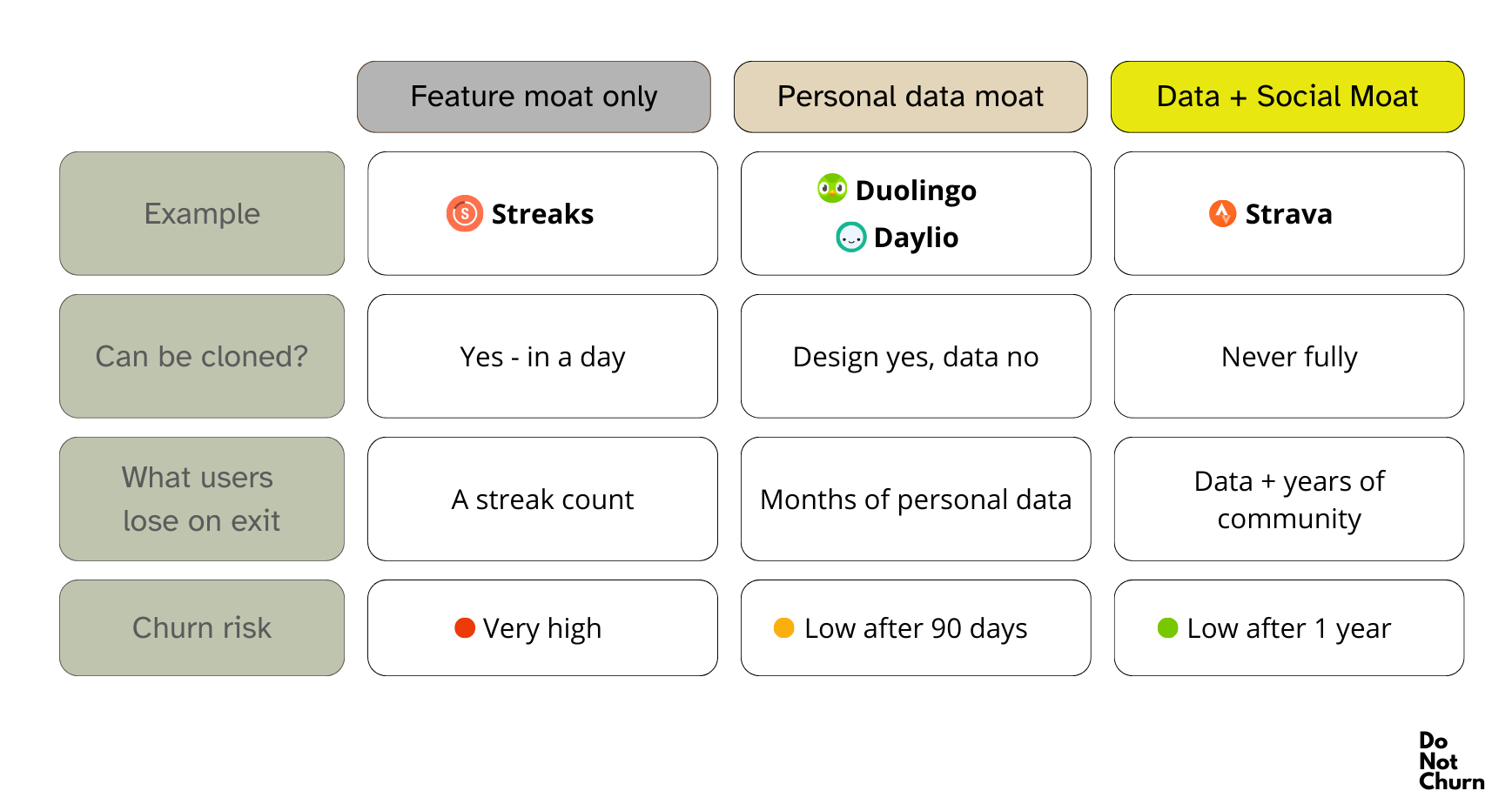
Duolingo, Strava, and Daylio are three different answers to the same question: what would it cost a user to leave? Streaks -- the beautifully designed iOS habit tracker -- sits as the cautionary contrast: a product with no compelling answer to that question.

Duolingo is optimised for what I’d call commitment-compounding utility -- the clearest example in consumer apps of a product that has systematically engineered the cost of leaving. It’s also, as of 2025, the clearest example of what happens when an identity moat runs into the limits of the identity it’s selling.
Primary intent: Identity formation through daily ritual
Job it does:
“Help me become the kind of person who speaks another language -- and make sure I don’t quit when motivation drops.”
It translates to: Open app ✔ > Complete daily lesson ✔ > Protect streak ✔ > Ascend league ✔ > Accumulate XP history
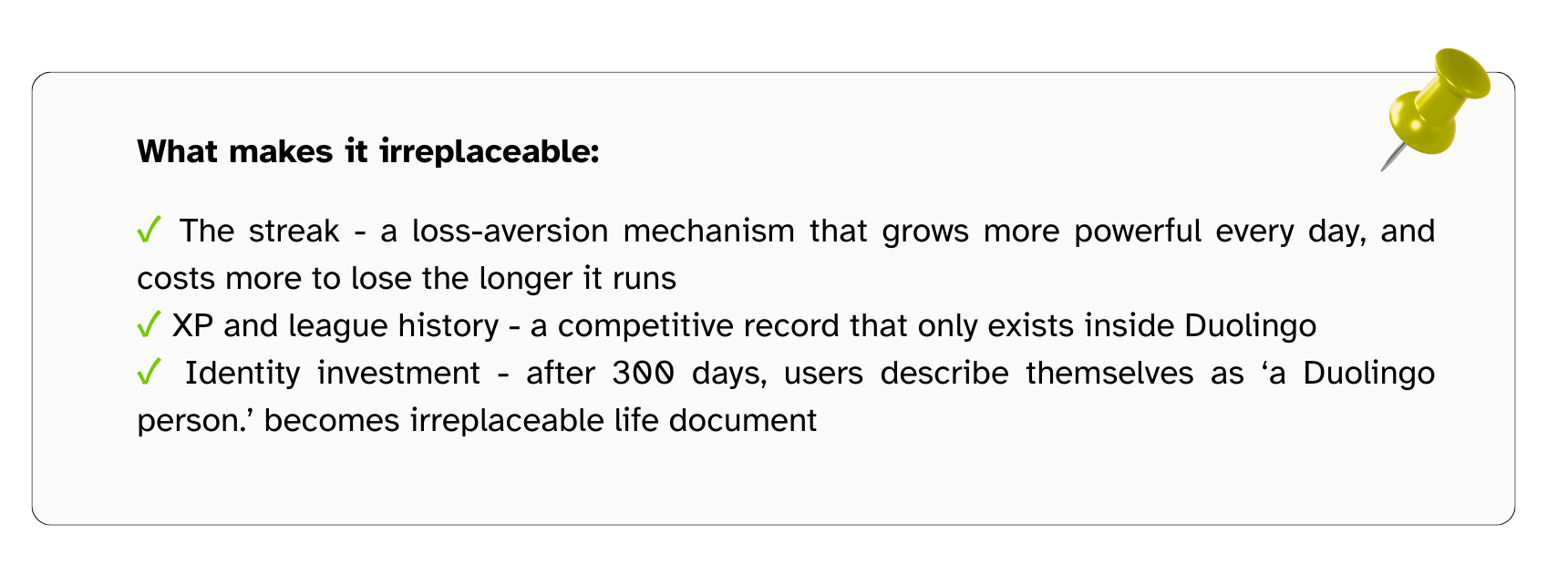
Duolingo intentionally ignores linguistic depth. Its lessons are short, gamelike, and emotionally engineered rather than pedagogically rigorous. It treats showing up as the product. Once a user has maintained a 200-day streak, the streak itself has become the product -- regardless of whether the lessons are any good.
The mechanics behind Duolingo's retention are exceptionally well-documented. Jorge Mazal’s piece in Lenny Rachitsky’s newsletter -- 'How Duolingo reignited user growth'-- is the definitive breakdown of how the streak was rebuilt from near-zero into the engine that drove 4.5x DAU growth in four years.[6] Over four years of streak optimisation alone, daily churn of best users fell by over 40%. A single copy change -- swapping 'continue' for 'commit to my goal' -- drove 10,000 incremental DAUs
The gamification engine
Around 2017–2019, Duolingo was bleeding users and sitting at $13M in revenue. The team asked a specific question: which app category had retention rates that education products couldn't touch? Mobile gaming. Angry Birds. Clash Royale. Candy Crush. Games built on the same daily habit loop Duolingo needed --mechanics refined over billions of player-hours to make quitting feel costly. Duolingo borrowed the playbook wholesale.
By 2020, revenue had reached $161M -- a 12x increase in three years, almost entirely from the gamification overhaul. The course content hadn’t changed. The psychological infrastructure had.
Social media virality
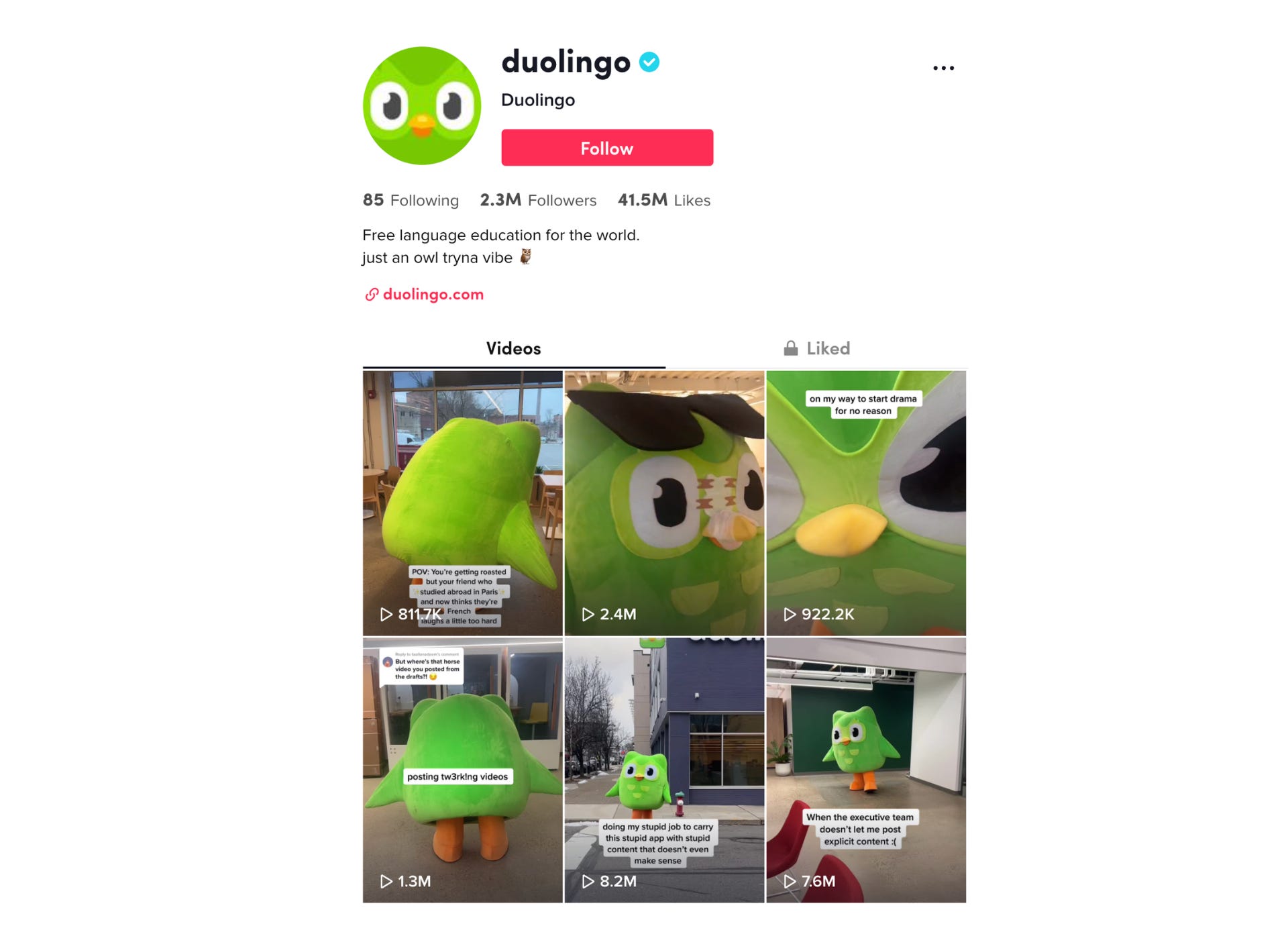
In 2020, a 23-year-old recent graduate named Zaria Parvez spotted a dusty owl costume in the Duolingo office and asked if she could make videos. "I don't need money. I have a crusty owl suit and an iPhone." The C-suite was skeptical about TikTok. She launched anyway. Five years later: 50,000 followers to 16 million, 8 billion impressions across social, and one of the most documented brand strategies in marketing history.
The core insight: Duo should behave like a creator, not a brand. On TikTok, Duolingo wasn't competing against other education apps -- it was competing against everything else in the scroll. Parvez treated the comment section as the content brief. Recurring storylines built Duo into a character with actual lore: unhinged lesson reminders that tip into threats, the Dua Lipa obsession running since 2021, the feud with Google Translate, the legal team as a straight-man foil. The account became satire of the creator economy.
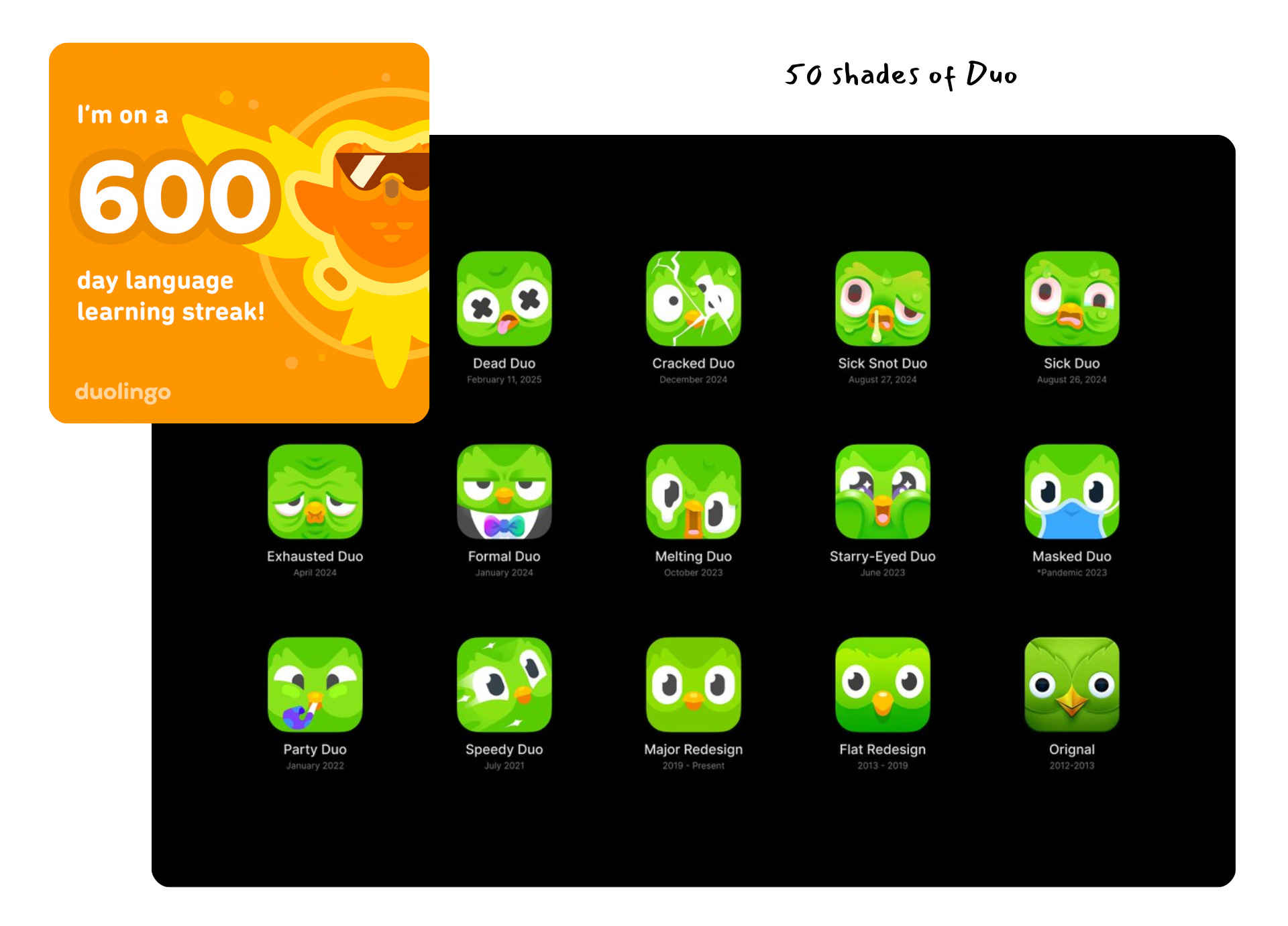
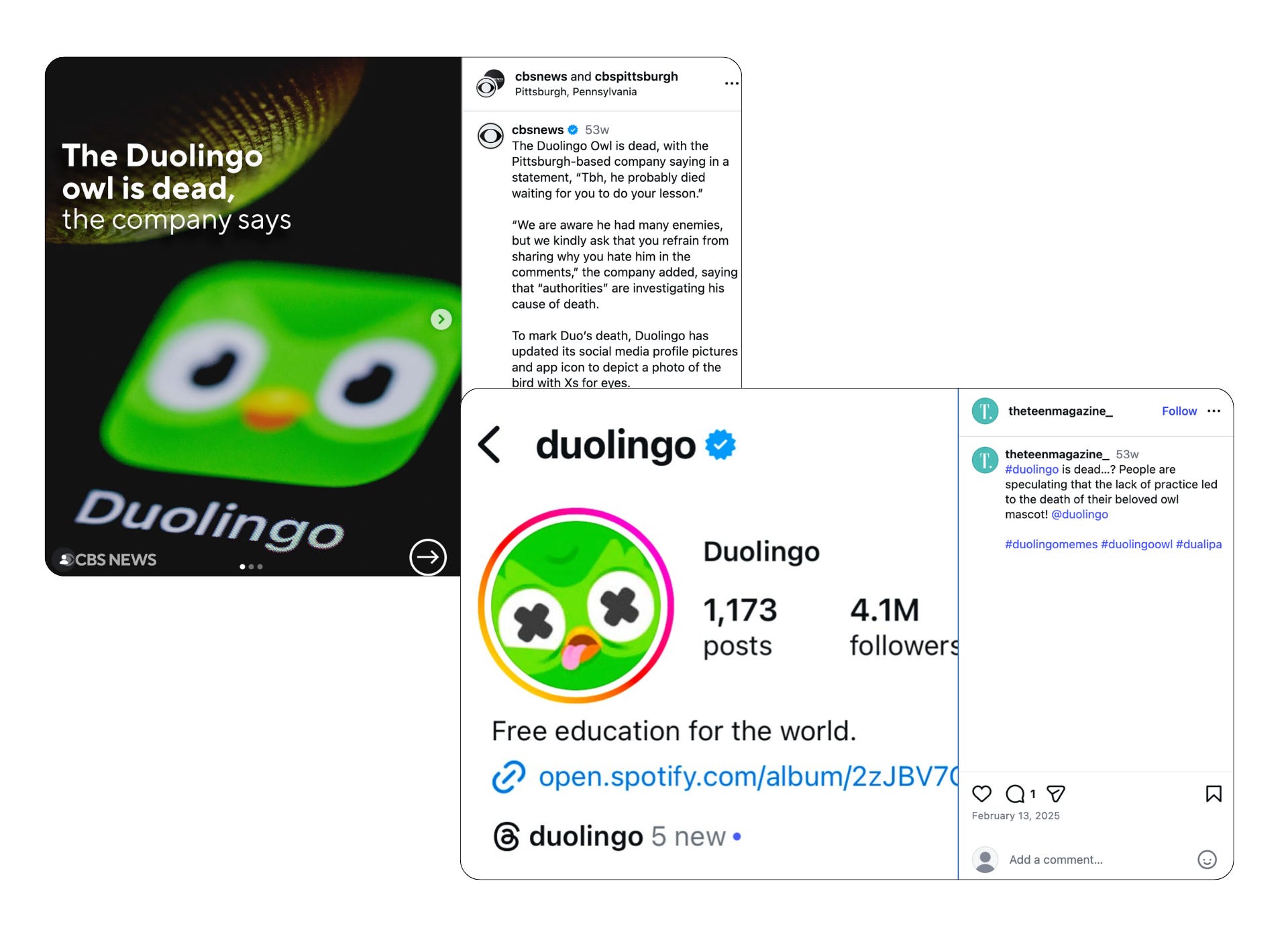
Then: Duo's death on February 11, 2025. Six days from concept to execution.
App icon tweak → Cybertruck murder mystery → collective XP goal to resurrect him.
Social mentions spiked 25,560% in a day.450 articles in 60% top-tier outlets.
Dua Lipa's response drove 667,000 engagement actions. The campaign out-mentioned every Super Bowl ad that week. Duo came back on February 24. The XP goal was hit. Over 5 billion lessons completed in two weeks -- because the resurrection mission was also a re-engagement campaign with an in-app mechanic built into it. The push notification, the streak system, and the viral moment all fired simultaneously. This is what it looks like when top-of-funnel virality is wired directly to the gamification loop.
AI Backlash
In May 2025 DUOL peaked at $544, ended the year down 46%, and was trading around $112 by February 2026 -- investors spooked by soft guidance, rising AI hosting costs, and one uncomfortable question the memo made impossible to ignore. Open ChatGPT and you get more speaking practice in ten minutes than a Duolingo lesson delivers all week. No streak, no subscription, no owl. The content moat Duolingo spent 12 years building was replicated in volume in under a year. What’s left is the behavioural moat -- the streak, the identity, the history. Reassuring because no LLM can clone a 900-day streak. Fragile because the AI-first pivot attacked that moat from the inside.
The research adds a second layer of pressure. On reading, vocabulary, and listening, Duolingo holds up -- learners hit comparable proficiency to one or two university semesters in roughly half the time. On speaking fluency, a 2021 systematic review found it not consistently effective. The structural problem is that Duolingo’s North Star metric is current user retention rate -- how many of yesterday’s users came back today. Excellent for retention engineering. A terrible proxy for whether anyone is actually learning. A user can hold a 900-day streak and still not hold a basic conversation. When that realisation lands -- and for motivated learners, it does -- the streak stops protecting against churn and starts looking like evidence of wasted time.
Churn watch:
Duolingo’s churn has two layers. Early churn catches the 52% who leave within 30 days before the streak builds real switching cost.
Post-realisation churn is more dangerous: users who’ve invested months or years and clock the gap between Duolingo’s retention metrics and their actual language competence. The AI-first backlash accelerated the second layer -- users who already had doubts about learning effectiveness then watched the content get handed to machines that are not always consistent with quality and make mistakes.
Closing that gap doesn’t require more features. The streak needs to remain a proxy for genuine progress, not a substitute for it: keep users coming back and give them something real to come back for.

Strava understood something most fitness apps missed: workouts aren’t the output. The permanent, social record of who you physically are is. Once you have five years of data, 300 followers, and a segment KOM you’ve defended through two winters -- leaving isn’t a product decision. It’s a simultaneous loss of your data, your community, and your athletic identity.
Primary intent: Athletic identity, community accountability, performance history
Job it does:
“Track my training, show my progress to people who care about the same things I do, and let me prove to myself - and occasionally others - that I’m the athlete I think I am.”
It translates to: Log activity ✔ > Auto-analyse performance ✔ > Share to followers ✔ > Receive kudos ✔ > Compete on segments ✔ > Accumulate years of personal athletic history
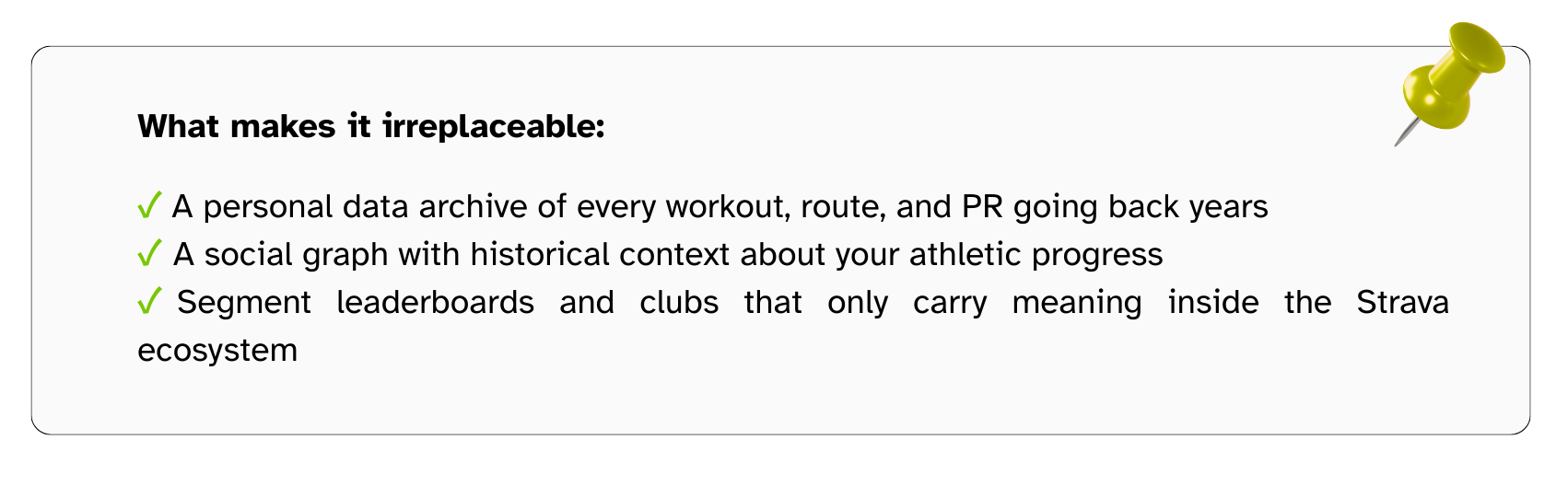
Strava has the deepest irreplaceability architecture in this category: a personal data archive that grows with every workout, a social graph with historical context, and a competitive layer -- segments, clubs, leaderboards -- that only carries meaning inside Strava. One data point tells the whole story: revenue grew from $110M in 2022 to $163M in 2024 even as quarterly downloads fell 16% in Q4 2024. Revenue up, acquisition down -- the signature of genuine lock-in. When Strava restricted its API in late 2024, the community reaction was visceral. Touching the perceived ownership of their data hit harder than any feature removal.
Users who feel they’ve built something inside the product that belongs to them don’t tend to leave.
Churn watch:
Strava’s churn risk is almost entirely self-inflicted. No competitor is close to replicating its social graph. The danger is internal: paywalling previously free features, restricting integrations, and compressing the free tier. When the moat depends on the community, the product team is the biggest churn risk on the board. The winning strategy is stewardship, not roadmap expansion.

Daylio is a minimalist micro-journal and mood tracker designed to build a longitudinal personal record of how your life actually feels. No coaching, no community, no wearable integrations.
It tries to be the most honest mirror of your inner life -- one tap at a time.
Primary intent: Self-knowledge through accumulated emotional data
Irreplaceability source: Months of mood patterns, habit correlations, and annotated life events -- nowhere else
Job it closes:
“Help me understand my own patterns. Why some weeks feel better than others, what actually affects my mood, and what I was feeling this time last year.”
It translates to:
Log mood ✔ > Tag activities ✔ > Write micro-note ✔ > Surface patterns over time ✔ > Build a personal emotional dataset that grows more useful every month
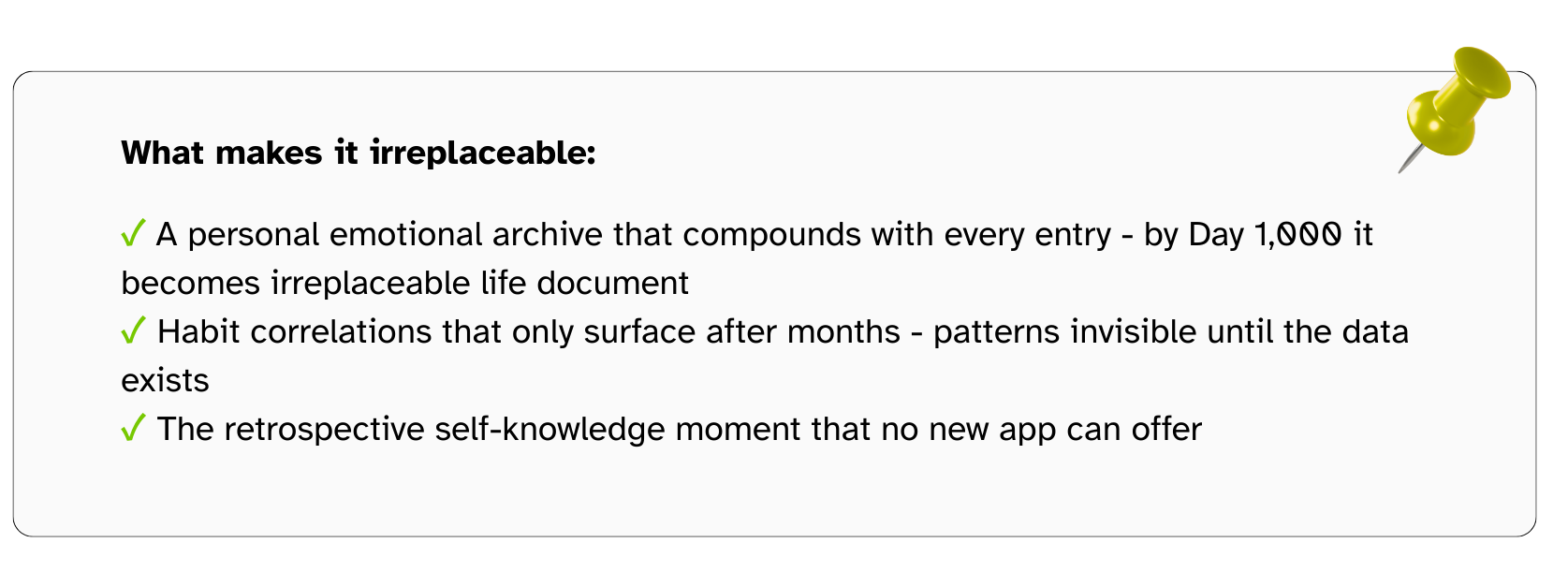
Daylio intentionally ignores everything outside your own emotional data. No social layer, no community, no coaching. It treats your inner life as the only audience worth serving -- and makes the accumulated data beautiful enough that revisiting it becomes a ritual.
A solo founder could build a Daylio clone by Friday. Minimal design, simple mechanics, low technical complexity. By every measure that defined product defensibility before 2025, it should be trivially replaceable. And yet it isn’t — because for a user with 1,200 days of mood entries, Daylio isn’t an app, it’s a personal archive. Switching means losing a record of their inner life that exists nowhere else and can’t be reconstructed.
Most apps lose their novelty value as motivation fades. Daylio appreciates -- every logged day adds to an archive that becomes more meaningful precisely because it’s older. That’s a fundamentally different retention dynamic than anything a feature list creates.
Churn watch:
Daylio’s churn risk is concentrated in the first 90 days -- before data accumulation creates switching costs. The lever most underused: surface patterns at Day 30, not after months. “Your mood was highest on weeks you exercised three or more times.” “This time last month you rated Tuesday as your worst day.” The data already knows. Show it sooner.
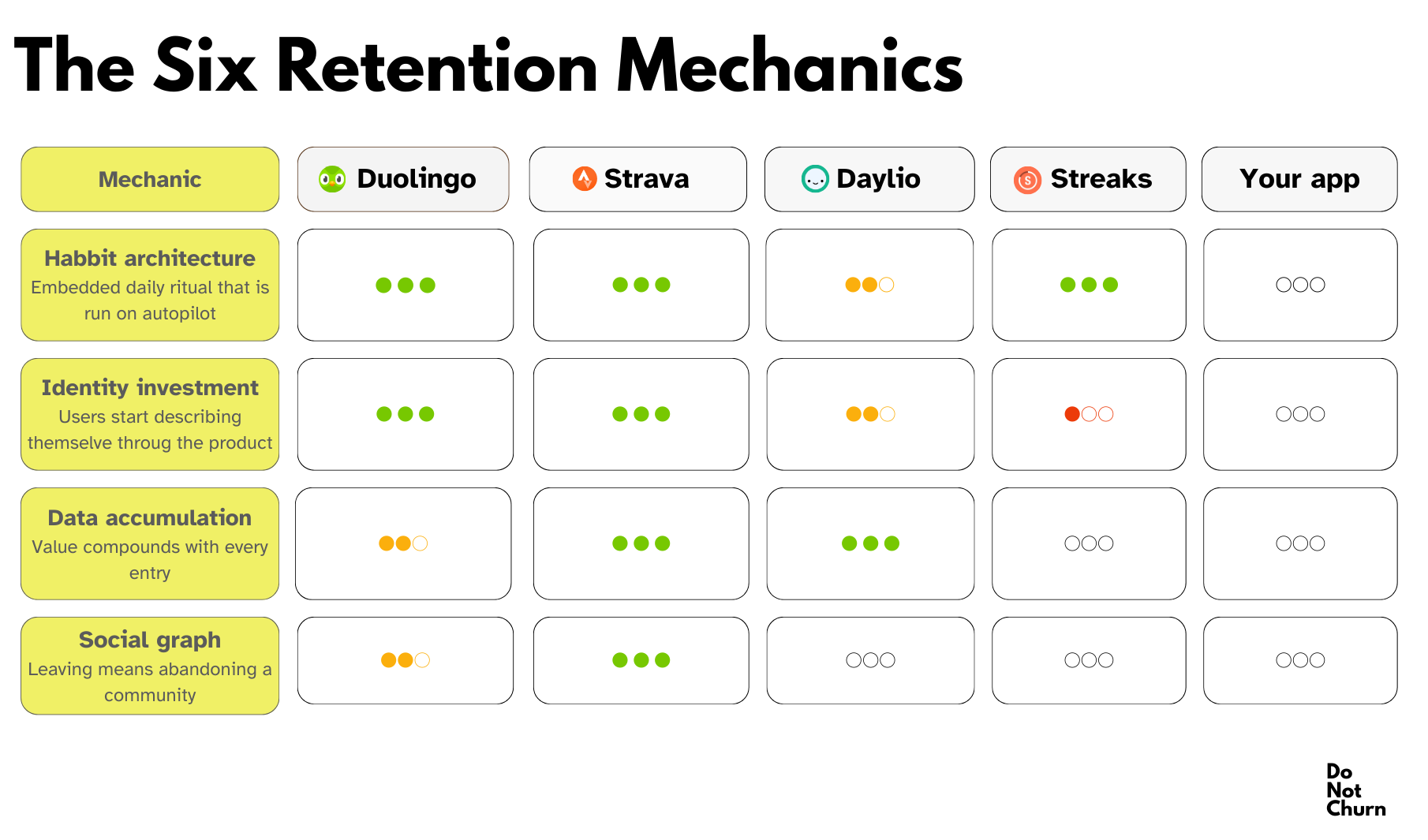
Streaks scores on habit architecture and progress visibility -- genuinely good at making the daily ritual automatic and showing what you’d lose. But those are the two mechanics any AI tool replicates by Tuesday. A Lovable clone ships with a streak counter on day one.
Strava’s near-clean sweep is what genuine lock-in looks like. When you score high across five of six mechanics, users don’t leave even when acquisition stalls, as the product has too many roots.
Duolingo’s split score tells the 2025 story exactly -- strong on the behavioural layer, weaker on data accumulation and content irreplaceability. The moat is real and concentrated. That’s both its strength and its exposure to LLM substitution.
Daylio’s high scores on data accumulation and content irreplaceability, with a moderate score on habit architecture explains the churn profile: great long-term retention once the archive kicks in, vulnerable in the first 90 days before it does.
The moat isn’t what you built. It’s what your user built inside your product. And in 2026, that’s the only kind of moat that can’t be vibe-coded away by Tuesday.
In habit tracking, retention grows when the app holds something the user has invested in — not something the app built for them. A streak matters only if it represents a self worth protecting. A dataset matters only if it reflects a life worth understanding. A community matters only if it contains people the user would genuinely miss.
Key Takeaways
Features are a starting point, not a moat. If anyone can clone your product by Tuesday, your differentiation lives somewhere else — or it doesn’t exist.
Identity moats have a shelf life. Duolingo’s streak works until users realise the streak outlasted the actual learning. DUOL fell 46% in a year finding that out.
Data accumulation is the slowest moat to build and the hardest to break. Daylio on Day 1 is a widget. On Day 1,000 it’s a personal document. The switching cost isn’t losing an app — it’s losing a record.
Communities don’t churn alone. Strava’s revenue grew while downloads fell. Leaving requires convincing everyone else to leave, too.
Score your own product on the rubric. If you’re only hitting habit architecture and progress visibility, a well-prompted founder is your most dangerous competitor.
Written from a casita in Antigua, Guatemala, overlooking three volcano peaks - Volcan de Agua, Acatenango, and Fuego.