

Every time I open Screen Time on my phone, I see the same thing. One app eats half my time. A handful more take almost everything else. The rest - the dozens I’ve installed out of curiosity - fight over scraps. And if I’m honest, I don’t remember most of them.
The modern reality: people spend more time in apps overall, but that time is increasingly monopolized by a small set of products - mostly in Social Media, Entertainment, and Productivity categories. For all other apps, they’re competing for the leftover minutes.
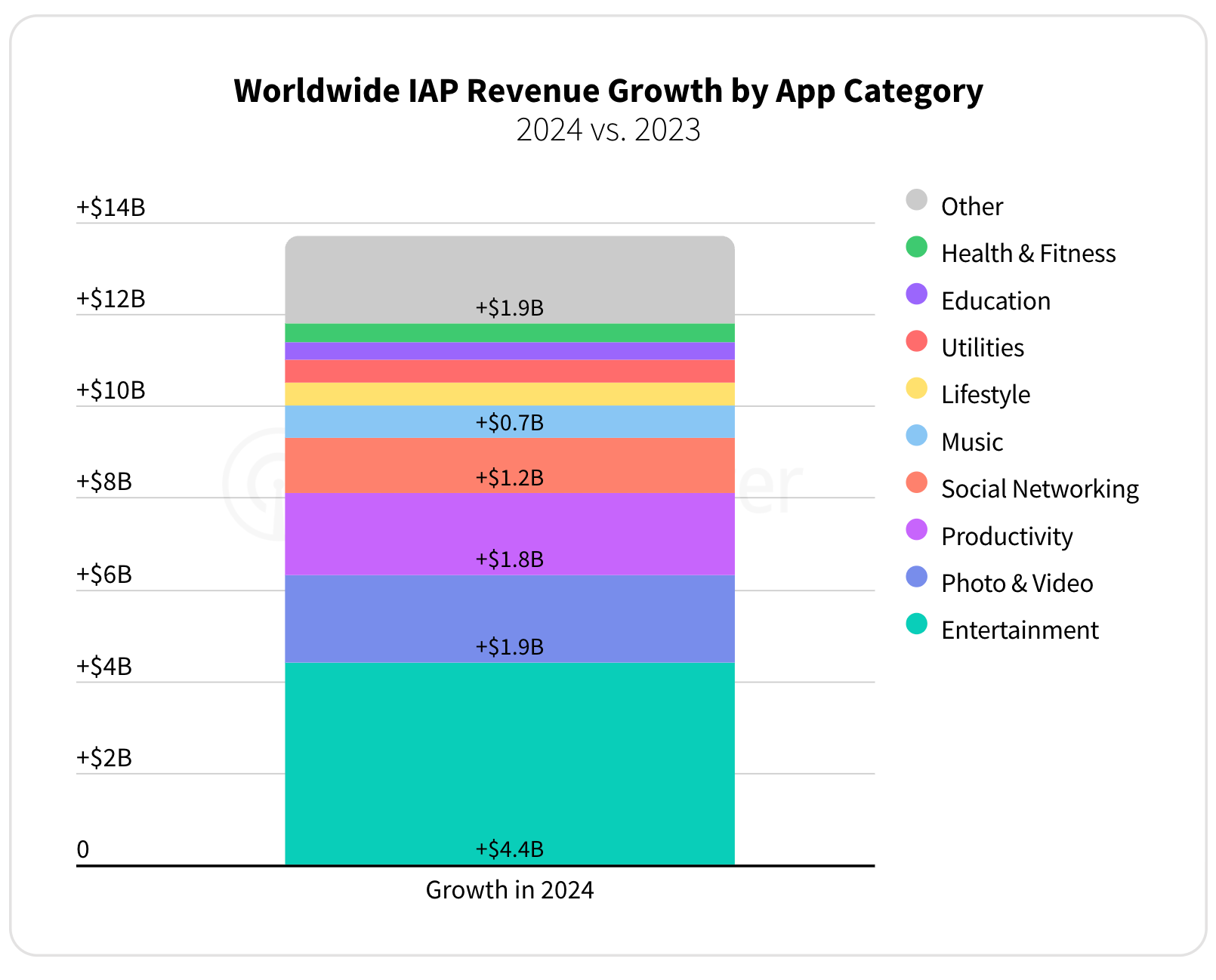
Apps gained nearly $14 billion in additional IAP revenue in 2024 alone (+25% YoY), well above the nearly $9 billion added in 2023.
What has changed across 15 years of App Store launch:
Users become more price sensitive; “delete to declutter” became a common practice.
Expectations got higher, formed by a TikTok-level “instant dopamine” baseline.
The fight is no longer for an app to get installed, but rather for an attempt to“steal time from someone’s top-10 list.”
Switching cost went to ~zero as delete/reinstall is effortless.
Market structure is changing. Retention got worse isn’t because teams got worse at UX, but because the bar moved + attention consolidated.
1️⃣ From Install to First Session - Day 1
One day, you’re just scrolling through your Instagram or LinkedIn feed and see someone mentioning a new planner app they’re using. Or, a friend of yours tells you that their only reason for starting to go to the gym consistently was a fitness app they started using a few months ago. That sparks curiosity: ‘I should check this out!’. You don’t even know yet if you need it. You're just curious to find out what’s so special about it. That is exactly why most churn happens shortly after.
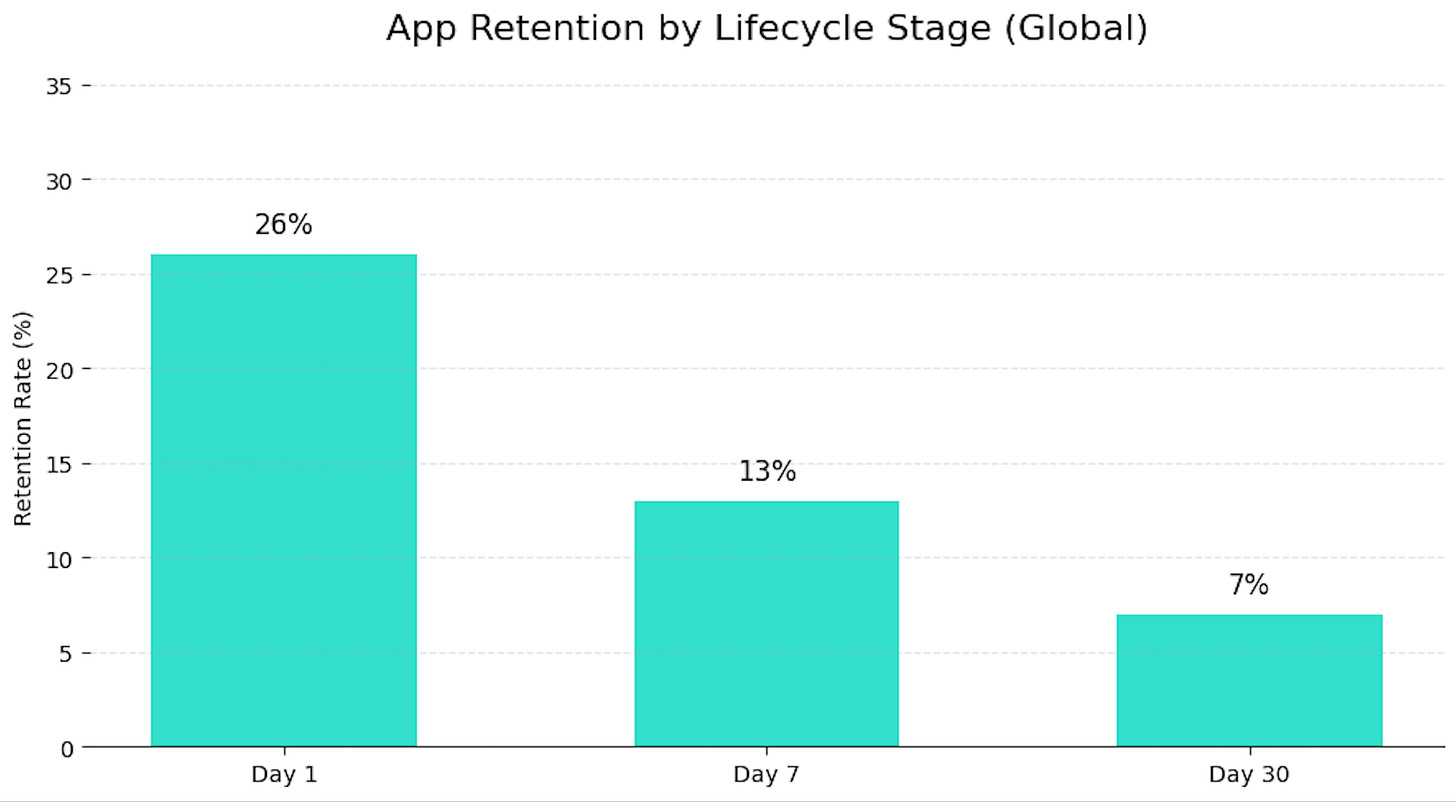
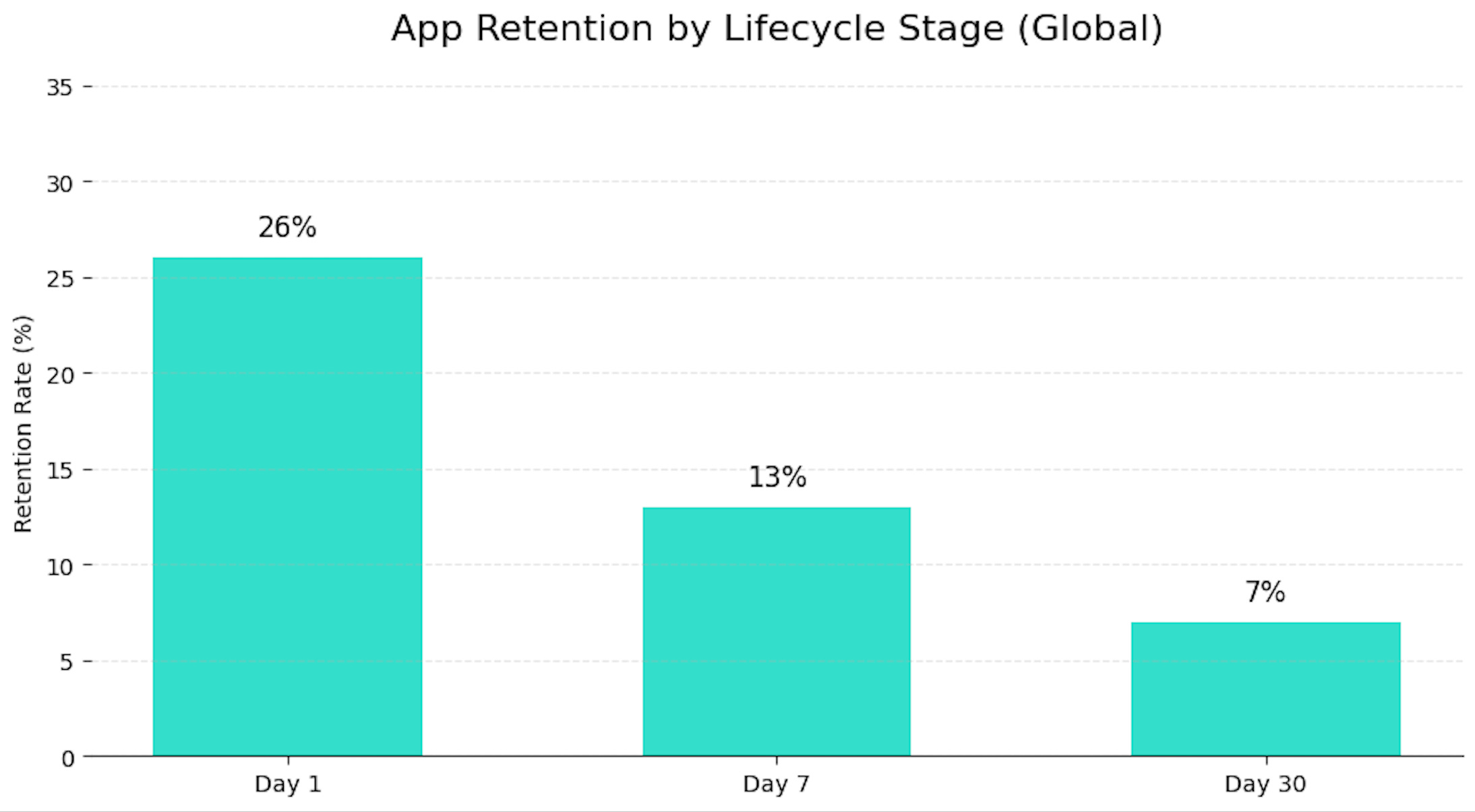
Day 0 is considered to be the biggest cliff when the majority of acquired users drop off. ~74% of users churn before they even come back the next day.
A huge share of users installs out of curiosity. If they leave the first session without forming an internal trigger association (“when I feel X, I open this”), there is no reason to return tomorrow.
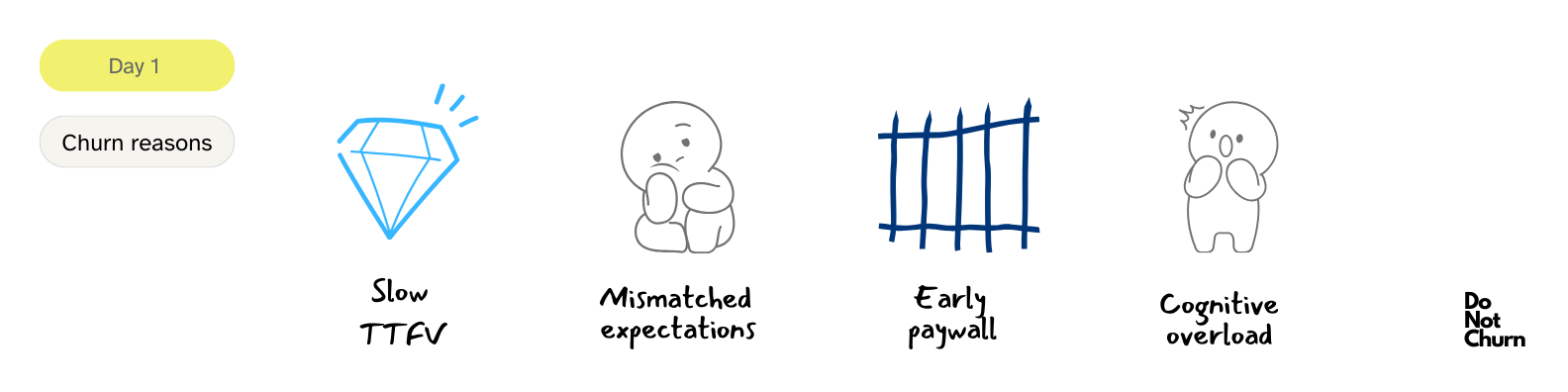
In plain terms, we, as users, do not churn because we forget that the app exists. We give up on it because our emotional cue (“I feel stressed/tired”) doesn’t route to the product.
🔧 High-impact fixes
1. Compress Time To First Value to minutes
Nothing kills curiosity faster than onboarding that feels like opening a bank account.
Define ONE micro success moment for the first session, and ruthlessly remove everything that doesn’t help a user to reach it.
“If I can’t feel something useful within minutes, my brain already moved on.”
Ex: for a dating app, it would be seeing high-quality matches or getting a like; for a fitness app, getting a 2-5 min workout in
2. Delay irreversible friction
Never ask the user to commit (time, data, money, cognitive effort) before they have felt value. Most apps violate this in the first 60 sec.
At install, the user has low trust, low motivation, high uncertainty, and zero sunk cost.
Any request you make is evaluated as:
“Is this worth my attention yet?”
Before the first win, the answer is almost always no.
That’s why long onboarding, mandatory signup, and early paywalls convert curiosity into instant abandonment that results in 70–75% D1 churn.
3. Instrument this stage
Instead of looking at downloads or sign-ups, go as granular as possible and tie each step to the value the user gets.
You should be breaking one journey stage (e.g. Install → First Win) into atomic steps, then measuring where users fall off between each step.
If you can’t point to the exact moment value appears, neither can your users.
Your funnel events should look like this:
Install → First Win Funnel (last 7 days)

1. app_install                      100%
2. onboarding_started                82%   (-18%)
3. onboarding_completed              61%   (-21%)
4. match_feed_loaded                 47%   (-14%)
5. profiles_viewed >= 5              31%   (-16%)
6. like_sent OR like_received 18% (-13%)2️⃣ “I tried it” - Day 7
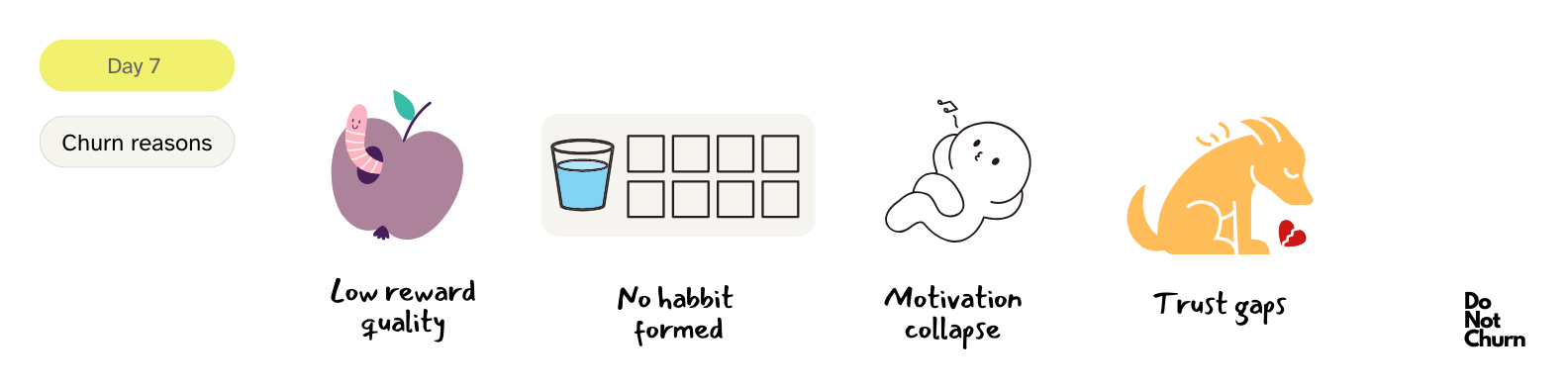
Second cliff. Once passed sign up and onboarding you get to a chance to take a peak what’s in there and how this app can potentially become your new tool. What exactly makes a user come back daily? It is a variable reward.
Variable rewards work because they keep us curious - but curiosity collapses when outcomes feel repetitive.
At some point, users stop thinking ‘what’s next?’ and start thinking ‘I’ve seen this already.’
Here’s why users abandon a recently installed product (let’s use Dating apps as an example):
“Same profiles. Same matches. Same outcome. Why open it again?”
🔧 High-impact fixes
1. Design meaningful rewards that work
Replacing infinite choice with curated anticipation, you would add more relevance that creates anticipation, which is a stronger retention driver than volume.
Limit availability and pre-frame future rewards, e.g.: “Today’s highlights”; “Your top 2 picks”.
Users should feel they might miss something good by not returning, not that there’s always more of the same.
2. Turn usage into visible progress
If users don’t feel that they’re getting better, there’s no reason to return.
“If I’ve used your app five times and can’t explain what’s better now, I won’t open it a sixth.”
Every meaningful action should update a progress signal that answers:
“Am I moving forward?”
This can be about a skill that’s improving, relevance getting better, or effort paying off. If a user completes 3–5 actions and cannot articulate what’s improved, churn risk is high.
3. Tie the reward to sequences instead of single actions
The longer we use the app, the more compounding effect we would like to see to justify spending time on it, building momentum and habit.
Design rewards after consistent behavior, after trying something new.
Then explicitly show: “This worked because you did X” ;“You unlocked this by sticking with it”.
If rewards are fired randomly, they don’t plant a seed of a habit.
Progress sticks when users feel responsible for it.
3️⃣ The settling - Day 30
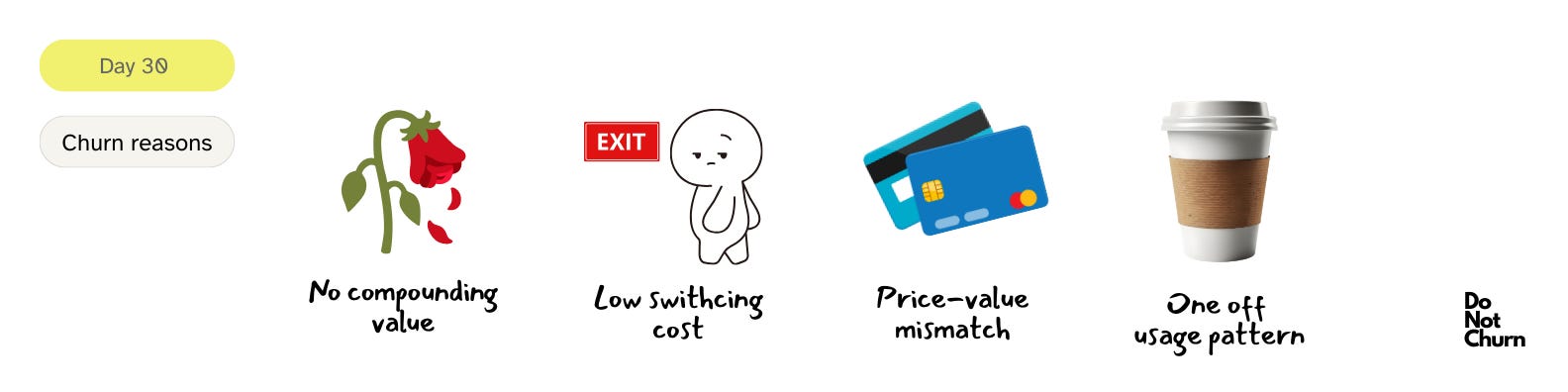
Around the one-month mark, users run a quiet audit - usually without even opening the app.
Usually before billing date (however, pretty often it happens right after subscribtion renewal) users question themselves: how often did I use this app throughout a month?
No one needs another subscription to pay for if they:
a) don’t engage with a product often enough to justify the cost
b) don’t feel the value of the product, even though it’s used a few times a month
🔧 High-impact fixes
1. Turn history into advantage
Products reduce Day-30 churn when they turn past usage into an unfair advantage. Settings are learned. Defaults are smarter. Shortcuts exist because the user earned them.
After a few weeks, starting over elsewhere doesn’t feel neutral - it feels like throwing progress away.
2. Store future values instead of storing just data
Retention improves when the product helps users build something that belongs to them, then quietly reshapes itself around that history so defaults, shortcuts, and outcomes feel personal, earned, and hard to replace, while continuously carrying forward plans, preferences, and unfinished work in a way that makes the user feel mid-journey rather than finished.
Leaving no longer feels like closing an app, but like abandoning progress they’ve already invested in.
3. Introduce optimization loops
Strong products treat success as the start of a lighter job, not the end of a task. After a win, the product should lower effort, suggest the next small optimization, and make improvement feel incremental instead of demanding.
Over time, the user stops thinking “I use this app” and starts thinking “this is how I run this part of my life.”

The real competition today isn’t the App Store ranking or the install button - it’s the handful of apps people open without thinking.
Users don’t consciously decide to churn most of the time; they simply stop routing their attention to you.
Winning retention now means earning a reflex, not a download.
If your product can compress value into the first session, create anticipation instead of repetition by week one, and make progress feel costly to abandon by day thirty, you don’t just survive churn cliffs - you quietly secure a permanent seat in someone’s top-10 apps.
And in a world where attention is already spoken for, that’s the only slot that matters