

Most founders I’ve seen build great products stumbled into them - not through a market map, but through a moment they couldn’t ignore.
Most of the products that failed at retention were built by founders who understood the opportunity better than the problem. The distinction sounds subtle, but the churn data makes it obvious.
In this issue:
Most churn analysis happens at the product level - onboarding flows, paywall placement, feature gaps. This issue goes one layer deeper: to the moment before the product existed, when the founder either had or didn’t have the kind of relationship with the problem that makes everything downstream easier. Three founders who had it, what it looked like in practice, and 6 retention mechanics you can steal from how they built - regardless of whether you were the first person to feel the problem or not.
There are two ways to decide what to build.
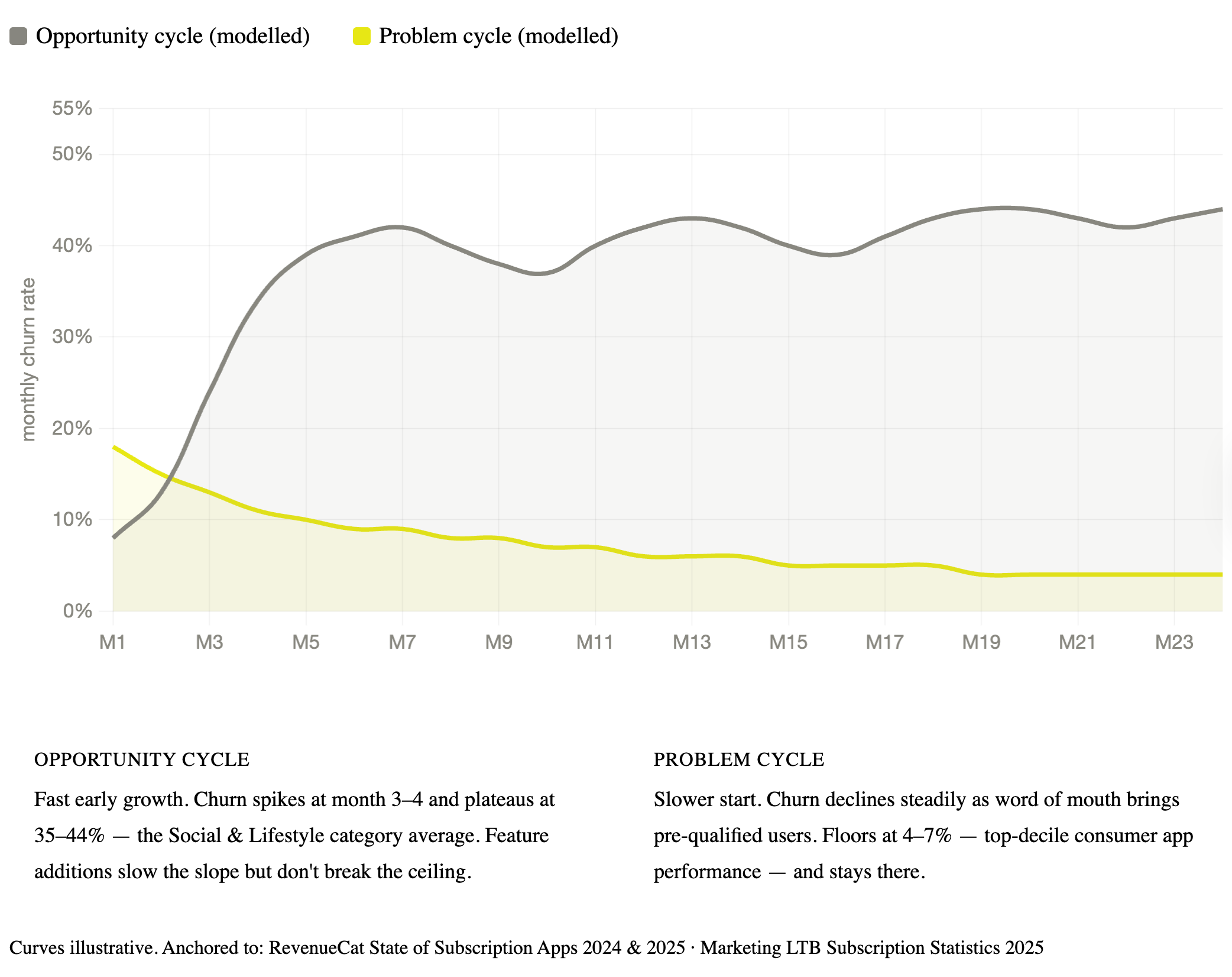
The Opportunity Cycle starts with the market. You identify the gap, size the audience, map the competitive landscape, and build toward the largest addressable segment. The revenue case for this approach is real and legible: because the product is designed for a broad audience, acquisition scales quickly - paid channels work, the positioning is clear enough to convert, and the early growth curve looks healthy. Many of these products cross their first million in ARR faster than anything built from personal obsession, because they’re engineered to capture demand that already exists and is easy to reach.
The problem is what happens next. The cohorts slope downward at a rate no growth spend can outrun, because something in the product is subtly wrong in a way the founder cannot see from the outside. It’s not broken - it works, it converts, it reviews adequately - but it was designed for the category of person experiencing the problem rather than for the specific, urgent, 2am version of it that the people who need it most are actually living. Users feel that difference even when they can’t name it. When retention drops the Opportunity Cycle founder improves onboarding; when onboarding improves and retention still drops they add features; when features don’t hold users they adjust the paywall or run a re-engagement campaign. The product becomes more complex and the churn problem doesn’t move, because the product was always solving the stated version of the problem rather than the real one - and the founder never had the intimacy with the problem to know the difference.
The Problem Cycle runs differently, and it is not a faster or more elegant one. It is slower, messier, and mostly invisible from the outside.
It starts not with a market but with an experience - something that happens to the founder personally, in a way they cannot ignore. They go deep on it not to validate a business idea but because they need to understand what is happening to them. They find everything written about it, speak to professionals, develop a precise personal vocabulary for what the problem actually feels like at its worst - the kind of understanding that no brief could give them and no user interview could replicate. Then they look for solutions and find only approximations: tools that work for the average case but not for the person who needs help most urgently. So they build something themselves - scrappy, value-first, technically imperfect - where execution is secondary to the feeling of finally getting the thing right. They launch quietly, often while holding down another job, with no paid acquisition budget and no growth playbook.
Early revenue is slow because they are finding the people for whom this is the only thing that works, and those people are harder to reach but far less likely to leave. Then something compounds: the users who stay leave reviews that read like personal testimonials, the founder responds to every one, treats each as a product signal, ships the improvement, and the product becomes more precisely right for the person who needs it most. Word of mouth does the work that marketing budgets usually have to. The organic growth that looked like a disadvantage turns out to be the proof - products found by people specifically looking for them retain at a structurally different rate than products discovered through a paid channel.
The timeline is long. Building takes months; growing to a meaningful business takes one to three years before the recognition arrives and the revenue crosses into seven figures. The founders who make it through that window are the ones who were never building from a brief - they were building the answer to a problem that had been theirs for long enough that they couldn’t let someone else get it wrong.
What separates the products that last from the products that don’t isn’t - is the depth of the founder’s relationship with the problem before the product existed.
There is a useful test for whether you have this. Build something that - if you found out someone else was building it - you would get genuinely upset, not competitive but upset, because you’d know they might not understand it well enough to do it right. That feeling is the signal: you are not building an app, you are building the answer to a problem that has been yours for long enough that you cannot let someone else get it wrong.
As Paul Graham emphasizes in his essays, founder market fit is foundational in building a company that is solving a problem the founder understands intimately.
Three products, three founders, three very different problems - all built by people who had no business building apps except for the fact that they couldn’t stop thinking about a problem no one else was solving well enough.

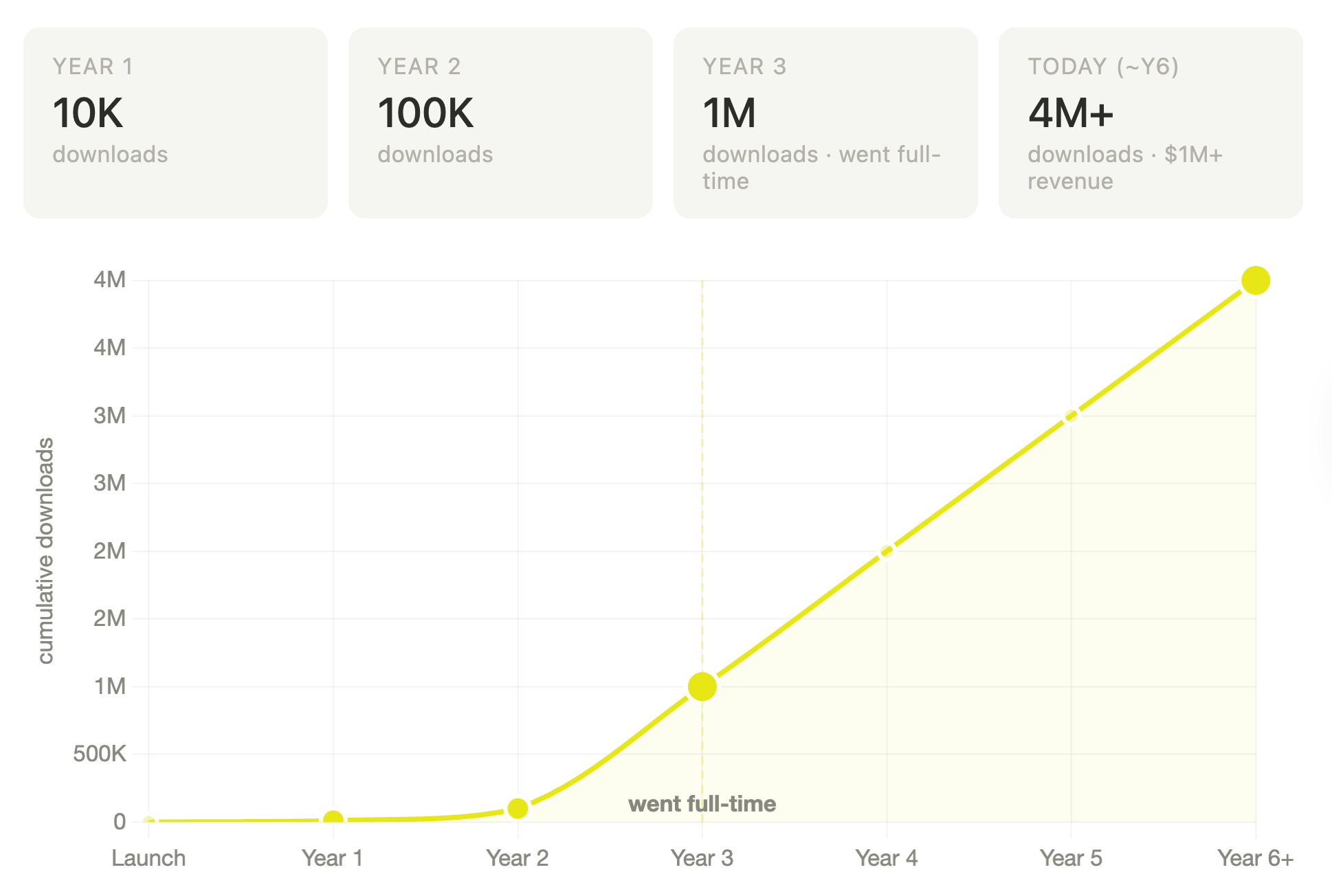
Ania Wysocka experienced her first panic attack in her final year of university, reached for her phone, and found nothing useful - just a medical app and a hypnosis tool, neither of which spoke to someone alone and in crisis. What followed was years of immersion in anxiety research, work with mental health professionals, and a self-taught design background, all of which gave her a precise personal vocabulary for what relief actually needed to feel like. By 2017, she partnered with a student developer to launch Rootd on World Mental Health Day -- a single red panic button at the centre of a deliberately un-clinical design - and crossed $1M in revenue six years later.
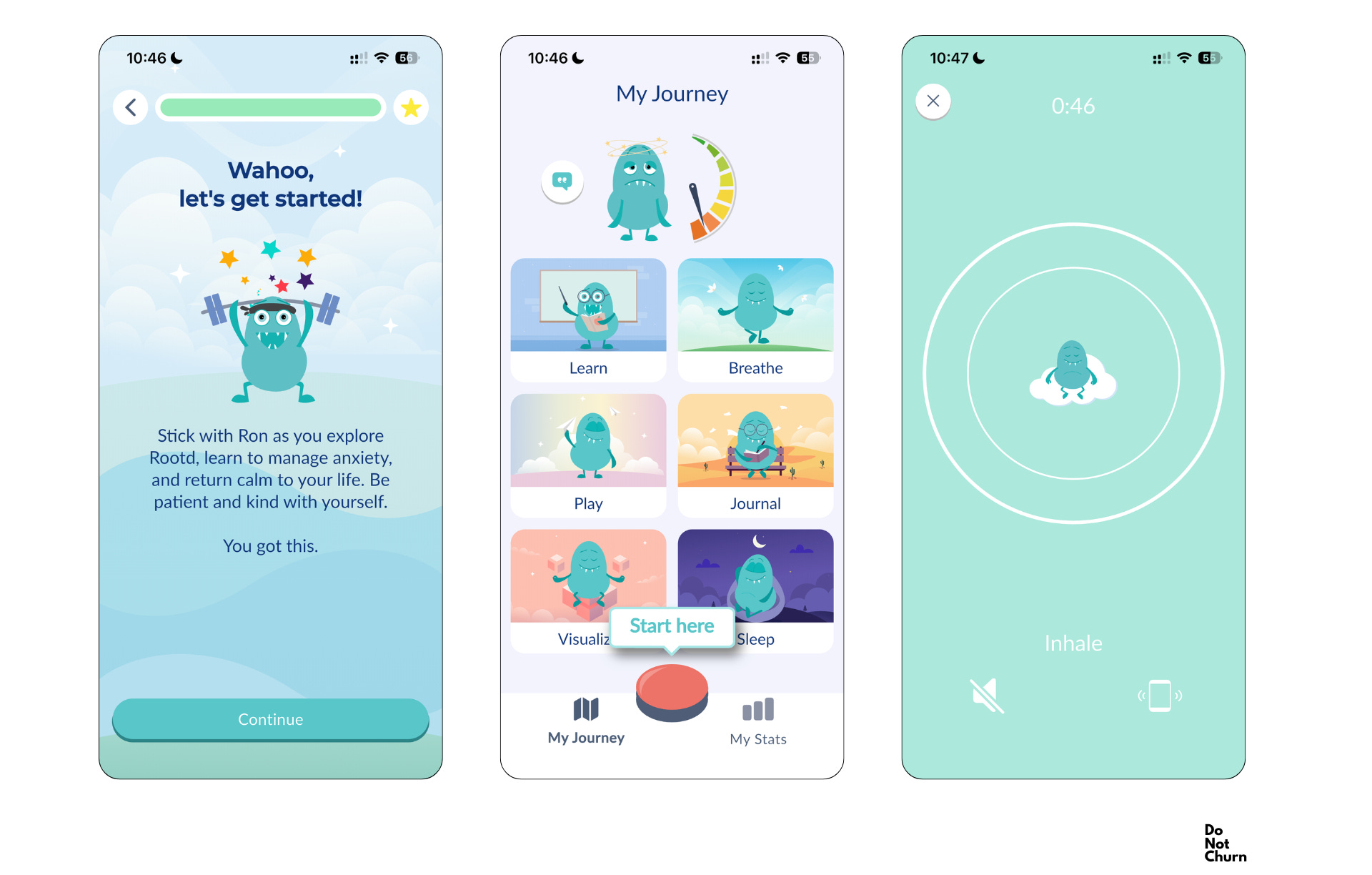
Rootd is optimized for what I’d call crisis utility - and it does its job better than anything in its category.
Primary intent: Immediate relief
Job it does:
“I’m in the middle of a panic attack, and I need something that understands what’s happening to my body right now - not a meditation, not a hotline, not a breathing exercise that assumes I have 10 minutes.”
It translates to:
✔️ Panic button triggered
✔️ CBT-backed guided interruption
✔️ Breathing and grounding tools
✔️ Stats page (panic attacks survived, warrior points)
✔️ Long-term lessons for anxiety management
Rootd intentionally ignores the broader wellness category - sleep coaching, journaling ecosystems, mood tracking dashboards - treating the panic attack as the moment that matters, not a data point in a larger health picture.
Churn watch: The product’s success creates the disengagement, just as in dating apps - you delete it once the goal is achieved. Users who feel meaningfully better start to deprioritise anxiety management, which means the strongest signal of Rootd working is also the earliest signal of potential churn. The structural answer is long-term lessons that shift value from crisis response to lasting change and a new crafted routine - a job that doesn’t end when the panic attacks become less frequent.

Travel Diaries is a memory architecture tool built for people who experience things worth keeping. Veerle nailed that photos and notes are not the output - the permanent, shareable, printable record is.
Veerle Witte was a travel journalist writing for National Geographic Traveler when, during a four-month trip through South America, she searched for a tool that could hold long narrative text alongside photos and route maps, allow sharing as a blog, and eventually produce a printed book - and found nothing. She built Travel Diaries in eight months while continuing to write, ran it as a side project for eight years, and only went full-time after external capital arrived in 2019. By then: 200,000 users, 15,000 printed books ordered, a 4.9 App Store rating.

Primary intent: Memory preservation
Job it does:
“I want to document this trip - or this season of life - in a way that actually survives. Not a camera roll. Not scattered notes. Something I’ll still want to open in ten years.”
It translates to:
✔️ Write long-form entries
✔️ Add photos and maps
✔️ Arrange layouts
✔️ Share as a blog and order as a printed book
Travel Diaries ignores the social feed and the engagement loop - it’s not competing with Instagram but replacing the printed photo album and the years of guilt about never quite making one.
Churn watch: The window between trips. Users who built a beautiful diary of their Portugal trip and don’t travel again for six months may not open the app for that entire period. Veerle’s expansion into Baby Diaries - and planned cookbook and journal apps - is the direct answer: widen the events that trigger the job so users never have to wait for the next trip to have a reason to return.

Ahana Banerjee had been tracking her cystic acne in spreadsheets since her early teens - logging products, ingredients, routines, and photos across a decade of trying everything and understanding almost nothing about what was working - so that by Imperial College London she had a precise picture of exactly what a tracking tool needed to do that nothing on the market could. When she pivoted to Clear at Y Combinator with four days between the idea and the interview, her MVP was a web app where she personally made every recommendation - “powered by Ahana.AI” - because her domain expertise was, at that point, more valuable than any algorithm she could have built in the time available. Clear was featured as App of the Day four times; YC and ~$1M in pre-seed funding followed roughly three years in.
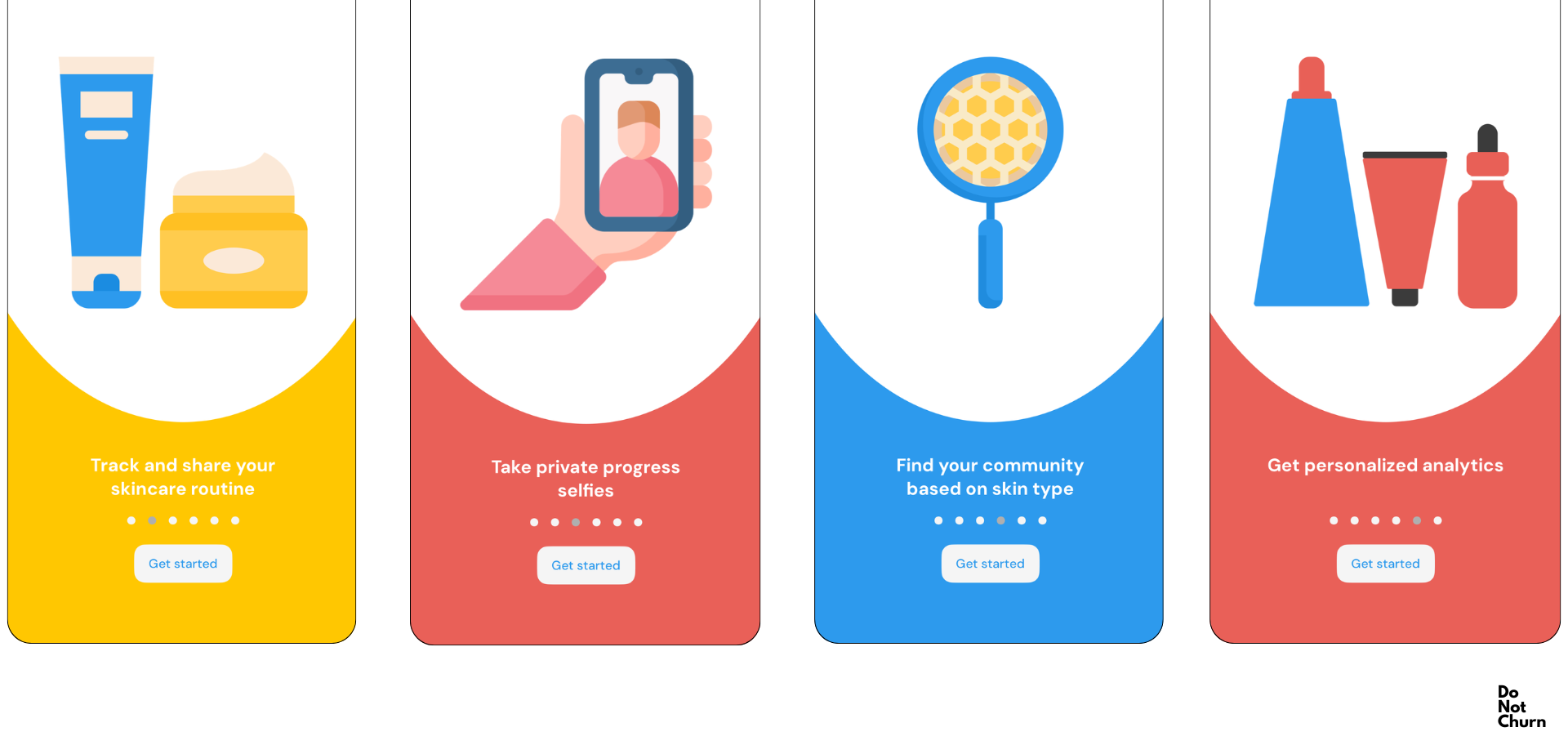
Clear is a skincare intelligence platform built for people who’ve run out of patience with guessing. Ahana nailed that products aren’t the problem - the inability to tell what’s working is.
Primary intent: Skin clarity (the understanding kind, not just the visual kind)
Job it does:
“I’ve spent years buying products and not knowing if any of them are actually doing anything. I want to track my skin the way I’d track a workout — and finally see what’s moving the needle.”
It translates to:
✔️ Selfie intake
✔️ Product logging
✔️ Routine tracking
✔️ AI-backed analysis
✔️ Community validation
✔️ Personalised recommendations
Clear fixes what dermatologists, influencers, and Reddit threads all leave behind: a personalised, longitudinal view of what’s actually working on your specific skin.
Churn watch: After the first improvement plateau. Users who see progress in the first 8–12 weeks have a strong retention signal, but if the skin stalls and the app can’t explain why or suggest what to change, the tracking starts to feel like just another chore. The moment the data stops producing insight, the habit starts to break.
6 retention mechanics these founders got right
1. Authentic voice as UX. None of these products sound like they were written by a content team, and that’s not a coincidence - it’s a direct consequence of founders who lived the problem so thoroughly that the copy couldn’t be generic even if they’d tried. When users feel genuinely understood at the language level — not just the feature level - they don’t go looking for alternatives, because there is nothing to compare it to.
2. Personal response as a feedback loop. All three founders treated every user review as a direct signal rather than a support ticket, with Ania personally responding to every one - investigating the issue, shipping a fix, encouraging the user to update their rating - which compressed the feedback cycle from months to days and built a visible public record of a founder still paying attention. Users who feel heard by the person who built the thing don’t just stay - they tell people.
3. Freemium structured around the highest-need moment. Rootd’s panic button was free for years — ungated, front and centre — not because Ania hadn’t thought about monetisation but because she had experienced a panic attack and knew that interrupting someone mid-crisis with a paywall would be a betrayal of everything the product stood for. The cost to revenue was real; the gain in trust was larger, and it meant users had an emotional relationship with the product before they were ever asked to pay.
4. Growing through a gap, not against a competitor. None of these products won users away from a competitor — they found people who had given up looking, which means discovery ran through organic search, word of mouth, and press rather than category switching. That growth is slower but produces users who are pre-qualified, high-intent, and far less likely to churn.
5. Niche precision as retention architecture. Rootd launched as a panic attack app before becoming an anxiety app — owning the narrower, higher-intent keyword first — because the most specific version of a problem is always the one the founder understands best, and users who find exactly what they searched for have no reason to look for alternatives.
6. The founder’s experience as the product’s implicit promise. Each of these products carries something no competitor can replicate: the legible presence of someone who has been exactly where the user is and built this because nothing else was good enough. When users can feel that presence — and they can, even if they can’t name it — the product becomes something closer to a relationship than a subscription, and relationships churn at a fundamentally different rate.
These apps split along lines of what each founder had personally lived through — one for surviving a crisis, one for preserving what matters, one for finally understanding what’s been happening to your body. What they share is not a product type but a founding condition: a problem personal enough, urgent enough, and poorly served enough that the founder couldn’t stop thinking about it until the product existed.
Churn emerges when a product forgets why it was built. Retention grows when users can feel — at every touchpoint — that the person who made this actually needed it too.
Key takeaways:
The technical build is a permission slip, not a competitive advantage — execution buys you the right to be in the market, and what keeps you there is the depth of understanding that no amount of engineering can replicate.
Recognition in a “replace nothing” category takes years, not months, and the founders who win are the ones who sustain the quiet period without mistaking slow growth for a broken product.
Freemium structured around the user’s highest-need moment builds more durable trust than freemium structured around withholding value — the paywall works better after the product has already earned it.
Personal response to user feedback is a retention mechanism with compounding returns, not a support cost — every review treated as a signal and every response treated as a relationship pays out over years.
Niche precision at launch is a retention decision as much as a positioning one, because users who find exactly what they searched for have no reason to look for alternatives and arrive with the highest intent the market can produce.