

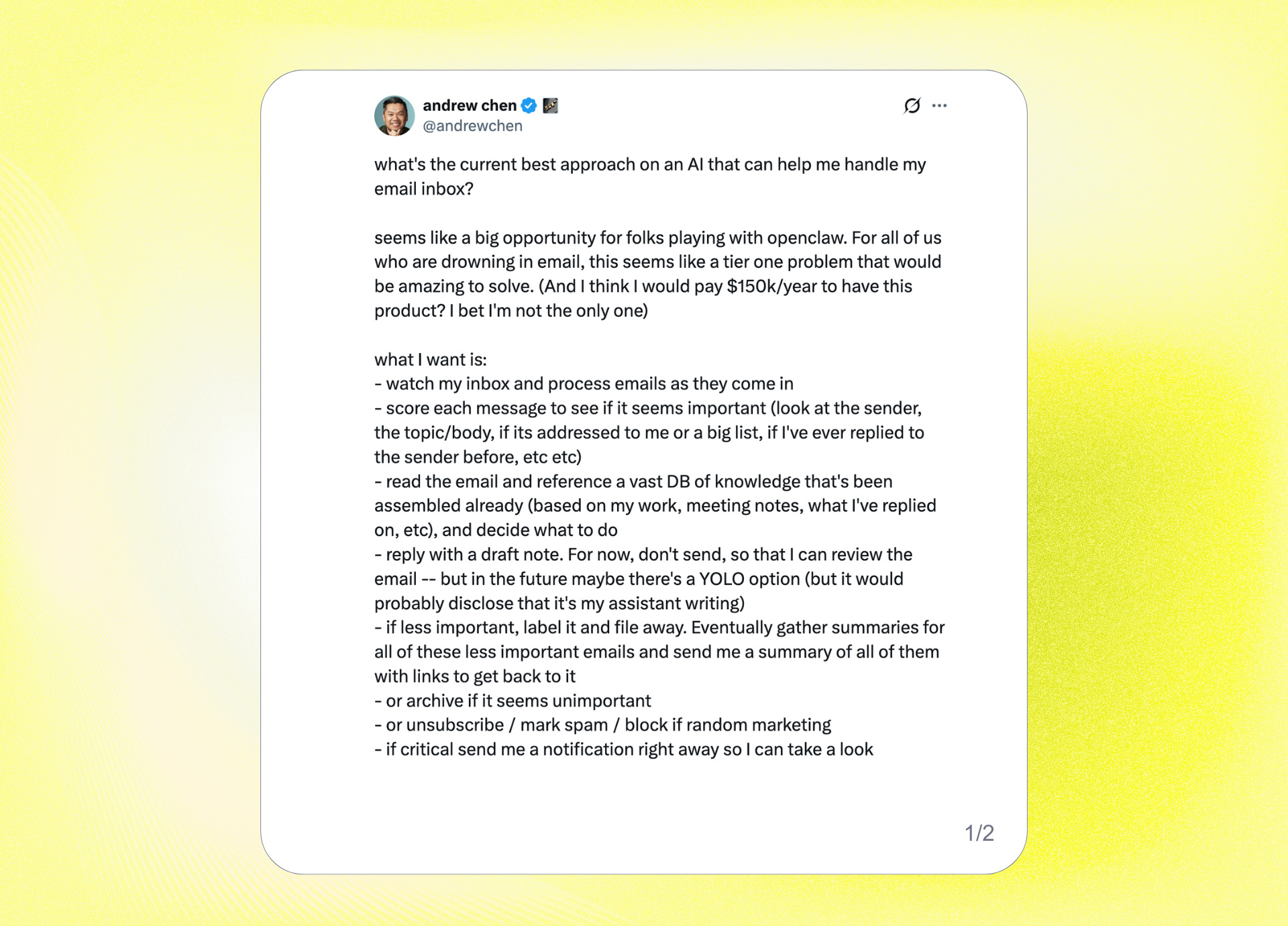
In February 2026, Andrew Chen - General Partner at a16z, former growth lead at Uber, and one of the most-followed operators in consumer tech - wrote a 700-word post on X describing the AI inbox tool he wanted someone to build.
He said he would pay $150,000 a year for it. He listed eleven specific capabilities, one of which was the line that made the post hit 108k views in 48h:
“in the future, we may not even really have an email inbox, but instead an interaction that feels more like I’m talking to an assistant who has a few questions for me.”
45+ products surfaced in the replies - Cora, Lindy, Fyxer, Serif, Jace, Poke, Tasklet, Superhuman, Extra, Notion Mail, Inbox Zero, Town, and three dozen more.
That matters right now because the AI productivity category is at a moment when all these products are claiming to solve the same problem, and the answer to which one will retain users has nothing to do with capability. When they all do roughly the same thing, then only one question remains: which user are they solving for? On that axis, the category has already split.
That wasn’t always the case.
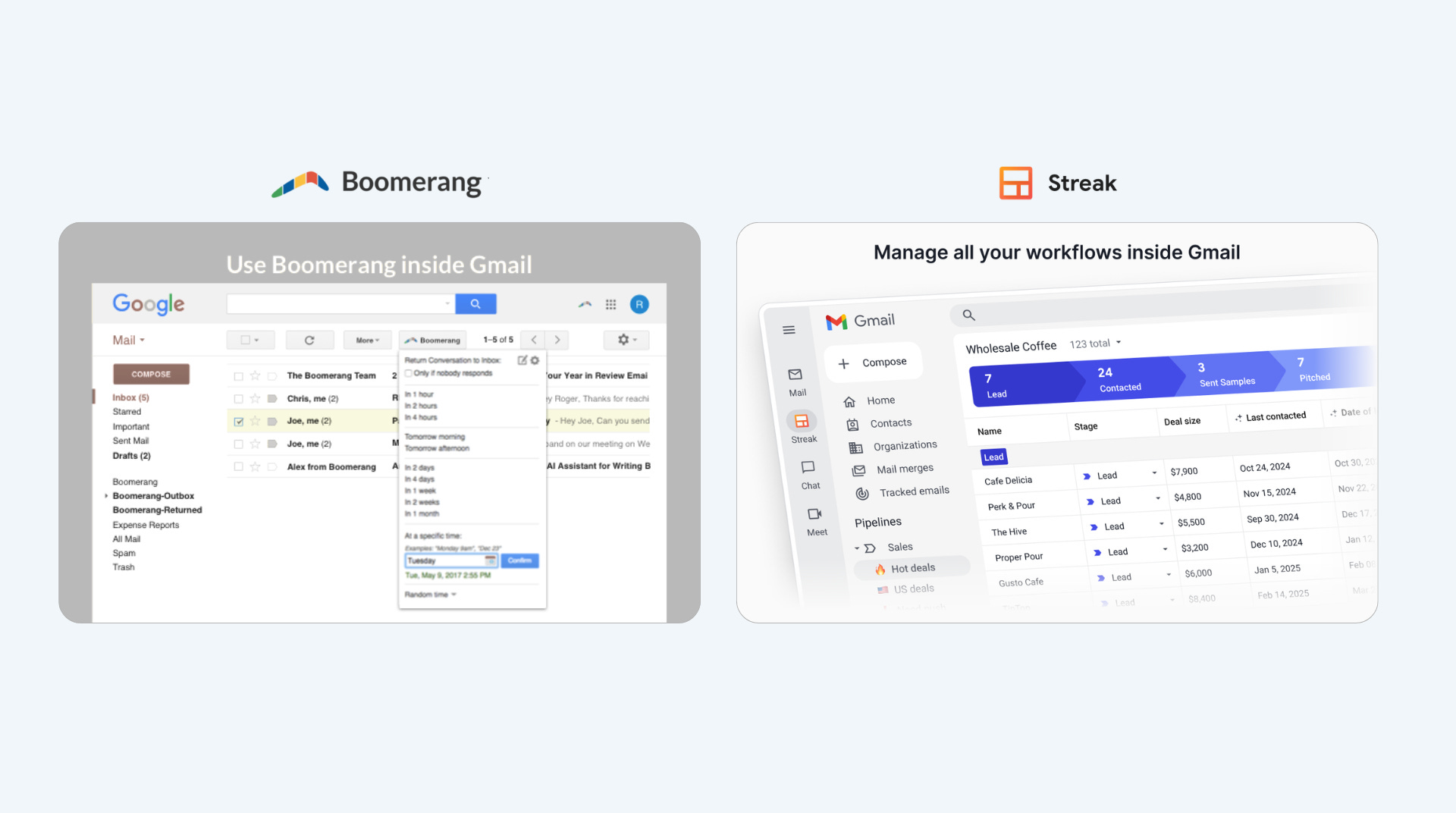
In the early 2010s, email management was a feature inside Gmail, and Gmail was a feature inside the browser. The serious productivity work happened in plugins. Boomerang shipped scheduling and reminders. Streak turned the inbox into a CRM. Mailbox raised eight figures, sold to Dropbox, and was shut down. Inbox by Google launched, attracted a fanatical base of power users, and was killed by its own parent company in 2018 for reasons that had nothing to do with the product.
The pattern was always the same: every five years a new entrant tried to displace Gmail, raised a round, got acquired or quietly died. The graveyard is full and the gravestones are nearly identical.
What changed in 2023 was not that anyone solved email. What changed was that the AI exposed a structural mismatch nobody had named — the inbox is a queue, and a meaningful slice of users had always wanted a feed. A queue assumes you will process every item. A feed assumes the system will surface what matters and let the rest scroll by. For two decades the productivity industry had been trying to make the queue faster. The new entrants started asking whether the queue itself was the bug for half their audience.
The email category is not one product.
It is two jobs being done by the same product line - one for users who want the inbox to be faster, one for users who want the inbox to disappear.
Market at a glance
The AI productivity tools market is scaling from $8.9B in 2025 to a projected $34.99B by 2034, growing at a ~16% CAGR, driven by generative AI maturity, knowledge-worker tool fragmentation (the average professional now switches contexts seven times before they have started their day), and the willingness-to-pay shift from seats to outcomes. The broader gravity includes calendar intelligence platforms and cross-app agent runtimes, making this a structurally expanding category rather than a feature war inside Gmail. (Grand View Research, 2025)
The willingness-to-pay ceiling moved from $30 a month in 2024 to a comparison set that now includes Cora at $20, Superhuman Mail at $40, and Andrew Chen’s stated $12,500 a month if someone actually built what he wrote down.
Email no longer competes on speed.
It competes on whether the user wants to stay in the inbox, leave the inbox, or never see the inbox again.
These three positions are not variations of the same product. They are answers to three different questions, and the products that win each one will retain users for entirely different behavioral reasons.

Superhuman
the inbox, accelerated
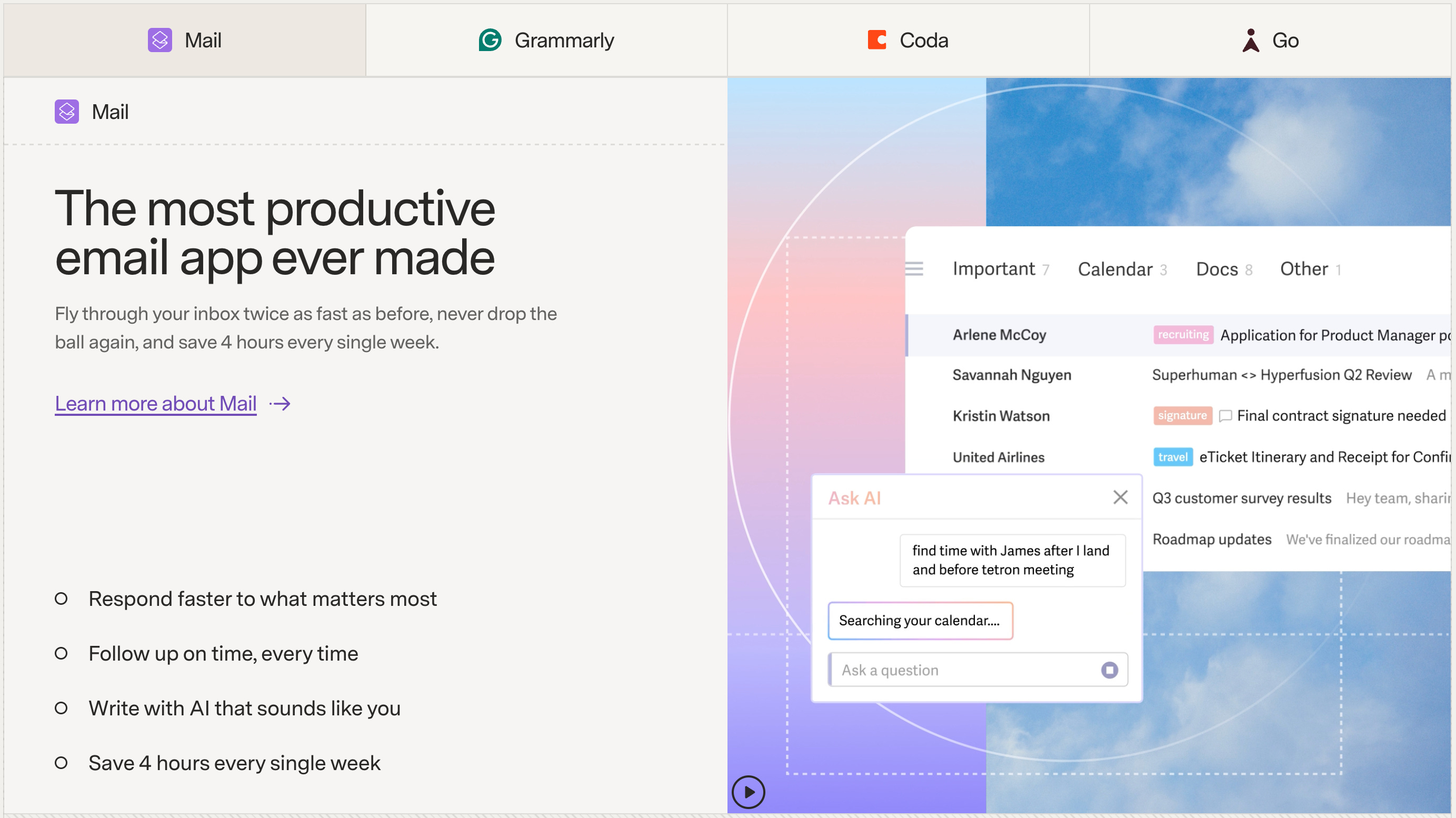
Superhuman is optimized for what I’d call velocity inside the existing metaphor, and it does its job extremely well.
Rahul Vohra is the longest-running operator in this category. Born in Birmingham, Cambridge CS graduate, taught himself to code at eight to make video games, interned at Jagex on RuneScape in 2004 - the gaming pedigree is where his now-famous obsession with how users feel about software comes from. He founded Rapportive in 2010 with two Cambridge classmates, built it into the first Gmail plugin to scale to millions, sold to LinkedIn for $15M in 2012, then started Superhuman in 2014 and has been at it ever since. More on what that sixteen-year arc reveals about the category in the section below.
Primary intent: Inbox throughput.
“I want to get through 200 emails a day without losing the thread on any of them. And… I don’t want to leave the muscle memory I’ve built around triaging my own inbox.”
It translates to:
> open Mail
> scan Auto Labels (response needed / waiting on / meetings / marketing / cold pitches)
> review Auto Drafts that adapt to your voice and tone per recipient
> Auto Archive sweeps the marketing and cold pitches before you see them
> Ask AI handles cross-references across inbox, calendar, and the public web in a single query
> Smart Send ships replies at the optimal time. Founder Rahul Vohra reports hundreds of his own emails are auto-archived daily. Ninety-four percent of weekly active users engage with at least one AI feature.
Ideal Customer Profile:
Founders and operators processing 200+ emails a day
Sales professionals running CRM-integrated workflows
Senior executives whose response time is a load-bearing variable in their role
Power users who have built keyboard-shortcut muscle memory over years
Churn watch: Superhuman’s risk is not in the product - net revenue retention sits above 120%, the highest in the category - it is in the audience size of users who genuinely want a faster inbox versus users who say they want a faster inbox but actually want no inbox.

Cora
the inbox, replaced with a feed
Cora is optimized for what I’d call the inbox as a once-twice-daily ritual, and it answers a question Superhuman explicitly refuses to answer.
Built by Every (Dan Shipper), launched June 2025, $15-20 a month, growing on word-of-mouth.
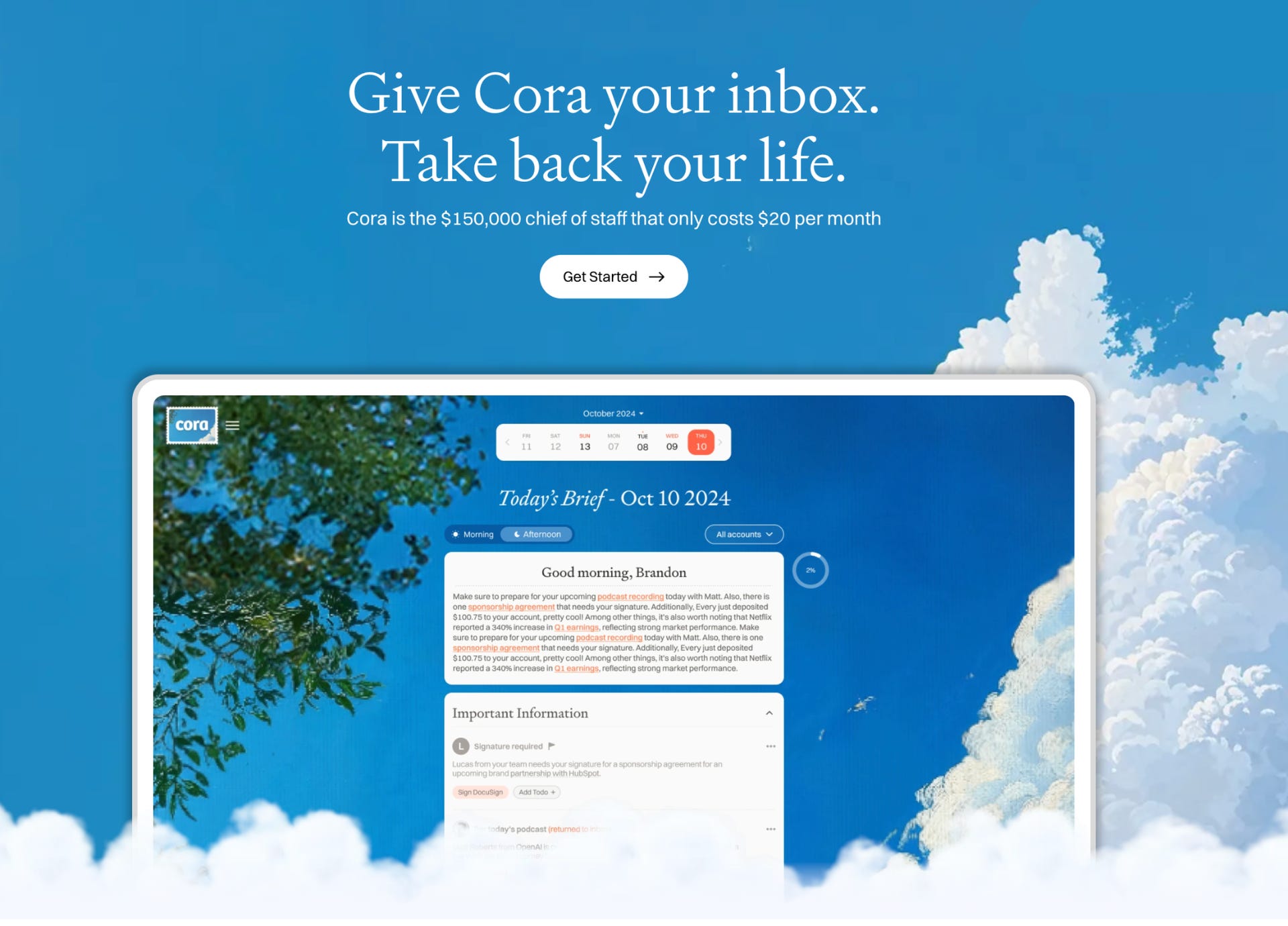
Cora is one of several products inside Every - built with Kieran Klaassen, Brandon Gell, and Nityesh Agarwal - and its design philosophy comes directly from Shipper's writer-first identity: he treats email as content to be summarized, not a system to be optimized. The product looks like an oil-painting morning briefing because the founder is a writer who happens to ship software, not a software person who happens to write.
Primary intent: Email as background.
“I want my inbox to disappear from my day-to-day attention. And… I don’t want to feel guilty about not opening it for six hours.”
It translates to:
> connect Gmail
> Cora reads your historical email to learn your patterns and writing style
> only humans needing a reply land in your inbox
> Cora pre-drafts replies in your voice for common requests
> everything else is summarized into a Brief delivered twice a day.
Best users:
Operators who would otherwise check email reflexively every fifteen minutes
Founders whose inbox is mostly noise punctuated by a few real signals
Writers and creatives whose work suffers from constant context-switching
Anyone who has tried Inbox Zero and found it made them feel worse, not better
Churn watch: Cora’s risk is the day a user actually needs to act on something in real-time and discovers the Brief came too late. The metric is whether the user starts opening Gmail directly between Briefs. If they do, the ritual has broken. The counter-lever is push notifications for genuine emergencies, but Cora has resisted this - emergency-channel inflation is the fastest way to turn a feed back into a queue.

Lindy
the inbox, dissolved into a work agent
Lindy is optimized for what I’d call email as one channel inside a bigger work graph, and it does not really think of itself as an email product at all.
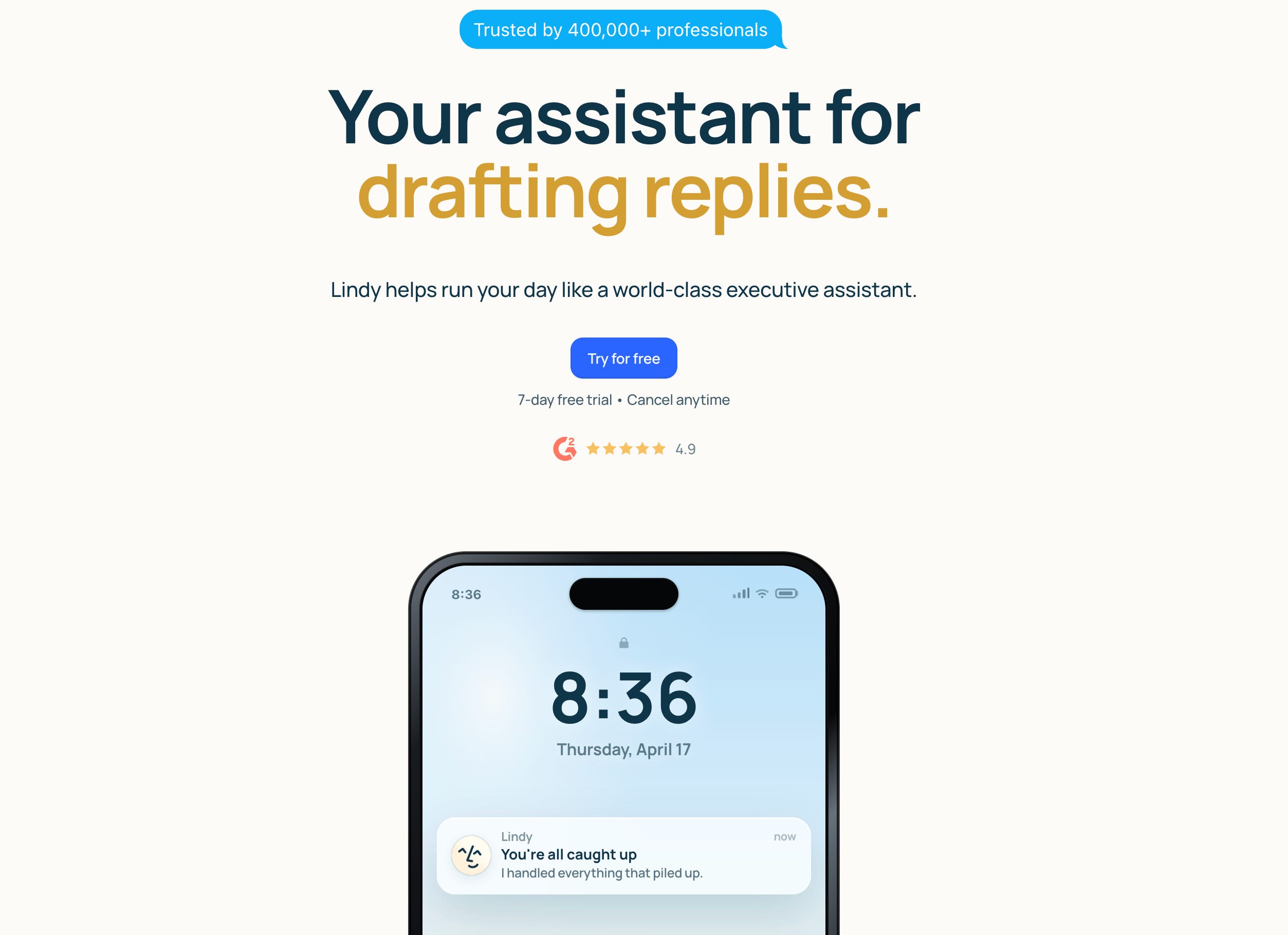
Flo Crivello is French, joined Uber as a PM in 2015, and has been writing publicly about technology, philosophy, and business for almost a decade. Before Lindy, he founded Teamflow in 2020, raised $50M, built it into a virtual-office product, and watched growth flatline the moment COVID ended. He fired two-thirds of the team and pivoted into AI agents in 2023. The breakthrough was a positioning move he calls “the Notion head fake” - Lindy 1.0 was sold as “AI employee,” which fell flat because the product was too broken for the promise; he repositioned as “Zapier of AI,” which made the platform legible to mainstream users while the product caught up to the original vision. That instinct - to ship something familiar on the way to something radical - is the entire Lindy strategy in one sentence.
Primary intent: Cross-tool action.
“I want an agent that knows everything I know — my inbox, my Slack, my calendar, my CRM, my notes. And… I don’t want to be the integration layer between my tools.”
It translates to:
> install Lindy in iMessage
>connect 3,000+ integrations including Gmail, Outlook, Slack, Notion, HubSpot, Salesforce, Linear
> describe what you want in plain English (”if an email comes from my manager, mark it urgent and ping me on Slack - if it’s a newsletter, archive it”)
> Lindy builds the agent and runs it 24/7
> The agent talks back to you over text. Founded in 2023 by Flo Crivello, $50M+ raised through Series B, 5.5x growth in twelve months.
Best users:
Founders who run their day across iMessage, not across apps
Solo operators who need an agent that handles email, calendar, and CRM in one breath
Engineering leaders who already think in workflows and triggers
Anyone whose actual job is happening in five tools, not one inbox
Churn watch: Lindy’s risk is the onboarding cost. The agent has to ingest enough of your work context before it becomes useful, and most users churn in week two - when context is still being built and the value has not compounded. The counter-lever is a templated agents that deliver value before personalization kicks in (shipped recently).
Six retention mechanics for anyone building in this category
If you’re shipping into the AI inbox space, these are the six mechanics the data suggests will decide who retains and who churns. Treat them as advice, not laws - the category is moving fast enough that the next twelve months will rewrite some of them.
1. Train for voice fidelity before you ship anything else.
(Superhuman’s Auto Drafts adapting tone per recipient; Serif’s 64% sent-without-edits rate.) Ingest at least 90 days of historical email before letting users see a draft. Below 50% sent-without-edits, you have a writing tool. Above 70%, you have a switching cost that compounds every week the user stays.
2. Pick one daily ritual and own the time slot.
(Cora’s twice-daily Brief.) If your product is in the inbox-replacement camp, the brief has to arrive at the same time every day without exception. Users who read at 7:42 a.m. for six weeks will not switch to a competitor delivering at 8:15 - but they will churn the day your brief is late twice in one week. Set the SLA tighter than your engineering team is comfortable with.
3. Make context depth feel useful in week one or you will not get to week three.
(Lindy’s templated agents; Tasklet’s starter recipes.) The biggest killer in the cross-tool agent camp is the gap between “the agent has ingested everything” and “the agent does anything useful.” Ship templated workflows that deliver value before personalization compounds. If less than 40% of week-one signups reach week three, your onboarding is the bug.
4. Let users escalate autonomy at their own pace.
(Superhuman’s Auto-Send opt-in per category; Cora’s resistance to push notifications.) Andrew Chen named this himself - “for now, don’t send… in the future maybe a YOLO option.” Users want to grant the AI more authority over time, not all at once. Ship every action behind a per-category toggle: auto-archive marketing first, auto-reply to scheduling second, auto-send to inner-circle last. Products that auto-everything on day one churn the user the first time the AI sends something they wouldn’t have.
5. Treat the metaphor as a product decision, not a default.
(Superhuman keeps the inbox; Cora replaces it with a feed.) The biggest unforced error in this category is shipping without picking. If your product is “AI for Gmail” without a point of view on whether the user should still see Gmail, retention collapses the moment a competitor with a sharper position takes the slot. Pick the metaphor. Defend it on the landing page. Build the rest of the roadmap downstream.
6. Build for the user behaviour you have, not the one your roadmap was written against.
The 2023 user opened Gmail twelve times a day and triaged manually. The 2026 user opens Gmail once and edits AI drafts. Run a behavioural audit every quarter - do your retained users actually use the product the way your personas describe? When the answer is no, the roadmap is the problem, not the product.
***
Key takeaways
Email as a category no longer competes on features or speed. It competes on which user psychology is being catered to.
Inbox-acceleration tools (Superhuman) retain through voice fidelity and muscle memory built across years.
Inbox-replacement tools (Cora) retain through ritual capture — the daily Brief becomes the new behavioral anchor.
Cross-tool agents (Lindy) retain through context depth that compounds with usage and is impossible to rebuild after switching.
Retention follows user psychology alignment; churn begins when the product solves a different relationship with email than the one the user signed up to have.