


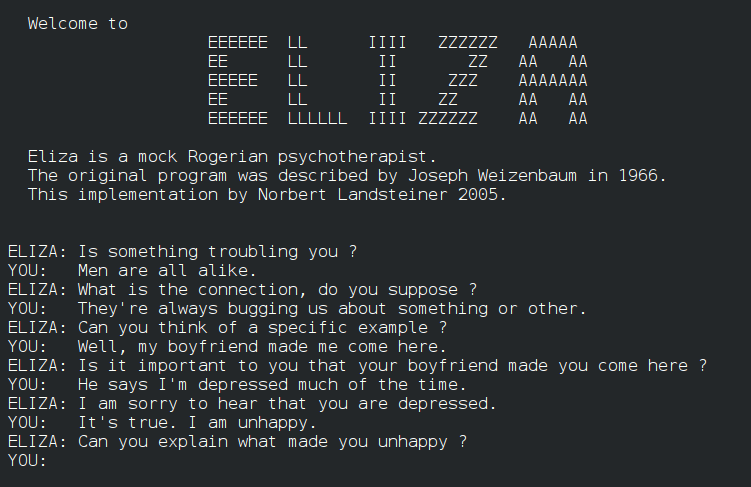
In 1966, a graduate student in psychology at MIT confided in a therapist named ELIZA. She typed that she was having problems with her boyfriend, and the program asked her to share more. She kept talking for several minutes, in real detail. Underneath the terminal, ELIZA was doing nothing more than scanning her words for keywords and handing them back as questions. It had no memory of what she'd said thirty seconds earlier, and no model of her, her boyfriend, or "boyfriends" as a concept. If it found no keywords, it just offered a generic response.
To someone who's spent much of their career in CX, this evokes the first customer-facing support chatbots. They all had a bit of ELIZA in them: too many questions, no memory, infinite patience, zero opinions. In the 1960s, that combination may have passed for a rough model of empathy. It obviously leaves a lot to be desired.
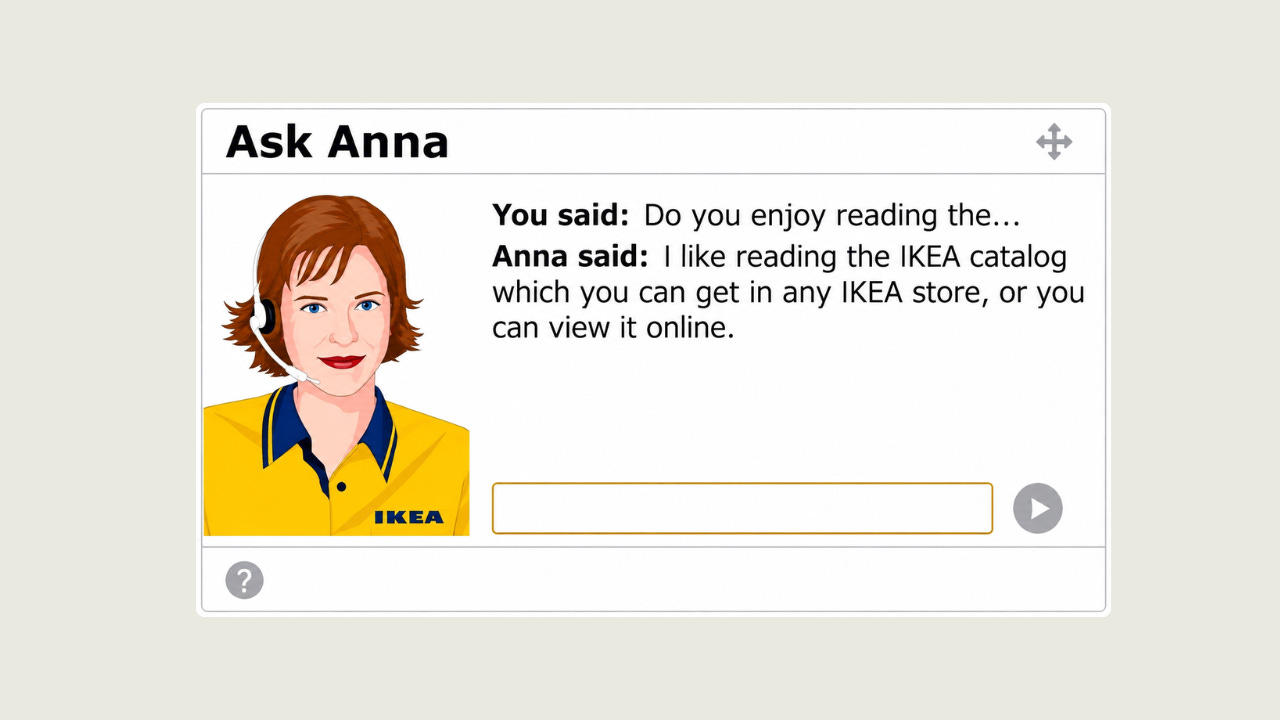
In 2005, IKEA was the first company to ever put a support chatbot in front of one of its customers. A lovely lady, this time named Anna, gladly accommodated user questions with a variety of answers about IKEA products, prices, sizes, delivery, spare parts, and opening hours. This was enough to ease the anxiety of customers in their post-purchase journey as they awaited quirky yet minimal furniture to arrive at their door.
However, customer expectations began to outpace reality extraordinarily fast.
Silicon Valley began scaling product capability faster than support could add capacity.
One-click purchases meant that a billing dispute, a fraud flag, or a wrong address was no longer a problem to be solved for ten customers an hour, but a problem which needed to be solved for twenty thousand customers per minute.
This turned the entire experience of being an online consumer into the worst one you could possibly have. If you’ve ever been a customer of Amazon, Uber, Airbnb, any cellular provider, any airline, any bank — any business operating at a scale where you’re one face among millions — you know the specific dread of getting on the phone with their support.
According to the latest Parloa research, when presented with alternatives to being put on hold, customers are willing to make remarkable sacrifices.
29.9% respondents claimed they would switch brands entirely if the company were to put them on hold, while 21.1% would be even willing to wake up at 5 a.m. instead of being left hanging. In March 2017, Servion Global Solutions predicted that by 2025, AI would power 95% of all customer interactions, and that the experience would be so seamless that customers would be "unable to spot the bot."
Now, let’s take a moment to do a reality check. Today’s state of AI is indeed at the height of its capabilities and beyond what we imagined it would be able to do by 2026. One single prompt run by Claude’s Fable 5 can now deliver passable product launch videos. Long-running agents can autonomously execute a single complex task for hours at a stretch. At the 2025 International Mathematical Olympiad, AI models sat the real contest. No internet, no tools, two 4.5-hour sessions back to back. Both Google DeepMind’s Gemini Deep Think and an OpenAI research model earned gold-medal scores. And yet, as recently as 2018, the people closest to this technology were telling us to expect all of it would take decades longer to arrive.
We definitely didn’t see it coming.
In a 2018 study, a consensus of machine learning scholars put “high-level machine intelligence” (AI that outperforms humans at every task) about 45 years out, roughly 2061. Even that came with only a 50% probability attached.
That wave of AI transformation hit customer support hard. It had to. Communication and issue resolution is what call centers and support teams do all day, at huge and growing volume, 24/7. On paper, that’s exactly the kind of task AI should replicate easily.
Your own experience as a consumer probably tells a different story.
Talking to a chatbot too often feels like a waste of time. “Press 1 to talk to a human” is most people’s first choice if they actually want the problem solved. Self-service menus work fine for a password reset. They don’t work when you’re standing on the shoulder of a highway waiting for a tow truck.
The data backs this up. Just 7% of respondents said that chatbots consistently resolve their issue, and 50.7% assumed their problem would be too complicated for automation before they even tried. That consistent frustration led many customers to draw the wrong conclusion: that the technology itself was bad.
So if AI capabilities keep outpacing the timelines we set for them, why haven’t we figured out how to make voice and chat bots reliable, or even just useful? Where’s the gap that remains unclosed?
Well, there’s a short answer and a long answer.
More than ever, humans desperately need other humans to solve their problems. Do users actually need human judgment? Or do they just want a better experience?
After a decade being on the other end of CX, and a lifetime of being a customer, the bad reputation of chatbot support is a signal of two things:
1. Chatbots have now become a synonym for low-quality, get-outta-here, ‘we-don’t-actually-want-to-talk-to-you’ kind of service.
2. What customers actually need is to have a positive AI experience, one which doesn’t suck - to rebuild the trust we lost.
I was wrestling with the bad chatbot problem while wearing the Head of Support hat at a $400M dating and social app holding company, serving 500M users, back in 2024. At the time, there were virtually no companies that could consistently deliver something that felt even remotely close to talking to a friend on the phone.
The few companies working in this space were still building old-school voice trees: four buttons to reach a human. That’s frustrating enough when your app crashes mid-chat. It’s much worse when someone’s had a safety issue: matched with a person, met them, and felt physically unsafe, only to get a phone robot on the other end.
Understandably, users say they hate AI, hate bots, hate automation, and demand a human instead.
What users are actually saying is: we’re tired of bad CX. There just hasn’t been enough proof that AI can do the job well.
If we decode this message, what the consumer asks for is:
Speed — my request gets processed quickly.
Comprehension — my request is understood the first time.
Reliability — whenever I leave and come back, it’s stable, and I don’t have to repeat myself or re-explain the context.
Resolution — my issue actually gets solved, and I’m happy!
And all of that should happen within a single interaction.
In short, consumer expectations of what an AI voice agent should deliver are higher than ever, maybe a little higher than what current companies can actually deliver. What's missing, at least for now, is trust: not the glamorous kind tied to model intelligence, but the boring kind, the kind that has nothing to do with how smart the model is and everything to do with whether the thing on the other end remembers you, understands you the first time, and actually finishes what it started.
Whether a company like Parloa closes that gap first is a separate question from whether it's worth trying. The capability ceiling is already proven. Gold medals, marathon coding runs, models that can reason their way through a graduate exam: none of that is in question anymore. What's still unproven is whether anyone can turn that capability into something a stranded, angry customer on the side of a highway actually trusts. That's not a model problem. It's a company-building problem, and right now almost nobody is building for it. Someone will close this gap. The only question is who gets there first, and how much longer customers have to keep pressing 1 for a human while they wait.